Why Benchmark Scores Miss the Point for Daily Dev Work
The coding model leaderboards are compelling reading. They rank models on HumanEval, SWE-bench, and LiveCodeBench, producing tidy scores that suggest a clear hierarchy. The model with the highest score on a controlled test environment should, the reasoning goes, be the best tool for your TypeScript refactor or your Python data pipeline.
It often is not. Controlled benchmarks are constructed from well-specified problems with clean solutions. Real development work involves ambiguous requirements, incomplete context, domain-specific conventions, existing codebases with technical debt, and the particular quirks of a framework version that may have been updated after the model's training cutoff. The benchmark problem is legible; the Tuesday afternoon task rarely is.
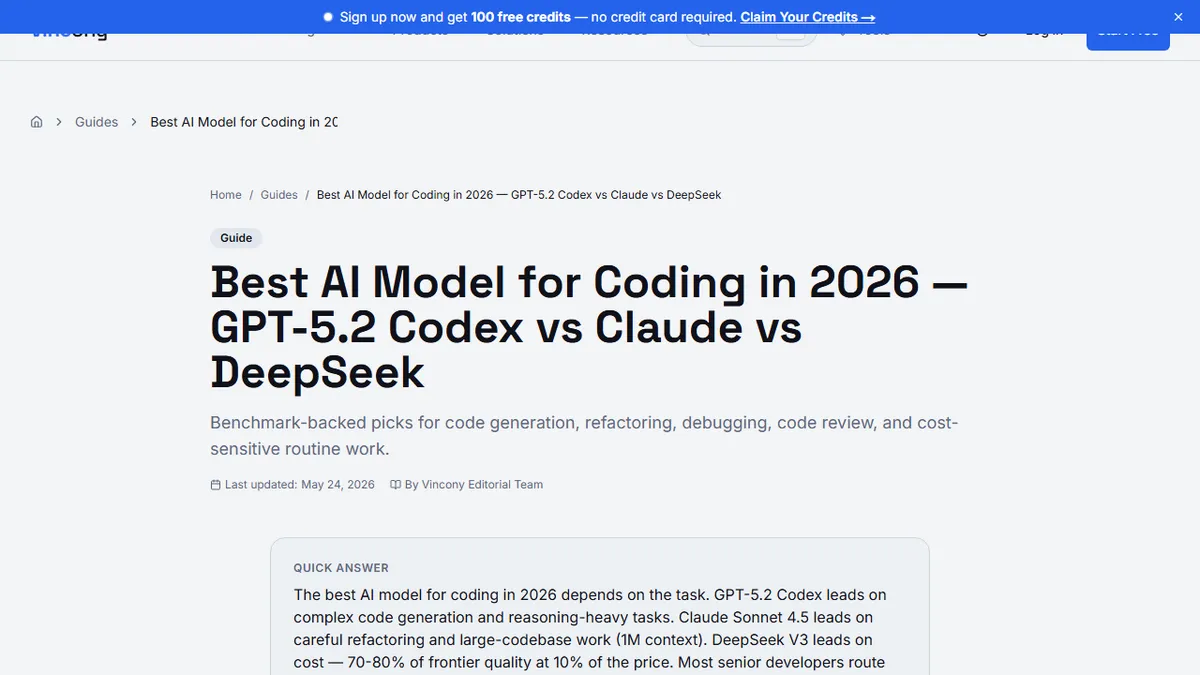
This guide ignores leaderboard positions and focuses on task categories. The question is not which model scores highest in aggregate. It is which model reliably handles the task you are actually doing right now.
Task Breakdown: Bug Fixing, Code Generation, Refactoring, Documentation
Bug fixing is where context depth matters most. To diagnose a bug in an existing codebase, a model needs to hold enough of the surrounding code in its context window to understand the execution path, identify the deviation from expected behaviour, and propose a correction that fits the existing patterns. Models with large, effective context windows substantially outperform smaller-context alternatives on bug-fixing tasks in real codebases, not because they are smarter, but because they can see more of the relevant code simultaneously.
Code generation from scratch favours models trained specifically on code. Specialist code models like Devstral and Qwen3 Coder demonstrate notably better performance on boilerplate generation, API integration code, and language-specific idioms compared to general-purpose flagships at equivalent tier levels. For greenfield code where context history is minimal, the specialist advantage is most pronounced.
Refactoring sits between these two poles. It requires understanding existing patterns (context depth), applying better structures (code knowledge), and preserving function while changing form (reasoning capability). This task type benefits from hybrid models: general flagships with strong code training, such as Claude Opus 4, often perform well here because the task requires both broad reasoning about architecture and specific knowledge of implementation patterns.
Documentation generation is an underappreciated use case where cost efficiency is easy to unlock. Writing docstrings, function comments, and README sections does not require a flagship model. A mid-tier balanced model handles documentation tasks at a fraction of the credit cost with outputs that are largely indistinguishable from what a premium model produces.
Specialist Code Models vs General Flagships: When Each Wins
The distinction between specialist and general models matters practically, not just theoretically.
Specialist code models (Devstral 2, Qwen3 Coder Plus, and equivalent offerings) are trained on massive code corpora with reinforcement learning from code execution. They understand syntax, patterns, library conventions, and common error modes at a level that general language models reach only approximately. For pure coding tasks, such as generating a working function, translating code between languages, identifying a syntax error, or writing unit tests, the specialist models are competitive with or superior to general flagships at a lower credit cost.
General flagship models with strong code capability (GPT-5, Claude Opus 4) retain their advantage on tasks where programming intersects with broader reasoning. Designing a system architecture, evaluating trade-offs between technical approaches, writing a technical specification from business requirements, or explaining a complex algorithm at multiple levels of abstraction: these tasks benefit from the broader knowledge and reasoning capability that general flagships bring.
The practical recommendation: default to specialist code models for implementation tasks and reserve general flagships for design, specification, and explanation work where the broader context matters.
Context Window Size: Why It Matters More Than Raw Score
In real development environments, context window size is often the single most consequential model specification. This is particularly true in three scenarios.
Large file analysis requires loading entire modules, classes, or files into the model's context. A model with a 32,000 token window can hold roughly 25,000 words of code, adequate for individual files but insufficient for cross-file analysis of a larger module. Models with 128,000 to 200,000 token windows can hold multiple files simultaneously, enabling analysis that smaller-context models simply cannot perform regardless of their raw code quality.
Long conversation debugging sessions accumulate context. When working through a complex problem across multiple exchanges — sharing error messages, revised code, test outputs, and follow-up questions — each turn adds to the context. Models with smaller windows eventually drop early context from the conversation, losing the initial problem statement and the diagnostic path taken to reach the current state. Larger context windows preserve the full debugging history.
Multi-file refactoring tasks require holding the files being modified alongside the guidelines and conventions being applied. The more files involved, the faster a smaller context window is exhausted.
For most individual coding tasks — a function, a component, a script — a 32,000 token context is sufficient. For working with real production codebases, context window size is a primary selection criterion.
Cost per Completion: Comparing Tiers Across Real Tasks
The credit economics of coding AI are worth mapping concretely. At the extremes: a simple code generation task routed to a mid-tier specialist model costs approximately 3 credits per completion. The same prompt through a flagship reasoning model costs 8 to 10 credits.
For an individual developer running 20 to 30 coding interactions per day, that difference compounds. At 25 daily interactions, the low-tier route costs roughly 75 credits per day. The flagship route costs 200 to 250 credits per day for the same volume. Across a month, that is the difference between 2,250 credits and 6,000 to 7,500 credits.
The quality difference on straightforward code generation justifies precisely none of that premium. The output of a well-prompted mid-tier code model on a function generation task is not meaningfully different from a flagship's output in most cases. The premium only earns its cost on complex reasoning tasks, and those represent a minority of daily coding interactions for most developers.
A detailed model-by-model coding task performance breakdown provides the specific credit costs and quality benchmarks across the full model library, including models not covered here.
Recommended Stack for Solo Devs vs Teams
Solo developers have the simplest configuration. A routing setup that sends standard code generation and boilerplate tasks to a specialist code model, escalates to a general flagship for architecture and design work, and reserves a reasoning model for debugging genuinely complex logic covers the full range of solo development work efficiently.
Teams introduce additional complexity. Shared credit pools mean that individual model choices affect the entire team's budget. The more useful approach for teams is to establish model selection guidelines by task category (documented so that every developer applies them consistently) rather than leaving model choice to individual preference. Inconsistent model selection across a team produces unpredictable credit consumption and no reliable quality baseline.
The starting point for building a team coding workflow is practical AI coding workflows for development teams, which covers both model selection and the workflow patterns that produce consistent outputs at managed cost.
The fundamental principle across both contexts: treat coding AI as a set of distinct tools for distinct purposes rather than a single tool for everything. The model that excels at rapid function generation is not necessarily the same model that excels at architectural reasoning, and treating them as interchangeable costs money and occasionally costs quality.