Why One-Size-Fits-All Model Selection Is Expensive
The default behaviour for most AI users is to pick a model once (usually the one with the best reputation or the most recent benchmark headline) and send everything through it. This is understandable. Model evaluation takes time, and the cognitive overhead of choosing differently for each query is not trivial.
The problem is that this approach treats a simple request to reformat a list identically to a complex multi-step reasoning problem. Both go through the flagship model. Both consume credits or tokens at the flagship rate. The output of the expensive model on the reformatting task is virtually indistinguishable from what a model costing a fifth as much would have produced, but the credit spend is the same.
At low query volumes, this inefficiency is ignorable. At moderate-to-high volumes, across a team or integrated into any workflow that generates dozens of AI calls daily, the cumulative overspend becomes substantial. A study of enterprise AI deployments found that routing all traffic through premium models typically means 40 to 60 percent of API costs are attributable to tasks that lighter models handle equally well.
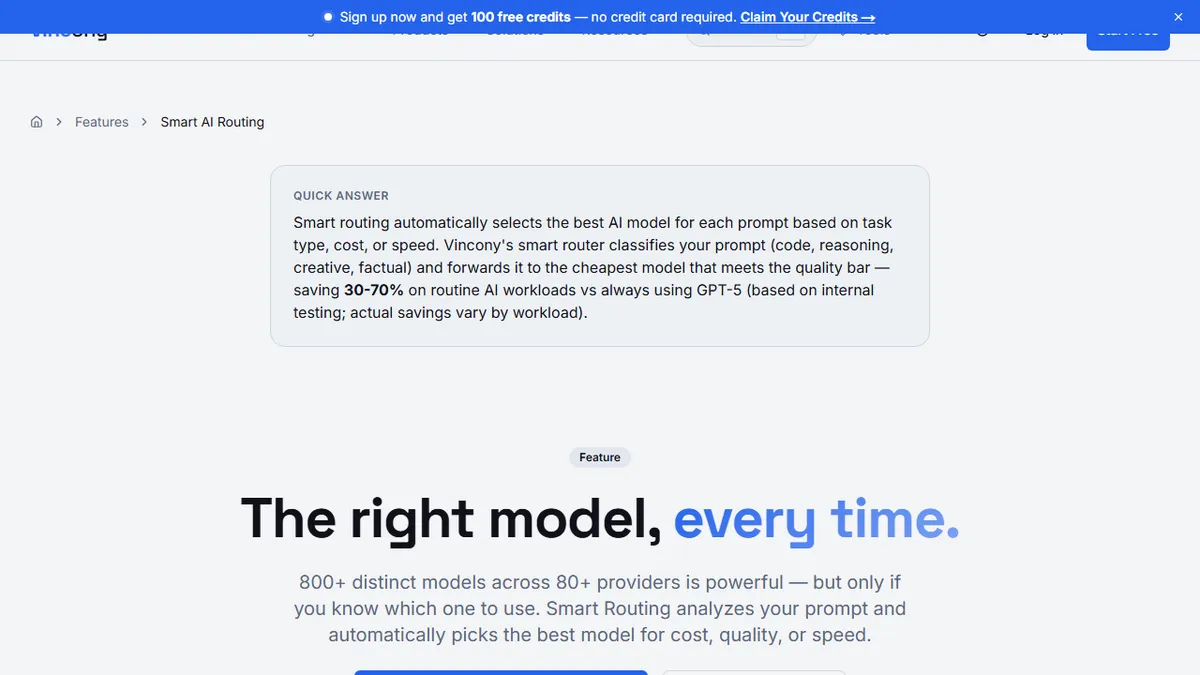
Smart routing exists to close that gap automatically, without requiring users to manually categorise every prompt before sending it.
What Smart Routing Actually Analyses in Your Prompt
The router is not a simple keyword detector. It analyses several dimensions of a prompt before selecting a model.
Task type is the most fundamental variable. The router classifies the request into broad categories: is this a coding task, a creative writing task, a factual question, a reasoning problem, or a retrieval task requiring current web data? Each category maps to a different model family that performs reliably on that type of work.
Complexity is a second dimension. A request to write a single paragraph differs from a request to produce a 3,000-word analytical article. A bug fix in five lines of code differs from a request to refactor an entire module. The router estimates task complexity from the instruction itself and adjusts model tier accordingly.
Context length matters as well. If the user is sending a large document for analysis, the router must select from models whose context window is large enough to hold the entire input, regardless of which tier would otherwise be optimal for that task type.
Finally, cost optimisation runs as a secondary filter. Among the models that satisfy the task type, complexity, and context requirements, the router prefers the most cost-efficient option that still meets the quality bar the user has set.
Task Taxonomy: Code, Reasoning, Creative, Search, and Fast Response
Different task types have genuinely different model performance profiles, and a well-designed router reflects these differences in its selection logic.
Code generation and review responds best to models trained heavily on programming data. Specialist code models often outperform general flagships on pure coding benchmarks, particularly for language-specific patterns, boilerplate generation, and test writing. For debugging complex logic or architectural decisions, a reasoning-capable model adds genuine value, but for simple function generation, a mid-tier code model is sufficient.
Reasoning tasks — mathematical proofs, structured argument evaluation, multi-step planning, legal analysis — benefit from models specifically optimised for chain-of-thought processing. These models operate at higher credit cost and higher latency, but the quality difference on genuinely complex reasoning is measurable. The router should not default to reasoning models for tasks that do not require systematic logical chains.
Creative tasks, including writing, ideation, and narrative generation, perform well across a range of models. The quality gap between a mid-tier and a flagship model on creative writing is often subjective and task-dependent. The router can apply a lower default tier here and route upward only when the task explicitly requires complex tone management or very long-form output.
Search and retrieval tasks — questions requiring current information, news synthesis, or citation-backed answers — are better served by web-augmented models than by static knowledge models regardless of parameter count.
Fast-response tasks, where speed matters more than depth, call for high-throughput models optimised for token generation speed at the expense of reasoning depth.
Cost Savings in Practice: Examples Across Model Tiers
The credit economics of smart routing are concrete. Consider a typical mixed-use day for a knowledge worker: three writing tasks, two research queries, one coding task, and several short conversational exchanges.
Without routing, sending all of this through a flagship model at 8-10 credits per generation might cost 70 to 90 credits for the day. With smart routing, the short conversational exchanges go to a 1-credit fast model, the writing tasks go to a 3-credit balanced model, the research queries go to a search-augmented model at 3 credits each, and the coding task routes to a specialist code model at 3 credits. The total for the same day drops to roughly 25 to 35 credits.
The output quality on the routed tasks is, for the large majority of them, equivalent to what the flagship would have produced. The 60 percent cost reduction is not a quality trade-off. It is the elimination of unnecessary premium spend on tasks that did not require it.
Understanding automatic model selection by task type and complexity shows how these routing decisions are implemented across the full model library, including how the system handles edge cases where task type is ambiguous.
When to Override the Router and Choose Manually
Smart routing improves the average case significantly, but average cases are not the only cases that matter. There are situations where manual model selection is the right call.
High-stakes outputs that will be published, submitted professionally, or used in a legal or medical context often warrant the flagship model regardless of what the router would select. The router optimises for quality at the median. Your judgment about what a specific task requires is still the ultimate authority.
Debugging a routing decision is a legitimate reason to override. If you believe the router selected a model that underperformed on a specific prompt, manually running the same prompt through a higher tier and comparing outputs is the diagnostic. That comparison informs whether to adjust your router preferences or accept that the task was an outlier.
Some users have personal preferences that override efficiency logic: a writer who has developed a specific working relationship with Claude's stylistic tendencies, for instance, may prefer to keep that model even for tasks where the router would suggest a cheaper alternative. The router is an optimiser, not a gatekeeper.
Setting Up Routing Rules in a Unified AI Platform
Most unified AI platforms that implement smart routing allow users to configure the aggressiveness of the optimiser. Conservative settings tend to route upward (spending more credits on fewer tasks), while aggressive settings apply lower-tier models more broadly.
Some platforms expose routing rules as explicit preferences, and you can specify that creative tasks should always use a particular model, or that anything involving code should be routed to a specialist. This is useful for users who have developed strong views about model performance on their specific use cases after sufficient experimentation.
The detailed logic behind model assignment (including how the router handles ambiguous prompts, how it weights cost versus quality at different tiers, and how it resolves cases where multiple models tie on suitability) is covered in how the smart router picks models behind the scenes.
For most new users, the recommended approach is to start with the default routing configuration, monitor which models are being selected for which tasks over several days of normal usage, and then adjust the rules for any categories where you consistently disagree with the router's choices. That data-driven iteration produces a routing configuration that reflects your actual quality requirements rather than theoretical optimisation assumptions.