On this page
Why Cambodia Is Quietly One of the Best Nomad Bases in Asia
The loudest nomad destinations in Southeast Asia are Bali, Chiang Mai, and Lisbon — all fine choices, and all considerably more expensive than they were five years ago. Cambodia occupies a different position: affordable by any regional standard, genuinely pleasant to live in across multiple cities, and home to a small but established international community that makes orientation fast.
Monthly budgets that would fund a stretched experience in Chiang Mai fund a comfortable one in Phnom Penh. Coworking spaces are well-connected. Café culture is strong. English is widely spoken. The food is excellent and cheap. The climate, while hot, follows predictable seasonal patterns that most people adapt to within a few weeks.
What Cambodia lacks is a purpose-built nomad visa. Thailand has its Long-Term Resident Visa. Indonesia has its digital nomad framework for Bali. Cambodia has neither, which means the legal path for remote workers requires a bit more understanding than in neighboring countries — but it is not complicated once you know what to use.
The Visa Reality: Why There's No 'Nomad Visa' and What to Use Instead
Cambodia has not created a dedicated digital nomad visa as of 2025, and there is no reliable indication that one is imminent. The practical solution used by the remote worker community is the E-class visa, officially classified as a business visa, which offers a flexibility profile that lines up well with nomad needs.
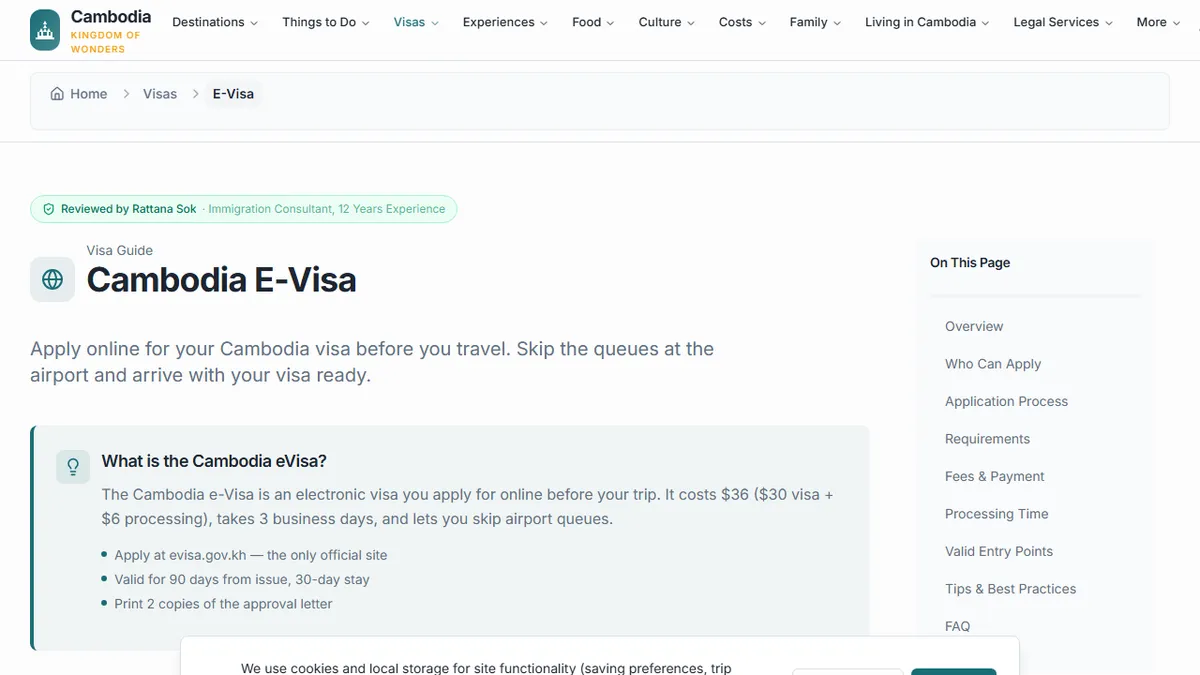
The E-class visa is available at arrival or via the e-visa portal for USD 35. Its key advantage over the tourist T-class visa is extendability: once in Cambodia, the E-class visa can be extended for one, three, six, or twelve months through a licensed visa agent or directly through the immigration department. Extensions are routine, inexpensive (approximately USD 45 to 285 depending on duration), and require no employment contract, business registration, or proof of local income.
The how the E-class business visa works for long-stay remote workers covers the full extension process, required documents, and the difference between single-entry and multiple-entry arrangements. The practical reality for most nomads is straightforward: arrive on an E-class, extend for three to six months, repeat as desired.
One note: Cambodia's visa extension system is heavily reliant on agents, and quality varies. Well-reviewed agents in Phnom Penh and Siem Reap are easy to find through the nomad community; using a random street-front service is less advisable.
Cost of Living Breakdown: Phnom Penh vs Siem Reap vs Kampot
Cambodia's three main nomad bases each have a distinct cost profile.
Phnom Penh is the most expensive of the three but remains cheaper than most comparable capitals in the region. A furnished one-bedroom apartment in a central neighborhood such as BKK1 or Tonle Bassac runs USD 400 to 700 per month. Street food and local restaurants are extremely affordable — daily food costs of USD 5 to 10 are realistic. Coworking passes run USD 80 to 150 per month. A comfortable nomad life in Phnom Penh fits comfortably within USD 1,000 to 1,400 monthly including accommodation.
Siem Reap sits at a lower price point for accommodation (comparable apartments run USD 250 to 450), but the smaller city means fewer high-quality coworking options and a more limited restaurant and social scene. It is the right choice for people who prioritize proximity to Angkor and a quieter daily pace over urban amenity.
Kampot is the outlier: small, slow, and exceptionally cheap. Accommodation can be found from USD 150 per month for a basic room to USD 350 for a comfortable riverside apartment. The coworking infrastructure is thin but improving, and the lifestyle rewards people who need few social events and a lot of calm. The coworking space directory and monthly cost breakdown for nomads in Cambodia provides current pricing across all three cities.
Best Neighborhoods for Remote Work in Each City
In Phnom Penh, the BKK1 neighborhood is the traditional expat hub — well-served by restaurants, cafés, gyms, and healthcare, with reliable utility infrastructure. Tonle Bassac to its south is slightly calmer and increasingly popular with longer-term residents who want the same amenities with less street noise. Tuol Tom Poung (the Russian Market area) offers more local character at lower price points.
In Siem Reap, the area around the Pub Street adjacent lanes sounds louder than it is for residents — most expats live a few streets removed from the tourist core in neighborhoods like Wat Bo and Svay Dangkum, which offer reasonable rents and walkability to both services and green space.
In Kampot, accommodation clusters along the river north and south of the town center. The riverside road is particularly pleasant for cycling between work and food options, and the majority of café-friendly establishments are within a short ride.
Top Coworking Spaces and Café-Work Culture
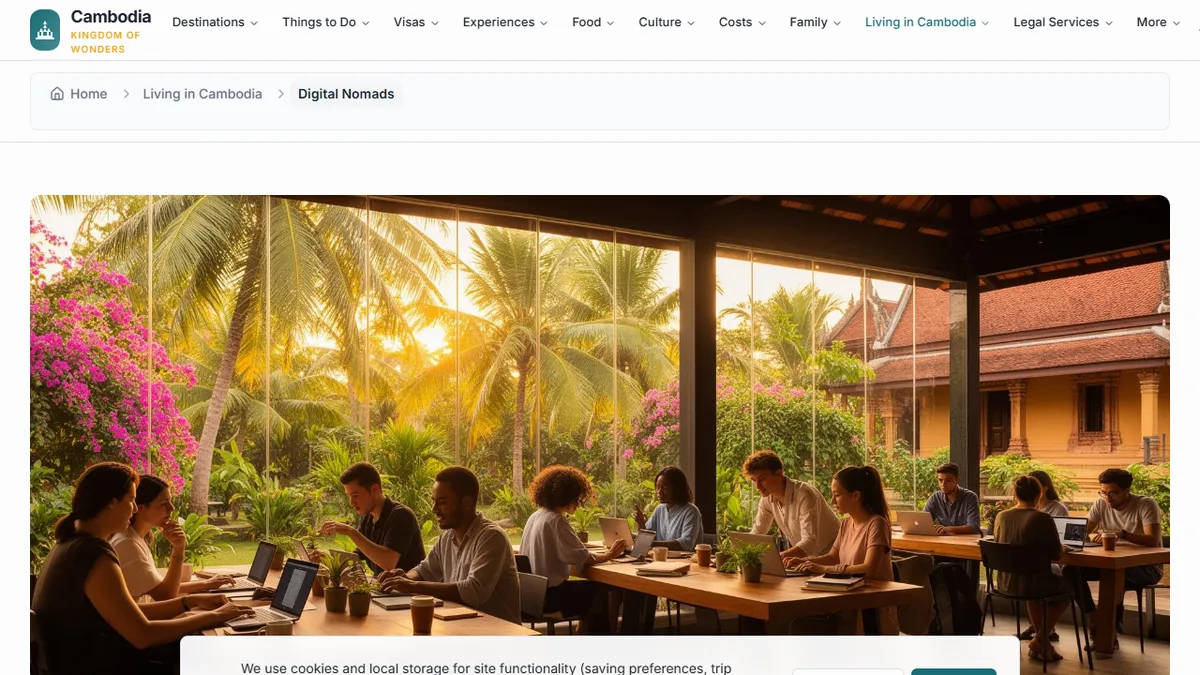
Phnom Penh has the most developed coworking scene, with several well-regarded spaces offering day passes, monthly memberships, dedicated desks, and private offices. Facilities at the better spaces include gigabit fiber connections, reliable air conditioning, printing, and community programming.
Café working is also deeply embedded in Cambodian urban culture. Phnom Penh and Siem Reap both have dozens of cafés where laptop workers are a standard sight, power outlets are provided, and wifi is reliable. The culture is tolerant of long-stay customers in a way that some coffee-first European cities are not. A daily café bill of USD 5 to 8 covers comfortable working hours with multiple drinks and a meal.
Internet Speed, SIM Cards, and Power Reliability
Mobile data in Cambodia is fast, affordable, and widely available. The major networks (Metfone, Smart, and Cellcard) each offer data SIM cards that cost a few dollars and provide fast 4G connectivity across both cities and most rural areas. Nomads typically use a SIM for mobile backup and rely on coworking or café wifi for primary connectivity.
Fixed-line internet in apartments varies considerably by building. Newer apartment blocks in Phnom Penh's expat areas are well-wired; older buildings may offer inconsistent connectivity. Asking specifically about internet speed and provider before signing an apartment lease is worth doing.
Power outages are occasional but brief in urban areas, and most coworking spaces have UPS systems or generator backup. The dry-season months of March to May see higher demand on the grid and slightly more frequent brief interruptions.
Community, Events, and How to Meet Other Nomads
The nomad community in Phnom Penh is small compared to Chiang Mai but is active. Facebook groups for Phnom Penh expats and digital nomads are the primary social infrastructure, with regular posts about events, housing, and practical questions. Siem Reap has a similar but smaller network.
Monthly meetups, language exchange events, and business networking evenings operate in both cities. The coworking spaces themselves often host these, which makes membership in one a reasonable social investment as much as a practical one. Kampot's smaller community is highly visible in the town's café and bar circuit — the social surface area per capita is actually higher than in Phnom Penh simply because the community is concentrated in a few recurring venues.