What the CEFR Is and Why It Matters
The Common European Framework of Reference for Languages, usually shortened to CEFR, was developed by the Council of Europe in the 1990s and published in its full form in 2001. Its purpose was straightforward: to create a shared vocabulary for describing language proficiency that would mean the same thing regardless of the country, the language, or the examining body using it.
Before the CEFR, a "intermediate" label on one course certificate could be entirely incomparable to the same word on another. Employers had no way to evaluate foreign-language skills listed on a CV without conducting their own assessments. Universities couldn't set consistent admission thresholds. The CEFR solved this by replacing vague descriptors with six defined levels (A1, A2, B1, B2, C1, and C2), each anchored to a set of "can-do" statements describing what a speaker at that level can actually accomplish in real communicative situations.
Today the CEFR appears on official language certificates, university admission requirements, EU visa applications, and job postings across nearly every professional sector. Knowing what each level genuinely means is not an academic exercise: it has direct practical consequences for how you present your skills and how you plan your study time.
A1–A2: The Survival Stages (What You Can Actually Do)
A1 is the entry point. A speaker at this level can understand and use very familiar everyday expressions — greetings, introductions, simple requests about immediate needs. They can ask and answer basic questions about themselves: their name, where they live, the people they know, the things they own. A conversation with a native speaker is only possible when the other person speaks very slowly, uses straightforward vocabulary, and is willing to repeat and rephrase.
A1 is often reached within the first two to four months of structured study for common European languages, and it feels like real progress because the learner has moved from zero to functional. The feeling of understanding a menu or a sign is genuine.
A2 extends this into routine transactions. The A2 speaker can handle simple, direct exchanges of information on familiar topics: directions, shopping, daily schedules, personal background. They can read short simple texts (signs, menus, personal messages) and write brief notes. Importantly, they are not yet independent: they still need slower speech and supportive interlocutors.
The gap between A1 and A2 is primarily one of vocabulary range and the ability to manage past-tense narrative, which opens up a much wider range of communicative scenarios.
B1–B2: The Independence Threshold That Opens Doors
B1 represents a genuine inflection point. The independent user, as the CEFR calls B1 and B2 speakers, can navigate real life in the target language without constant support. At B1, a traveller can handle most situations likely to arise in a country where the language is spoken. They can produce simple connected text on familiar topics, describe experiences and events, give brief explanations of plans and opinions.
Crucially, B1 speakers can maintain a conversation on topics that are familiar or personally interesting even without the interlocutor making allowances for them. That shift from "needs support" to "can manage independently" is what the B threshold actually marks.
B2 is arguably the most important CEFR level in practical terms. At B2, a speaker can understand the main content of complex text, including technical content in their area of specialism. They can interact with native speakers with a sufficient degree of fluency and naturalness that strain does not arise on either side. They can produce detailed, well-structured text on complex subjects, expressing points of view and relating them to others.
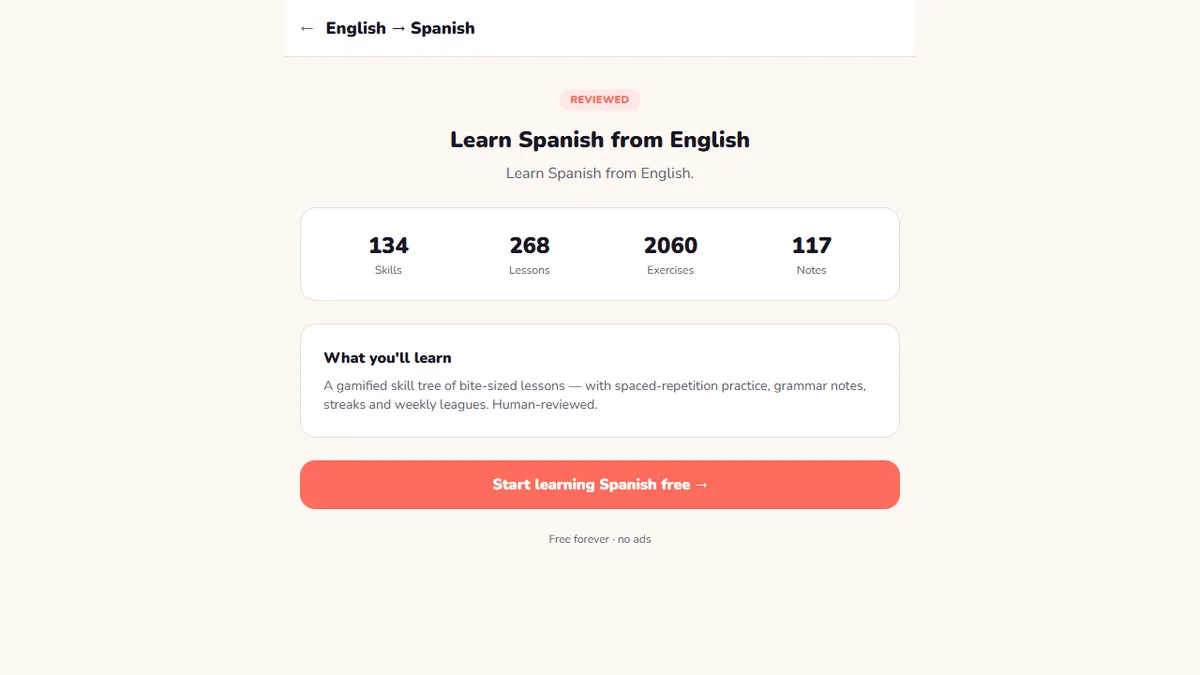
B2 is the threshold typically required for academic study in a foreign language, for most professional roles that list the language as a requirement, and for immigration pathways in many European countries. The structured A1-to-B2 Spanish course for English speakers illustrates exactly why this range is the natural target for most learners — it covers the entire journey from first words to genuine independence.
C1–C2: Near-Native and Why Most Learners Never Need to Get There
C1 is where language stops being a conscious exercise and becomes a transparent medium. The C1 speaker can understand a wide range of demanding, longer texts and recognise implicit meaning. They can express themselves fluently and spontaneously without obvious searching for expressions. They can use language flexibly and effectively for social, academic, and professional purposes.
C2 is the CEFR's highest level and describes what is often called near-native or mastery proficiency. At C2, a speaker can understand virtually everything heard or read with ease, can summarise information from different spoken and written sources, and can express themselves spontaneously with very high precision.
The honest advice here is that most people who need a language for work, travel, or daily life do not need C1 or C2. These levels require thousands of additional hours beyond B2 and often demand years of immersive exposure. The people who achieve them are typically those living in the country where the language is spoken, those in professions requiring very high linguistic precision, or dedicated lifelong learners.
How Employers and Universities Use CEFR Ratings
When a job posting says "B2 German required," it means the employer needs someone who can hold substantive meetings, write professional correspondence, and understand complex documents without a translator. When a university sets a B2 English requirement for international applicants, it means they expect students to follow lectures, write academic essays, and participate in seminars.
The CEFR is also used for immigration. Many European countries require language certificates at B1 for residency permits and at B2 or higher for citizenship. Major language certification bodies (DELE for Spanish, DELF/DALF for French, Goethe-Zertifikat for German, JLPT for Japanese) have all mapped their qualification levels to the CEFR framework.
Mapping Your Current Level: Simple Self-Assessment Tricks
Official level tests exist for most major languages, but informal self-assessment is often sufficient for study planning. The most reliable approach is the "can-do" check: work through the CEFR's published descriptor statements for each level and honestly assess which ones describe your current ability.
A quicker heuristic: find authentic media in the language and notice how much you understand without assistance. If you understand almost nothing, you are at A1. If you can follow the general topic of a slow, clear broadcast, you are probably at A2. If you can follow a standard news broadcast while missing perhaps 30 to 40 percent of content, B1 is realistic. If you follow most of an unscripted conversation between native speakers, you are approaching B2.
Planning a Realistic Timeline from A1 to B2
Time estimates for reaching B2 vary by the linguistic distance between the learner's first language and the target. The US Foreign Service Institute publishes research-backed hour estimates for English speakers: approximately 600 to 750 hours for Category I languages (Spanish, French, Italian, Portuguese, German), around 1,100 hours for Japanese and Korean, and 2,200 hours for Mandarin Chinese, Arabic, and Japanese are the most demanding.
These figures assume focused study, not passive exposure. At one hour of focused daily study, reaching B2 in Spanish from scratch would take roughly two years. Most learners study less consistently than that, which is why realistic planning around three to four years for a category I language is common. Understanding this timeline, and breaking it into A1, A2, B1, B2 milestones, is far more motivating than treating proficiency as a single undifferentiated destination.