Why Learners Often Agonise Over This Choice
For a certain cohort of Western language learners (those drawn to East Asian culture through entertainment, cuisine, travel, or work), the Korean-versus-Japanese question has become a genuinely common agonising decision. Both languages have seen extraordinary growth in learner numbers over the past decade. K-pop and Korean drama have pulled millions of new learners toward Korean, while anime and manga have kept Japanese a perennial top-five choice on every major learning platform.
The problem with making the choice based purely on cultural affinity is that cultural appeal fluctuates while the linguistic structure of these languages does not. K-pop fandoms are famously intense but sometimes temporary. Anime phases pass. The grammar of Korean and Japanese, on the other hand, will still be waiting for you at month six when the initial enthusiasm has settled into the grind of actual language acquisition.
This comparison is designed to help you evaluate both languages on the factors that will actually determine your experience: writing system difficulty, grammar structure, vocabulary acquisition speed, cultural motivation durability, and practical utility. Some of these will weigh more heavily for your situation than others.
Writing System Difficulty: Hangul in Two Days vs Three Scripts
This is where the comparison is at its most asymmetric. Korean uses Hangul, a phonetic alphabet invented in 1443 that is widely praised as one of the most logical writing systems ever devised. It consists of 24 letters (14 consonants and 10 vowels) arranged into syllable blocks. Most motivated learners can read and write Hangul to a basic level within a weekend; reaching genuine reading fluency takes a few weeks. The script does not conceal pronunciation — what you see is what you hear.
Japanese uses three scripts simultaneously. Hiragana and katakana are phonetic syllabaries similar in function to an alphabet, each with 46 base characters. Both are learnable in a few weeks. But Japanese text also incorporates kanji (Chinese-derived logographic characters), and educated Japanese readers are expected to know around 2,000 of them. Kanji study is a multi-year project, and even at intermediate levels, learners will regularly encounter characters they do not recognise.
For learners who want to feel literate quickly, Korean's writing system is a significant advantage. For learners who are genuinely fascinated by logographic writing and find kanji an interesting rather than daunting challenge, the script difference matters less.
Grammar Structures: SOV Order, Honorifics, and Verb Conjugation
Both Korean and Japanese are subject-object-verb languages, both use postpositional particles to mark grammatical function, and both have elaborate systems for expressing different levels of formality and respect. These structural similarities mean that a competent Korean speaker learning Japanese (or vice versa) has significant transfer advantages, but for a monolingual English speaker starting fresh, neither is easy.
Korean grammar is often described as more regular and more accessible early on. The verb conjugation system follows predictable rules with relatively few irregular forms at the A1–A2 level. The honorific system, while genuinely complex, largely operates through verb endings that can be learned in layers: a learner who knows the polite form can function in most situations without mastering the full formal and humble registers.
Japanese grammar presents its own challenges. The honorific system, called keigo, is more pervasive and more demanding, with distinct vocabulary substitutions as well as verb form changes required for different social contexts. The particle system is conceptually similar to Korean's but has some additional subtleties. Japanese also requires more consistent attention to the distinction between plain and polite speech registers across different contexts.
At the A1–A2 stage, most learners find Korean grammar slightly easier to systematise. The gap narrows at B1 and beyond.
Vocabulary Acquisition Speed: Cognates and Loan Words
Japanese has a substantial English loanword vocabulary represented in katakana. Words for technology, food, sports, and modern concepts are often close enough to English originals that a learner can guess them reasonably well: terebi (television), suupaa (supermarket), hoteru (hotel). This gives Japanese beginners a useful recognition vocabulary that eases early frustration.
Korean also has English loanwords: keopi (coffee), taekssi (taxi), syoping (shopping). But the proportion of useful cognates is somewhat lower than in Japanese. Korean does have significant Chinese-derived vocabulary (Sino-Korean) that shares roots with Japanese, which becomes a real advantage for learners who later tackle the second language.
Neither language offers the rich cognate overlap that a Romance language provides for English speakers, so vocabulary acquisition in both cases is primarily a matter of systematic memorisation rather than lateral thinking from existing knowledge.
Pop-Culture Motivation: K-Pop vs Anime — Does It Last?
There is genuine evidence that pop-culture motivation is one of the most durable drivers of language learning — more so than many educators acknowledge. Learners driven by genuine love of media in a language study longer, tolerate plateaus better, and are more likely to seek authentic exposure outside structured lessons. Cultural passion translates into hours, and hours are ultimately what drives acquisition.
The honest question is not whether K-pop or anime motivation is legitimate; it is whether yours specifically will outlast the first year. Initial enthusiasm is almost universal; sustained engagement through the difficult A2-to-B1 plateau is far less common. Think about whether your interest in the language extends beyond the media that initially attracted you: an interest in the culture, the history, the food, the people, or the country itself tends to sustain motivation through plateaus far more reliably than attachment to a single band or show.
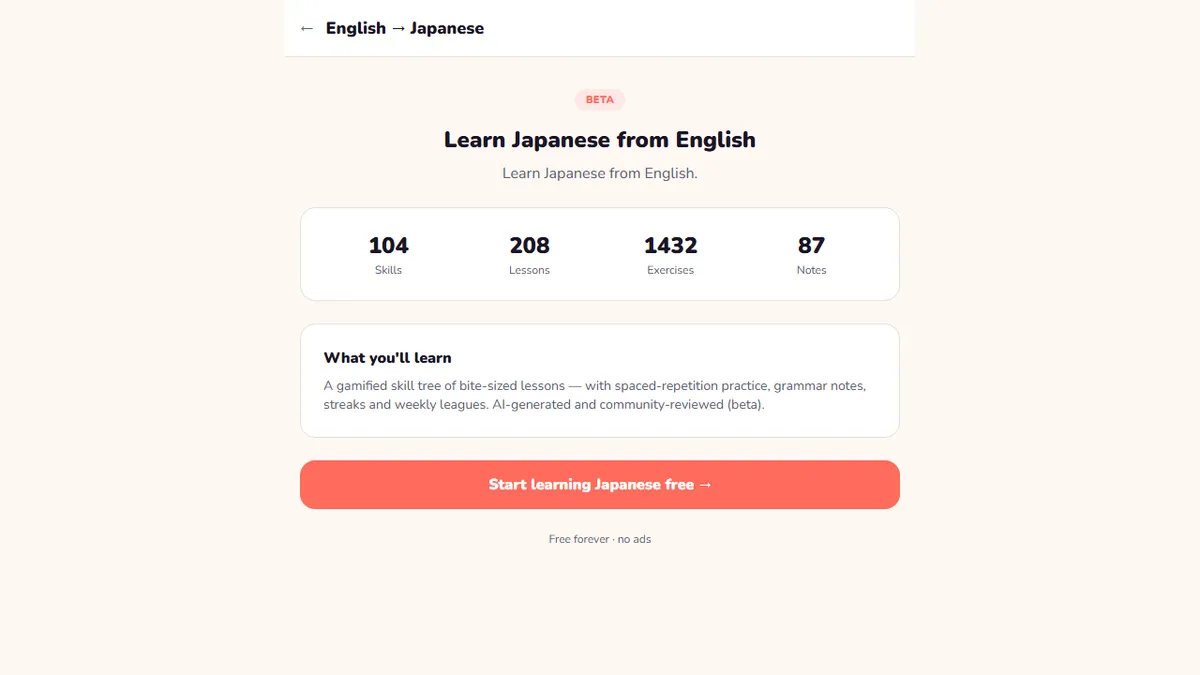
If your primary motivation is a specific artist, show, or game, acknowledge that honestly and plan for it. Use the gamified English-to-Korean course from A1 through B2 or the side-by-side Japanese course at the same CEFR range as your structural spine, but let the media you love serve as the comprehensible input that keeps the whole enterprise emotionally alive.
Job Market and Travel Practicality
For learners with professional goals, the calculus shifts. Japanese has the larger economy and a longer history of international business relationships with Western companies. Japanese language skills are valued in automotive, electronics, gaming, financial services, and manufacturing sectors. Japan's tourism and hospitality sector is also enormous and has created significant demand for Japanese-speaking professionals in travel and customer relations.
Korean has grown sharply in commercial importance over the past two decades. South Korea's technology sector, global entertainment industry, and manufacturing presence have created real demand for Korean-language business skills, particularly in electronics, entertainment, and increasingly in diplomacy. Korean language skills are especially valued in roles connecting with the Korean diaspora in North America, Europe, and Australia.
For travel alone, Japan has historically received more Western tourists and has more infrastructure designed to accommodate non-Japanese speakers, though Korea has invested heavily in tourism infrastructure and is an increasingly popular destination.
How to Make the Final Decision (and Stick With It)
The most useful framework is this: choose based on what you will actually do with the language in three to five years, not on what excited you last month. If you have a concrete professional reason, a family connection, a planned extended stay, or a long-standing cultural passion for one country over the other, that is the language to choose. If all else is equal, Korean's writing system gives beginners a faster on-ramp and may help sustain early momentum.
Once you have chosen, commit. The most expensive mistake in language learning is switching languages at the six-month mark, just as the initial excitement has faded and the real work has begun. Both languages reward sustained attention over years. The one you will actually study consistently is the one you should start.