Why Japanese Feels Impossible (and Why That's Partly Wrong)
The US Foreign Service Institute classifies Japanese as a Category IV language — its highest difficulty tier — estimating that English speakers need approximately 2,200 classroom hours to reach professional working proficiency. That number is daunting, and it is accurate for formal diplomatic training standards. But it is not a ceiling you need to worry about in year one.
The perception of impossibility comes from several converging factors: three distinct writing systems, a completely different grammatical structure from English, essentially no cognate vocabulary to lean on, and an elaborate honorifics system that governs how you speak to different people in different contexts. Any one of these challenges, encountered without preparation, can feel like a wall.
What experienced learners know is that these challenges do not all arrive at once, and they are not all equally urgent at the beginning. Hiragana and katakana can be learned to reading fluency in weeks. Basic grammar patterns, once the shock of reversed word order fades, follow predictable rules. Kanji is a multi-year project, but it does not need to block conversation. A clear sequence removes the paralysis.
Month 1–2: Hiragana, Katakana, and Your First 200 Words
The first priority (before grammar, before vocabulary lists, before anything) is hiragana. This phonetic syllabary of 46 characters represents every sound in the Japanese language, and reading hiragana fluently is the foundation for everything that follows. Using romanised pronunciation (romaji) as a crutch beyond the first week delays this process and creates habits that are genuinely difficult to unlearn.
With spaced repetition and 20 to 30 minutes of daily practice, most learners can read hiragana reliably within two weeks. Katakana, which represents the same sounds but in a different character form used mainly for foreign loanwords, follows a similar timeline.
Once both syllabaries are in place, the first two months should focus on around 200 high-frequency vocabulary items and the most basic sentence structures: identifying yourself, expressing existence, describing immediate situations. These early words are not exciting (numbers, colours, greetings, common objects, basic verbs), but they provide the scaffolding for everything more complex.
Month 3–4: Basic Grammar Patterns and Sentence Structure
Japanese grammar operates on a subject-object-verb word order rather than the subject-verb-object pattern English speakers use instinctively. This is the adjustment that takes the most active attention in early months, because it is not just a mechanical rearrangement; it reflects a fundamentally different approach to how a sentence presents its information.
Months three and four should focus on particles, the grammatical markers that perform the role of prepositions and case endings in Japanese. Understanding は (wa), が (ga), を (o), に (ni), and で (de) unlocks the ability to construct sentences about real situations rather than just reciting memorised phrases. These particles are the grammar system's skeleton.
Also in this window: the present and past tense of common verbs in both plain and polite form, basic adjective conjugation, and question formation. By the end of month four, a learner following this sequence should be able to produce and understand simple statements about daily activities, preferences, and locations.
Month 5–6: Introducing Kanji Without Getting Overwhelmed
Kanji is the system of characters borrowed and adapted from Chinese that represents a large portion of written Japanese. There are approximately 2,136 characters in the official joyo kanji list (the set recommended for general use), and reaching full literacy requires knowing most of them.
The mistake many beginners make is either deferring kanji entirely until "later" or trying to tackle them all at once with undifferentiated intensity. Neither works. The better approach is to begin introducing kanji in months five and six at a manageable rate (5 to 10 new characters per day), using spaced repetition to build a foundation of the most common 300 to 500.
These high-frequency characters carry enormous return on investment. The kanji for numbers, days of the week, common verbs, and basic nouns appear constantly in everyday text. Knowing 300 characters does not make you literate, but it makes written Japanese significantly less opaque and dramatically increases the value you extract from every reading exercise.
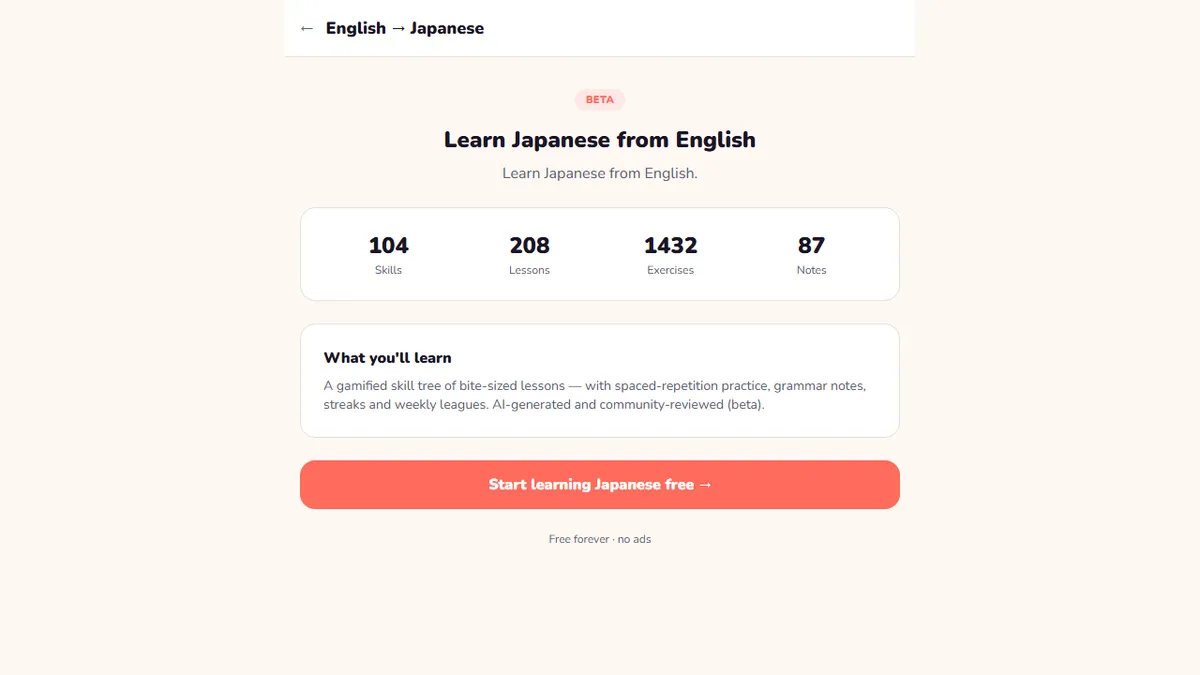
The English-to-Japanese skill-tree course for beginners handles the script challenge in a pedagogically sensible way, using tap-completion exercises rather than requiring learners to type non-Latin characters from a cold start, which removes friction and keeps study moving.
Month 7–9: Listening Practice and Filling Grammar Gaps
By month seven, a learner who has followed this sequence will have a working knowledge of basic grammar and a vocabulary of perhaps 500 to 700 words. The next phase should substantially increase the proportion of time spent on listening comprehension, which in Japanese lags well behind reading and speaking skills for most self-taught learners.
Native spoken Japanese is faster, more contracted, and grammatically freer than textbook Japanese. Verbs are regularly dropped when understood from context. Particles disappear in casual speech. Regional accents introduce variation that can make the same word sound completely different. This gap between "textbook Japanese" and "actual Japanese" is jarring when first encountered, but it closes faster than learners expect when they give it dedicated attention.
Useful listening resources at this stage include Japanese-language podcasts designed for learners, subtitled drama or anime (subtitle in Japanese, not English, once vocabulary allows), and structured listening practice within courses. The goal by month nine is not perfect comprehension but the ability to extract main points from moderately paced speech on familiar topics.
Month 10–12: Reaching A2–B1 and Planning What Comes Next
The end of the first year is a good moment to assess where you actually are before deciding what the next 12 months should look like. A learner who has followed this roadmap with consistent daily study should be approaching or entering the CEFR A2 to B1 range — able to manage simple conversations on familiar topics, read texts aided by occasional lookups, and understand spoken Japanese in contexts that are not too linguistically complex.
This is not fluency, and it is worth being clear-eyed about that. Japanese at B1 is still a learner who needs effort and patience from conversation partners. The path from here to B2 is longer than the path from zero to A2, because the challenges shift from basic acquisition to the kind of nuanced grammar and vocabulary range that only comes through substantial exposure.
Planning for months 13 through 24 should include: systematic kanji expansion toward 1,000 or more characters, increased engagement with authentic media, and deliberate conversation practice (ideally with native speakers) to test and stress the grammar foundations that have been built.
Tools and Resources to Complement Your Core Course
A structured skill-tree course should be the spine of year-one Japanese study, but several complementary tools are worth integrating. A dedicated spaced repetition system for kanji and vocabulary review allows learners to maintain a much larger active vocabulary than course exercises alone can sustain. Listening-focused podcasts at the learner's current level provide comprehensible input in the absence of full immersion. Graded readers offer reading practice calibrated to A1–B1 grammar ranges, which is important because authentic Japanese text is almost always too complex for a first-year learner without extensive support.
What matters most, however, is consistency across the year, not the specific resources you use. Japanese rewards daily practice more than almost any other language. A modest daily routine maintained without breaks will outperform intensive bursts separated by weeks of inactivity, both in terms of what you retain and in terms of the motivation required to keep going.