What Makes a Dismissal 'Unfair' in UK Law
Unfair dismissal is a statutory right in UK employment law, not simply a feeling that your employer behaved badly. For a dismissal to qualify as unfair, a Tribunal must find either that the employer lacked a potentially fair reason for dismissing you, or that their reason was potentially fair but they acted unreasonably in the way they carried out the dismissal.
The potentially fair reasons in law are a defined list: capability, conduct, redundancy, breach of a statutory restriction, or some other substantial reason. A dismissal for capability might be entirely fair if the employer followed a proper performance management process, or entirely unfair if you were dismissed after one bad review with no warning and no opportunity to improve. The test is procedural as much as substantive. The legal tests for unfair dismissal in UK employment law sets out the full framework; this guide focuses on the practical steps claimants need to take from the moment they are dismissed.
The Two-Year Rule: Who Can Actually Claim
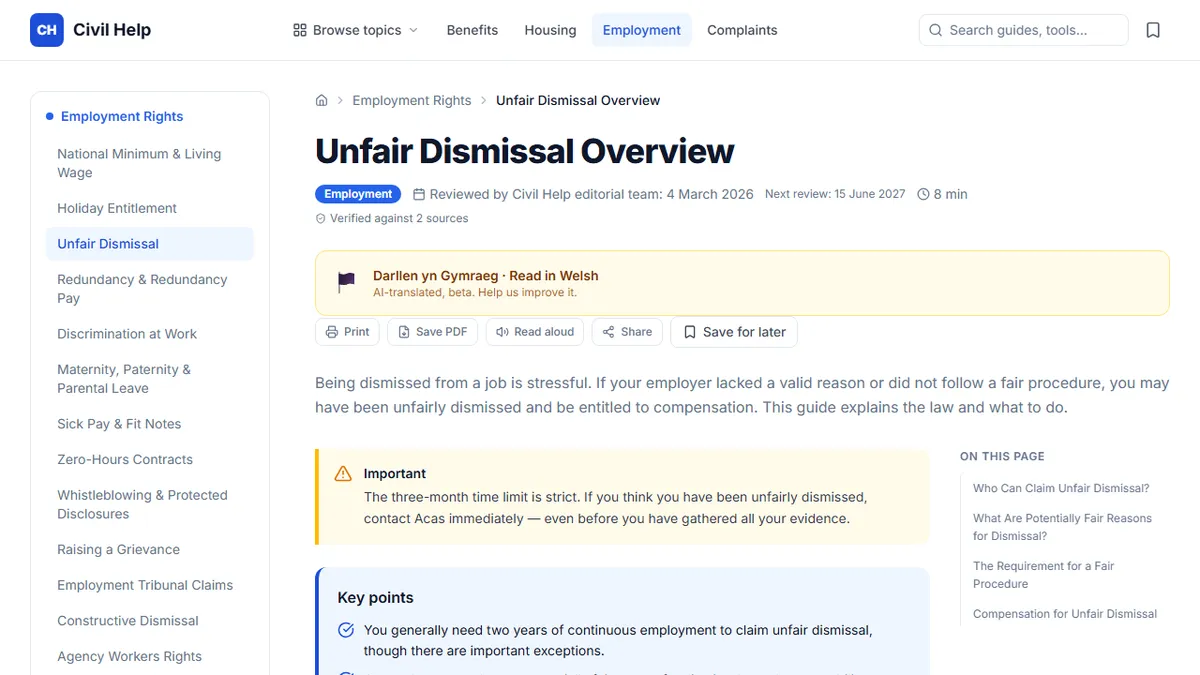
The standard qualifying period for unfair dismissal is two years of continuous employment. If you have been employed for less than two years, you generally cannot bring an ordinary unfair dismissal claim regardless of how egregious the dismissal was.
There are important exceptions. Dismissals that are automatically unfair (for whistleblowing, for exercising a statutory right, for trade union membership, for taking maternity or paternity leave, for making a flexible working request) require no minimum service period. If any of those factors was connected to your dismissal, the two-year rule does not apply, even if you have been employed for only a few weeks.
If you are unsure whether your dismissal connects to any protected reason, this is worth investigating before assuming you lack standing.
Day 1: Start the Clock — Your Three-Month Time Limit Explained
The employment tribunal time limit for unfair dismissal is three months less one day from the effective date of termination. This deadline is strictly enforced. Extensions are granted only in exceptional circumstances and tribunals are not generous with them.
The effective date of termination is usually the last day you worked, or the last day of any notice period (whether worked or paid in lieu). The three-month clock starts from that date, not from the date you received the dismissal letter, not from the date a grievance appeal was rejected.
Many people spend weeks processing what happened, seeking advice, or hoping the situation resolves itself. By the time they contact an employment lawyer, the deadline has passed or is days away. Whatever else you do on day one, write down the effective date and count forward three months less one day.
Why You Must Contact Acas Before Filing
Before you can submit a claim to the Employment Tribunal, you are legally required to notify Acas and participate in Early Conciliation. This is a mandatory step: a tribunal will reject your claim if you have not obtained an Acas Early Conciliation certificate first.
The notification to Acas pauses the tribunal time limit for the duration of the conciliation period, which means delaying the Acas contact does not extend your overall time. Contact Acas as soon as possible. The pause on the clock that conciliation provides gives you breathing room you may need. Understanding why Acas Early Conciliation is a mandatory first step helps you approach the process strategically rather than treating it as an administrative formality.
What Happens at Early Conciliation
After you notify Acas, a conciliation officer contacts both you and your former employer to explore whether a settlement is possible without tribunal proceedings. Participation is encouraged but not mandatory on either side — either party can decline, and you will receive a certificate that allows you to proceed to tribunal.
Acas conciliation resolves a significant proportion of employment disputes. Employers often prefer a confidential settlement to a public tribunal hearing, and claimants often value certainty over the risk of a contested hearing. If your former employer makes an offer during conciliation, you do not have to accept it — but any offer is worth considering in the context of the time, stress, and uncertainty of the tribunal route.
If conciliation does not produce agreement, Acas issues an Early Conciliation certificate with a reference number. You include this number in your ET1 claim form.
The Tribunal Process From ET1 to Hearing
Submitting an ET1 is the formal beginning of tribunal proceedings. The form asks for your details, your employer's details, your grounds of claim, and the remedy you are seeking. Accuracy matters — errors in the ET1 are difficult to correct later and can undermine your credibility.
After the ET1 is submitted, the employer receives an ET3 response form and has 28 days to file their defence. The tribunal then case-manages the proceedings: exchanging documents, scheduling witness statements, and setting a hearing date. Simple unfair dismissal cases are typically listed for a one-day hearing; complex cases involving multiple claims can run for several days.
Hearings are conducted by an Employment Judge, who may sit alone or with lay members. The process is more formal than most claimants expect, but less formal than a court. Legal representation is permitted but not required.
How Much Compensation Could You Actually Receive
Unfair dismissal compensation has two components. The Basic Award is calculated using a statutory formula based on your age, length of service, and gross weekly pay (capped at a statutory limit that changes annually). The Compensatory Award covers actual financial losses, such as lost earnings, lost pension contributions, and other quantifiable losses arising from the dismissal, subject to a statutory cap.
The cap on the compensatory award is either one year's gross pay or a statutory ceiling, whichever is lower. Compensation is not automatic and is reduced if the claimant contributed to their dismissal or failed to take reasonable steps to find new work. Many awards are considerably below the maximum because the claimant found new employment relatively quickly.
Knowing the realistic range before you begin helps calibrate whether the investment of time and stress is proportionate to the likely outcome.