The real question isn't which hospital is best
Most people start a hospital search with the same question: which hospital is best? That question is too broad to be useful. A hospital can have excellent cancer results and a poor dermatology waiting list, or a good CQC rating and a crowded A&E. The question that actually drives the decision is narrower: for the treatment you need, is the wait at a further hospital short enough to justify the travel, the parking, and the follow-up appointments? For planned care, the answer is often yes, but only once you know which figures actually bear on your situation and which don't.
In England, patients referred by a GP can generally choose which hospital to attend for their first outpatient appointment. That choice is real, and it's the whole reason this is worth thinking through rather than defaulting to the nearest building out of habit.
Specialty gaps, not hospital reputations, drive the decision
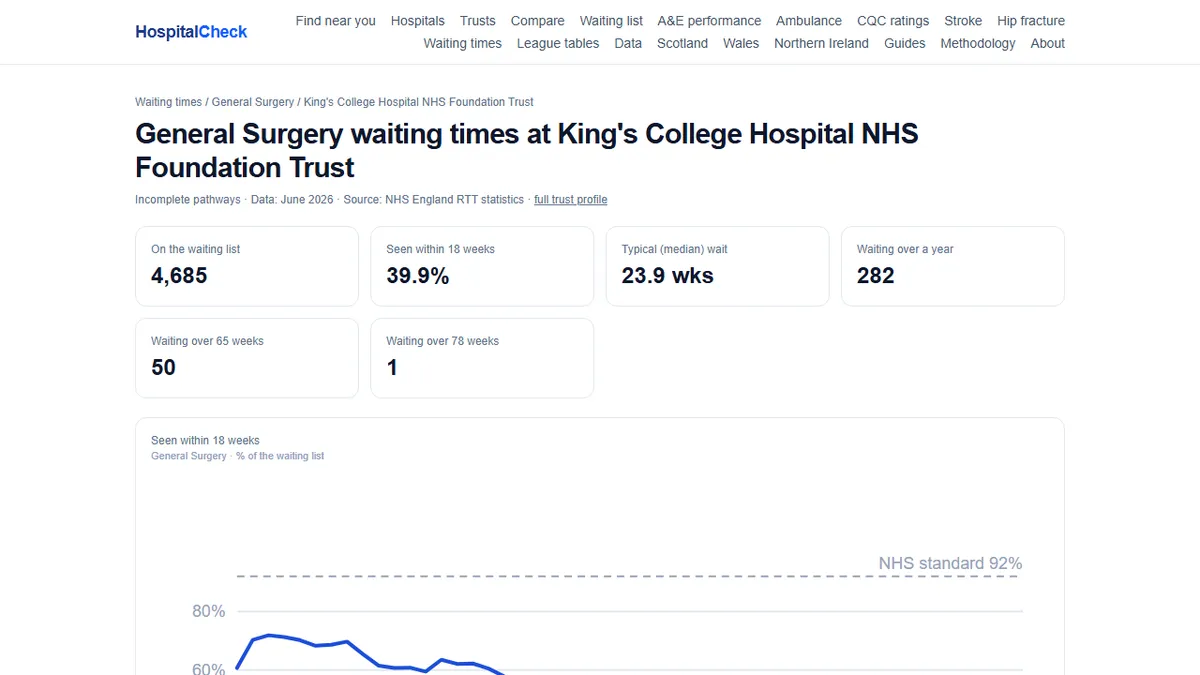
The gap that matters is between specialties, not between hospitals in general. A trust can run a fast orthopaedic list and a slow dermatology one, or the reverse, so a general reputation for being "good" or "bad" tells you very little about the specific referral in front of you. HospitalCheck's hospital profile pages break waiting times down specialty by specialty for exactly this reason, and it's worth remembering that most of what you'll find there is published trust-wide rather than building by building. If you need a hip or knee replacement, trauma and orthopaedic waiting times for a trust such as East Suffolk and North Essex is the page to pull up, not a general league table. Every trust reports the percentage waiting 18 weeks or less against the 92% constitutional standard, the median wait, and the number waiting over 52 weeks, for that specialty specifically, and those three numbers are what you should be comparing between your local trust and the one further away.
When the travel is worth it for planned care
For a one-off, planned procedure, a real gap in the numbers is usually worth the drive. If your local trust's list for your specialty runs months longer than a trust twenty miles away, that difference alone can justify the journey. The same logic applies if you've been referred with a suspected cancer: one trust hitting the 28-day Faster Diagnosis Standard and the 62-day treatment standard comfortably while another is missing them by a wide margin is a meaningful reason to travel. It applies to diagnostic tests too. MRI, CT, ultrasound and endoscopy waits are measured against a standard where fewer than 1% of patients should be waiting six weeks or more, and a trust badly missing that mark is worth avoiding if a nearby alternative is hitting it.
Repeat visits change the maths
A one-off procedure is a different calculation from a condition that needs ongoing management. Dermatology is a good example: some referrals are a single consultation, but eczema, psoriasis or mole monitoring can mean several appointments spread across a year, and each of those trips adds parking, time off work and mileage to the running total. Check the dermatology waiting times in west suffolk and weigh the first wait against how many follow-ups the pathway typically involves before deciding a further trust is worth it. A shorter initial wait at a distant hospital can lose its advantage entirely once you multiply the trip by five or six return visits. If you also want a sense of how safe and how well-regarded a trust is, its mortality band, infection figures, Never Events count and Friends and Family Test score are all on the profile, though each of those comes with its own caveats before it should sway a decision either way.
A&E is the exception: distance matters more than data
A&E is the one place where distance genuinely does matter, and in the opposite direction from planned care. In an emergency you go to the nearest appropriate department, full stop, and the four-hour figure won't help you choose one over another anyway: in England it's published per trust with every department type combined, so a trust with a large minor injuries unit can look better than one running a stretched major emergency department under identical pressure. Scotland reports its four-hour figure per hospital site rather than by health board, which is a more genuinely comparable number where it's available, but England's isn't built that way. The 12-hour trolley wait count is the closer read on overcrowding, though it's a raw total, so a bigger trust will naturally record more of them than a smaller one regardless of how well either is actually coping.
None of that belongs in a planned-referral decision. A&E performance tells you how the emergency department is coping today, not how an outpatient clinic or a surgical list will treat you next month. If you're weighing two hospitals for surgery or an ongoing outpatient referral, the waiting list, the CQC rating and the facilities data are the numbers that matter. Save the A&E figures for the day you actually need them.
How to actually compare two hospitals
Once you know the specialty and the type of care involved, the comparison is mechanical. Pull up the waiting-time page for both hospitals, note the percentage within 18 weeks, the median and the over-52-week count, then check the CQC rating for the actual building you'd attend, since that's the one figure tied to the site rather than the trust. HospitalCheck's find and compare tools exist for exactly this, so you don't have to hold six numbers in your head across two open tabs.
Distance should win when the gap is large relative to the journey: a several-month difference in wait for a one-off procedure, or a specialist service the local trust simply doesn't run, easily justifies the drive. A two-week difference does not, and neither does a marginally better CQC rating if it means adding an hour each way to a course of treatment that needs six visits. If you're comparing against Scotland or Wales, remember their standards aren't England's: Scotland's waiting-time target is 12 weeks, Wales's is 26, so a number that looks strong on one side of the border can look weak on the other.
The numbers can tell you where the wait is shorter and which building is better run. Only you know what an extra hour on the road is worth, and how many times you'd have to make that journey before it's over.