On this page
The three clocks in one sentence
If you are referred for NHS treatment, "how long will I wait?" has no single answer. England, Scotland and Wales each run their own health service, and each uses a different waiting-time standard for planned care. England measures referral to treatment against an 18-week target, Scotland uses a 12-week stage-of-treatment target, and Wales uses a 26-week referral-to-treatment target. The same condition, the same referral, and a completely different official clock depending on your postcode.
England's 18-week clock
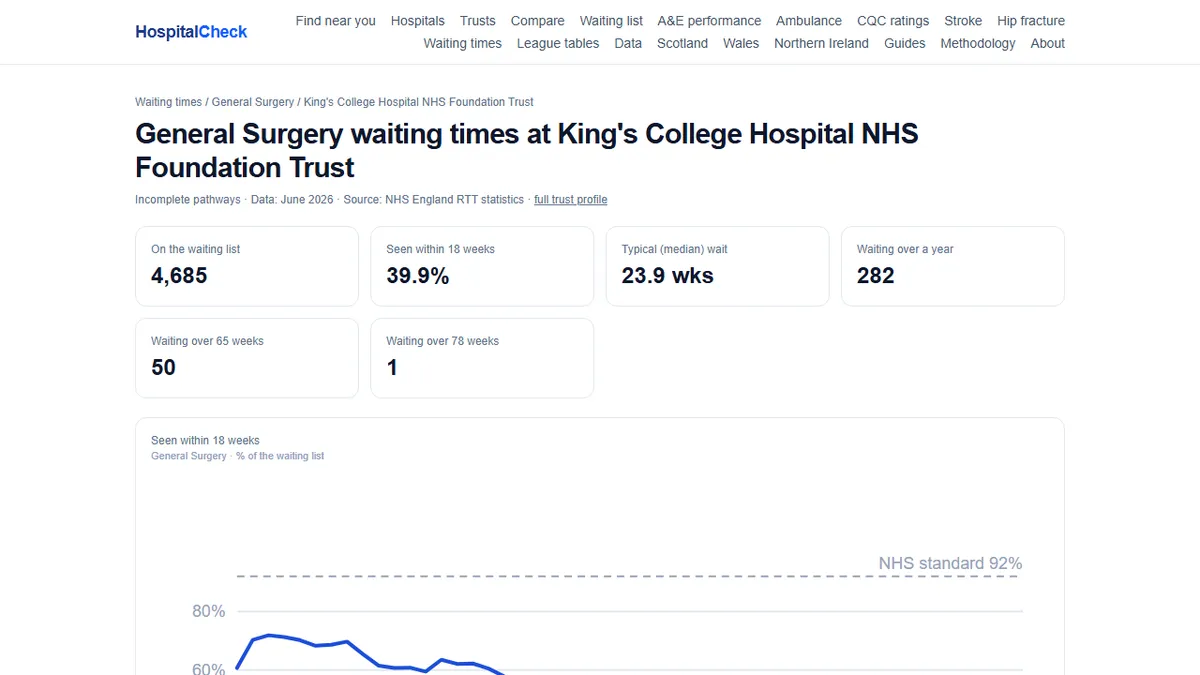
England's constitutional standard is that at least 92% of patients waiting for consultant-led treatment should be treated within 18 weeks of referral. That is the Referral to Treatment (RTT) measure. The clock starts when your GP or another referrer sends the referral, and stops when you start treatment, or when a decision is made not to treat. It is published monthly by NHS England, per trust and per specialty.
That last point matters. A trust's overall waiting list can look reasonable while a specific specialty is struggling. Dermatology, oral surgery and trauma and orthopaedics tend to have longer waits than some other specialties. If you want to see how a particular English trust is doing in a particular specialty, you can look at a page like this one for dermatology at Imperial College Healthcare. It shows the median wait, the percentage within 18 weeks, and the number of patients waiting over 52 weeks.
Scotland's 12-week clock
Scotland does not use England's 18-week RTT measure. It uses something called "Stage of Treatment", which splits planned care into two stages: the wait for a new outpatient appointment, and the wait for inpatient or day-case treatment. The Scottish standard is that patients should wait no more than 12 weeks for either stage. The figures are published per health board, not per trust.
This is not a cosmetic difference. A patient in Scotland can be told they are "within the standard" while waiting 11 weeks — a wait that would be well inside England's 18-week target anyway, but is two weeks away from Scotland's own clock. Conversely, a patient in England might be told they are "within the standard" at 17 weeks, which would be five weeks past Scotland's target. The numbers are not interchangeable. If you want to see a Scottish hospital's profile, you can look at St Margaret's Hospital in Scotland, but bear in mind that waiting-time data for Scotland is reported at health-board level, not for individual buildings.
Wales's 26-week clock
Wales has its own referral-to-treatment measure, and its target is the most generous of the three. The Welsh standard is that 95% of patients should wait under 26 weeks from referral to treatment. The data is published per health board, with all treatment functions combined. That means you cannot see a single Welsh health board's RTT performance broken down by specialty in the same granular way you can in England.
Wales also measures other things differently. Its cancer target is 75% of patients starting treatment within 62 days, whereas England's is 85% and Scotland's is 95%. Its diagnostic standard is that no patient should wait over 8 weeks, whereas England and Scotland use a 6-week benchmark. Welsh figures are never combined with English or Scottish figures, because the definitions are too different to allow a fair comparison.
The same word, different meanings
The confusion does not stop at national borders. Even within England, there is more than one waiting-time clock. The monthly RTT measure is the one used for the 18-week standard, but NHS England also publishes a separate weekly waiting list for the whole of England. It is based on slightly different data, so the total will not exactly match the sum of the monthly trust-level figures. If you see a headline about "the waiting list" that does not match a trust's RTT number, that is why.
A&E waiting times are another clock entirely. England, Scotland and Wales all use a four-hour standard, but they report it differently. Scotland reports per hospital site. England reports per trust, combining all department types. Wales reports all facilities separately from Major Emergency Departments, because including minor injury units can flatter the headline number. The same "95% within four hours" standard exists in all three nations, but the measurement basis makes cross-border comparisons unreliable.
What the numbers do and don't tell you
Every figure published on HospitalCheck is taken unmodified from an official public dataset, with the period and source shown. That is useful, but it comes with cautions. Most waiting-time data in England is trust-wide, meaning every hospital run by the same trust shows the same value. It is not building-specific. A large trust will also record more infections, more attendances and more cancellations simply because it is larger; raw counts are not adjusted for size.
The most recent month of many datasets is provisional and can be revised later. And some measures are screening tools, not verdicts. The mortality ratio (SHMI) is a prompt to investigate, not proof of poor care. None of this means the data is not worth reading. It means you should read it with the same caution you would apply to any official statistic.
How to use the clocks when you are waiting
The practical takeaway is straightforward. If you are referred for planned NHS care, find out which nation's clock applies to you. In England, ask about the 18-week RTT standard and look at the specialty-specific figure for your trust. In Scotland, ask about the 12-week stage-of-treatment standard and look at your health board. In Wales, ask about the 26-week RTT standard and look at your health board.
You can also compare trusts directly. If you have a choice of provider — and in England you often do — a side-by-side comparison of two trusts can show you which one is meeting the standard and which one is not. A page like this Royal Free London and University Hospitals Birmingham comparison lets you see the same metrics for two trusts at once. That is the kind of information that turns a vague anxiety about "waiting times" into a specific, answerable question.
The bottom line
The NHS is not one system with one waiting-time clock. It is three systems with three different clocks, and each clock tells you something different. England's 18 weeks, Scotland's 12 weeks and Wales's 26 weeks are not variations on a theme; they are separate standards, measured on separate bases, published at separate levels of detail. Knowing which clock applies to you is the first step to understanding whether your wait is normal, whether your trust is performing well, and whether you should be asking for more information.