Why Declassified Records Matter More Than Whistleblower Testimony
The distinction between a confirmed covert operation and an alleged one is fundamentally a question of documentation. Whistleblower testimony, anonymous source accounts, and circumstantial inference all carry some evidential weight, but they remain contestable. Primary documents released under declassification review, or compelled by Congressional investigation or litigation, carry a fundamentally different evidentiary status. They represent the institution acknowledging its own conduct.
The operations below are confirmed in this primary-document sense. Each has been acknowledged by the CIA itself, confirmed by Congressional hearings, or established through court proceedings. They were, at various points in their history, characterised as paranoid fiction by commentators who had not seen the documents. The documents now exist and are publicly available. The topic hub for documented state misconduct and covert programs provides a comprehensive index of what falls into this confirmed category.
This matters for how we evaluate current allegations. Knowing that the CIA ran a domestic mind-control programme, overthrew elected governments, and conducted large-scale media influence operations does not validate every contemporary claim involving the agency. It does mean that such allegations deserve evidentiary examination rather than reflexive dismissal on grounds of implausibility.
Operation Ajax: The CIA's Own History of Overthrowing Iran's Mossadegh
In August 1953, a coup removed Iranian Prime Minister Mohammad Mosaddegh from power and restored the Shah of Iran, Mohammad Reza Pahlavi, to full authority. For decades, US government officials denied or minimised American involvement. The coup was described by some commentators as a domestic political development.
In 2013, the National Security Archive published a CIA history of the operation written in the early 1970s that confirmed American and British involvement in comprehensive detail. The document, titled "The Battle for Iran," describes the operation (codenamed TPAJAX by the CIA and Operation Boot by British intelligence) as a deliberate regime change programme that included bribery of Iranian legislators, organisation of street demonstrations, and coordination with military officers to execute the final takeover.
The CIA's own declassified history of the 1953 Iran coup is notable because the primary source is the agency's own internal account, not an external allegation. The operation's long-term consequences (including the Iranian Revolution of 1979) are matters of ongoing historical and political debate, but the basic facts of US involvement in the coup are no longer disputable.
Operation PBSUCCESS: Guatemala, Fruit, and a Coup in 1954
A year after Iran, the CIA executed another coup, this time in Guatemala. President Jacobo Arbenz had nationalised portions of United Fruit Company's landholdings under a land reform programme. United Fruit had significant connections to the Eisenhower administration, including Secretary of State John Foster Dulles and his brother, CIA Director Allen Dulles, both of whom had prior professional ties to the company.
Operation PBSUCCESS involved the training of a paramilitary force in Honduras, a psychological warfare campaign using clandestine radio broadcasts, and air support for the coup. Arbenz resigned in June 1954 after his military refused to defend him. The installed government reversed the land reforms.
CIA operational histories of PBSUCCESS were partially declassified in the 1990s. The State Department's official "Foreign Relations of the United States" documentary series has confirmed the role of US policy in the operation. The United Fruit connection is documented through lobbying records, personnel overlaps, and internal government communications from the period.
MKUltra: Documented Mind-Control Experiments on US Citizens
The CIA's MKUltra programme ran from 1953 to 1973 under the directorship of Sidney Gottlieb's Technical Services Staff. Its ostensible purpose was to develop interrogation techniques and potential mind-control methods that might counter Soviet advances in similar research. In practice, it involved the administration of LSD and other substances to unwitting subjects in hospitals, universities, and prisons across the United States and Canada.
When CIA Director Richard Helms ordered most MKUltra files destroyed in 1973, he anticipated Congressional scrutiny — and he was correct. The Senate Church Committee investigations of 1975-76 uncovered the programme through surviving documents and testimony. A second cache of approximately 20,000 documents was found in 1977 in a financial records building that had not been included in the destruction order.
The programme's human cost included the death of US Army biochemist Frank Olson, who was dosed with LSD without his knowledge in 1953 and died shortly afterward. His family received a settlement from the US government. The destruction of records means the full scope of MKUltra will never be known; what survives is damning in proportion to its incompleteness.
COINTELPRO: The FBI's Illegal Domestic Intelligence Program
Between 1956 and 1971, the FBI's Counter Intelligence Program systematically surveilled, infiltrated, and worked to destabilise domestic political organisations it considered subversive. Targets included the Communist Party USA, the Black Panther Party, the American Indian Movement, the Socialist Workers Party, and (most infamously) the civil rights organisations of Martin Luther King Jr.
The programme's existence came to light not through official disclosure but through the 1971 burglary of an FBI field office in Media, Pennsylvania, by activists who distributed the documents to journalists. The subsequent Senate Church Committee investigation confirmed the programme's scope and illegality. Tactics included wiretaps installed without court orders, letters written under false identities, and deliberate attempts to destroy marriages and professional relationships.
The FBI's internal COINTELPRO memos, now widely available in the National Archives, constitute among the most detailed primary-source records of any domestic intelligence abuse programme in American history.
Operation Mockingbird: Media Manipulation Claims and the Evidence
Operation Mockingbird is described as a CIA programme to recruit journalists and plant stories in domestic and international media outlets. The primary evidence comes from the Church Committee hearings, which confirmed that the CIA had, through the 1950s and 1960s, paid journalists and employed them as intelligence assets, placed stories in publications, and maintained relationships with news organisations to shape coverage.
What the Church Committee established does not fully support every version of the Mockingbird narrative that circulates today. The confirmed scope involved specific paid assets and specific planted stories, a real and documented programme, but one with defined boundaries that are often exceeded in popular accounts. CIA Director William Colby confirmed the existence of approximately 400 journalists with agency connections in testimony to Congress.
The honest position is that a real media-influence operation existed and was confirmed, while more expansive claims about its current scope and architecture require their own documentation.
What Confirmed Programs Tell Us About Evaluating Current Claims
The six operations above were, at some point, described as paranoid speculation. They are now confirmed facts. The appropriate lesson is not that all allegations are therefore true — it is that the default position of institutional trustworthiness should be informed by institutional history.
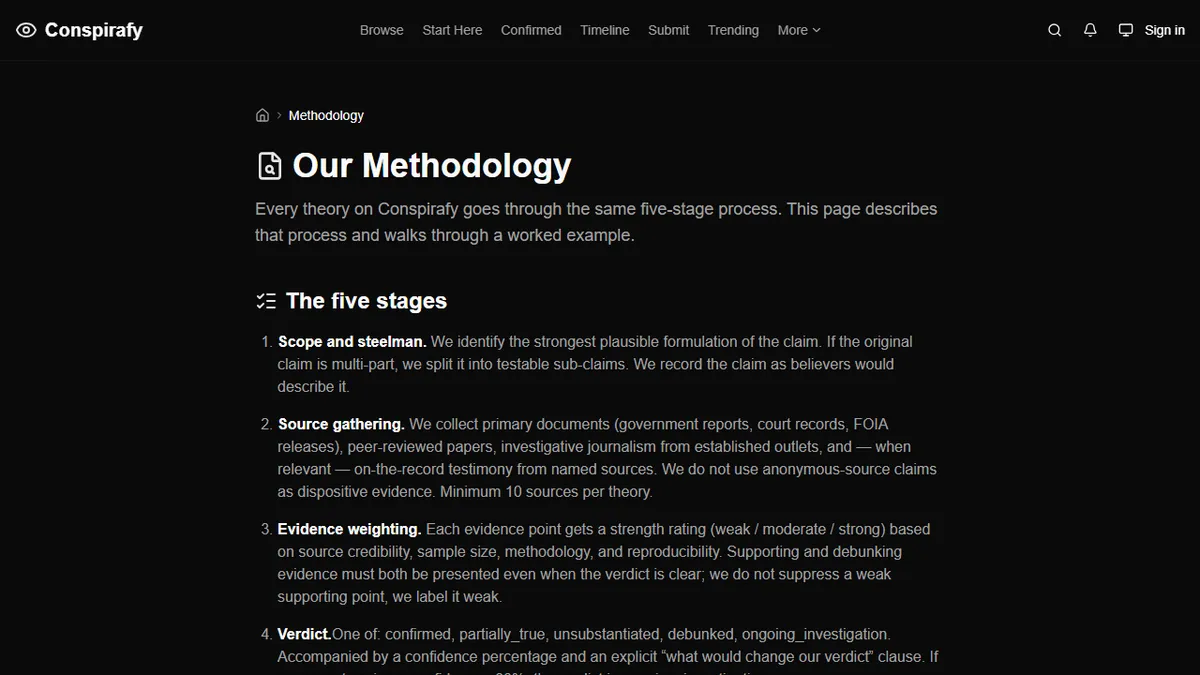
Evaluating current allegations about agency behaviour requires the same documentary standard applied here: what primary record, declassified file, or court finding supports the specific claim? Confirmed historical operations establish that such programmes can exist; they do not establish that any particular current allegation is accurate. The discipline of distinguishing between these two propositions is what separates rigorous analysis from simple pattern-projection.