"Don't feed the trolls" is the oldest piece of moderation advice still circulating, and it is not wrong. It is incomplete. The phrase assumes a troll is a person who wants attention and that withholding attention ends the exchange. That describes one band of trolling accurately and another band not at all. The useful question is not "should I reply?" but "what kind of act am I facing?" The answer changes what ignoring can achieve, what documenting is for, and when you should stop treating the problem as an online manners issue.
The folk advice was built for one band
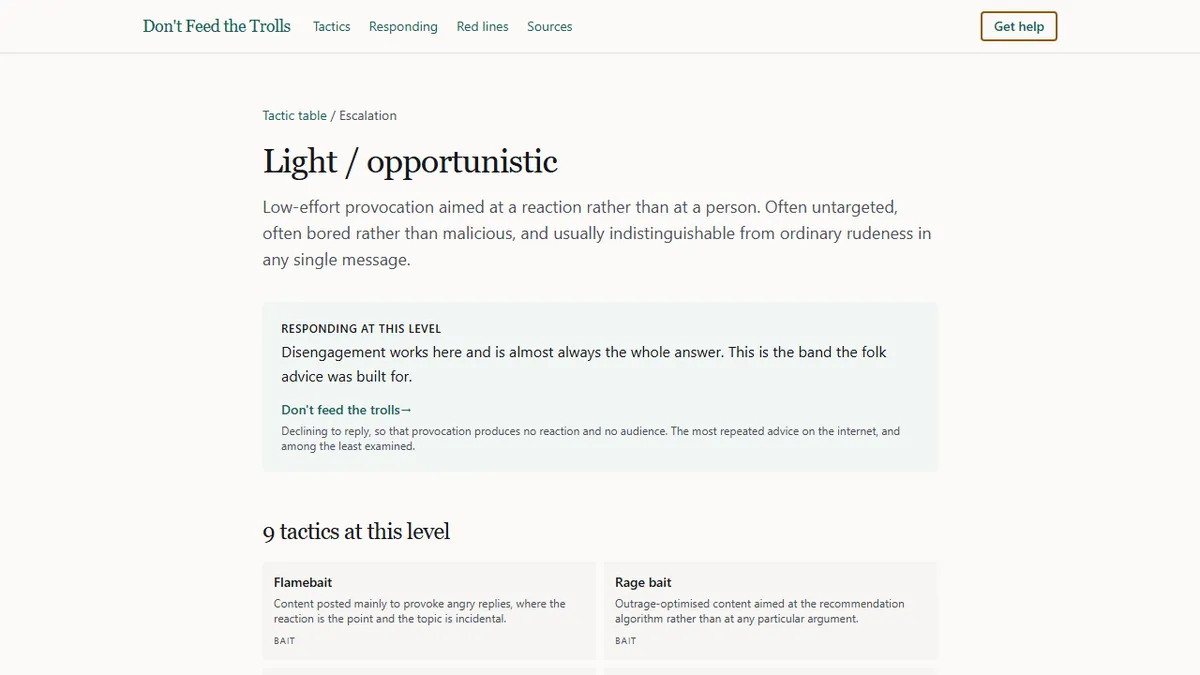
At the light opportunistic end of the spectrum, the folk advice is the whole answer. This is low-effort provocation aimed at a reaction rather than at a person. It is often untargeted, often bored rather than malicious, and usually indistinguishable from ordinary rudeness in any single message. Flamebait, rage bait, shitposting. The reaction is the point; the topic is incidental. Disengagement works here because the actor is fishing for any response and will move on when none arrives. If every piece of trolling were this, "don't feed the trolls" would be a complete policy and this article would not exist.
The reason the advice survives is that it is true for the most common case. But common is not universal. The site's escalation levels exist because the level of the act predicts how much disengaging alone will actually achieve. That is the core idea the folk advice misses: ignoring is a tactic calibrated to a threat level, not a universal shield.
The reactive band: the bait gets personal
One step up, the trolling is still about attention, but it is aimed at a specific person or group. Inflammatory content is designed to produce an emotional reply from you. The provocation is the point; the topic is a vehicle. Ad hominem baiting attacks the person so the reply becomes self-defence rather than argument. The "just joking" defence retroactively reframes a provocation as humour, so objecting becomes the offence. Quote-dunking requotes you to someone else's audience for ridicule, so your reply is performed rather than exchanged.
Disengagement still usually works here, but the pull to answer is much stronger because the bait is personal. Naming the pattern does most of its work in this band. When you can say "this is ad hominem baiting" rather than "why does this person hate me," the provocation loses its grip. The advice to ignore is still sound, but it needs an extra step: recognise the pattern first, then choose not to feed it. Ignoring without recognition leaves you confused and raw; ignoring with recognition leaves you free.
The covert band: the troll who looks reasonable
The folk advice breaks down earlier than most people expect. Sophisticated and covert trolling is bad faith wearing the costume of good faith. The endless sincere question. The worried ally. The debate that resets every time you answer it. Sealioning demands evidence relentlessly and politely until you are exhausted. Concern trolling opposes something while posing as a worried supporter. A gish gallop buries you under more claims than you can answer, so unanswered reads as unanswerable. Motte-and-bailey advances a strong claim, retreats to a defensible one when challenged, then returns.
Each individual message in this band looks reasonable. That is the point. The tell is the pattern across a conversation, never any single message. "Don't feed the trolls" fails here because the troll is not visibly a troll; replying makes you look evasive, and not replying makes you look defeated. The honest advice is to judge the exchange rather than the sentence. Recognition matters more than response. You do not need to win the conversation; you need to see what kind of conversation it is.
The coordinated band: you were never the audience
When trolling becomes coordinated, disengaging no longer ends it. Several accounts — run by one person, a small group, or a loose crowd — produce the appearance of independent agreement. Sockpuppetry runs multiple accounts to manufacture independent support. Brigading brings an organised group in from elsewhere to overwhelm a discussion or a person. Dogpiling lets volume rather than any single message do the harm. Astroturfing manufactures the appearance of grassroots support for an organised interest.
The product is manufactured consensus; the weapon is volume. You were never the audience. The performance is for onlookers, algorithms, and the record. This is where "just ignore it" starts doing harm as advice. If you ignore a coordinated campaign, the coordinated accounts keep going, and the fake consensus accumulates. The real moves are documentation, platform reporting and support. The folk advice was built for a single bored provocateur; it was not built for an operation.
The campaign band: individual response is irrelevant
At the top of the trolling scale, the act is organised, resourced and strategic — sometimes commercial, sometimes state-linked. It blends provocation with disinformation to shift what looks normal rather than to win any particular argument. Troll farms run paid, staffed operations that produce division as a job. Coordinated inauthentic behaviour uses fake accounts to mislead about who is behind the activity. Firehose of falsehood floods every channel with high-volume, inconsistent messaging that overwhelms rather than persuades. Flooding the zone makes sustained focus on any one thing impossible.
Individual response is close to irrelevant at this scale. Answering one false claim does not matter when the operation produces dozens more per hour. The useful reader here is a moderator, journalist or researcher. Understanding is the point. "Don't feed the trolls" is not just incomplete at this level; it misunderstands the objective. A campaign's goal is not to make you reply, but to make the false look normal.
Red lines are a different category
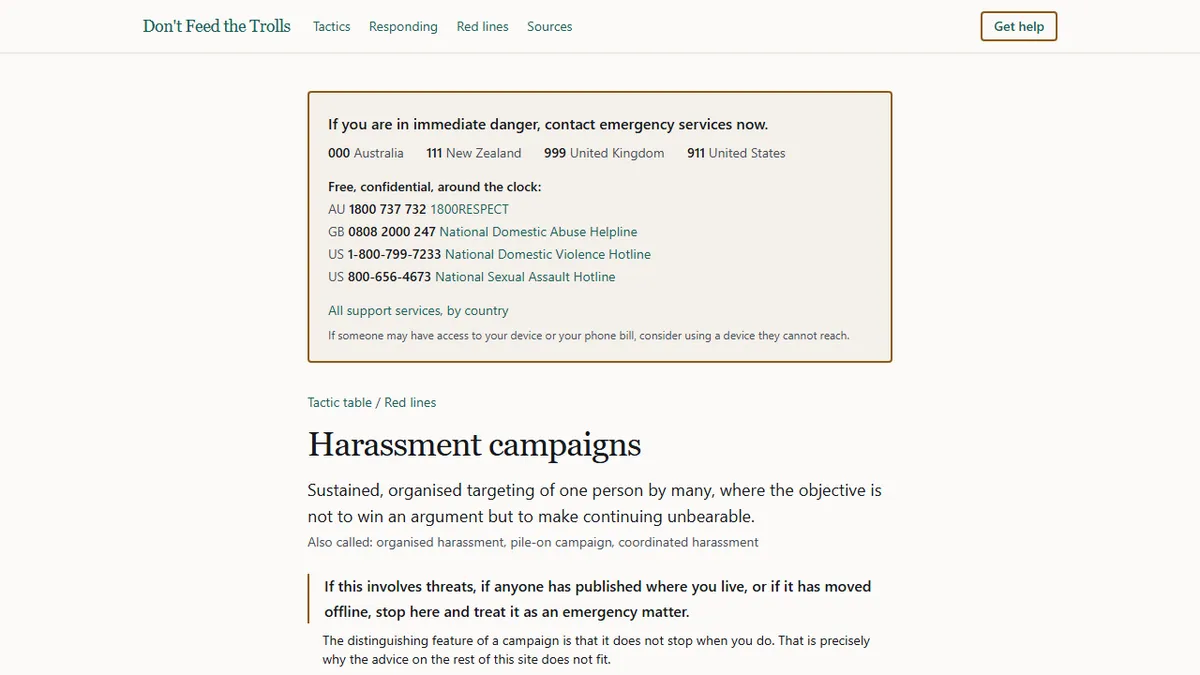
Doxxing, swatting, stalking and sustained harassment campaigns are not the far end of the trolling spectrum. They are a different kind of act. Treating them as continuous with flamebait is how real harm gets minimised. Doxxing publishes private identifying information to expose someone to harm from strangers. Swatting provokes an armed emergency response to someone's home through a false report. Stalking is a pattern of unwanted attention that makes you afraid. Harassment campaigns are organised, prolonged targeting with the objective of driving someone out entirely.
The site treats red lines as a separate category for a reason: the advice on the rest of the site does not apply to them. Disengagement is not a strategy against someone who has your address. The correct response is documentation first, engagement never, and contact with the relevant platform and authorities. If you are at this level, the question "should I feed the troll?" is the wrong question entirely.
A better question than "should I reply?"
The replacement for "don't feed the trolls" is a short set of questions. Is this low-effort provocation aimed at anyone who bites? Ignore it and move on. Is it aimed at you personally? Name the pattern, then ignore. Does every individual message look reasonable but the conversation never advances? Stop treating it as a debate and start treating it as a pattern. Are multiple accounts involved? Document and report rather than reply. Is this doxxing, stalking, swatting or a harassment campaign? Skip the advice column and involve the authorities.
The site's response decision tree makes the same point in a more structured form: the right response depends on the level of the act. "Don't feed the trolls" is good advice for the light and reactive bands, useful but incomplete for the covert band, and actively misleading for coordinated campaigns and red lines. The phrase survives because it is easy to remember. The reality is more demanding: know what you are facing, calibrate your response, and never let a slogan decide whether you are safe.