How We Ranked: Metrics That Actually Matter
Ranking companies built over three decades requires a consistent framework. Revenue and headcount alone mislead. A capital-light software platform and a rocket factory both appear on the same list but operate on fundamentally different economics. So this ranking weighs four factors together: annualised revenue or verified contract value, direct employee headcount, global footprint (countries served, physical assets), and measurable impact on its sector.
Historical companies, those where Musk exited before building what followed, sit at the bottom regardless of their symbolic importance. Active companies sit higher the more they dominate their respective markets today. See the full company-by-company breakdown with key facts for the primary-source figures behind each entry.
8. Zip2 and PayPal — The Financial Launchpad (Historical)
Zip2 sold to Compaq in 1999 for $307 million, handing Musk roughly $22 million. He rolled nearly all of it into X.com, which merged with Confinity and became PayPal, then sold to eBay in 2002 for $1.5 billion in stock. Musk netted somewhere between $160 million and $180 million from that sale.
Neither company exists as Musk built them. Their legacy is entirely financial and network-based: the capital that seeded every subsequent venture, and the alumni cohort (Peter Thiel, Reid Hoffman, Max Levchin, David Sacks, and others) who would collectively shape Silicon Valley for the following two decades. Without Zip2 and PayPal, none of the companies above them on this list exist.
7. The Boring Company — Small Footprint, Real Tunnels
The Boring Company was founded in 2017 on a single thesis: tunnelling in the United States costs far too much and takes far too long, and that problem is solvable with engineering discipline rather than public-sector process. Its first commercial installation, the Las Vegas Convention Center Loop, opened in 2021 and now carries passengers in Tesla vehicles beneath the convention district.
By revenue and headcount The Boring Company is the smallest active Musk venture. It has delivered one functioning system and holds permits and contracts for several others. The gap between ambition and current deployment is wide, but the ambition (city-scale underground transit at a fraction of traditional tunnel costs) is real and technically grounded.
6. Neuralink — 21 People, Unlimited Potential
By January 2024 Neuralink had received FDA approval and implanted its N1 brain-computer interface in a first human participant. By early 2026 at least 21 people carried the device, all actively using it, with zero serious adverse device events reported. Participants have moved cursors, played games, typed messages, and created digital art using thought alone.
The company remains in clinical trial phase, which means revenue is minimal and headcount is modest relative to its profile. But its regulatory trajectory, including an FDA breakthrough-device designation for a separate vision-restoration implant called Blindsight, suggests the gap between current scale and eventual market size could be enormous.
5. xAI — Fastest Supercomputer Build in History
Founded in July 2023, xAI built its Colossus computing cluster (100,000 Nvidia H100 GPUs) in a converted Memphis factory in 122 days. Nvidia's own leadership described the pace as unprecedented. xAI subsequently expanded the cluster well past the initial target and announced ambitions toward one million GPUs.
The Grok assistant launched in late 2023 and has since progressed through several generations, posting competitive scores on hard reasoning and mathematics benchmarks. In early 2025 xAI formally acquired X Corp, creating a combined entity valued in the tens of billions. For a company less than two years old, the trajectory is extraordinary.
4. X — 600 Million Monthly Users
When Musk completed his $44 billion acquisition of Twitter in October 2022 and renamed it X, the platform had an established but struggling position in the digital advertising market. Under new ownership the headcount was cut sharply, the verification system was restructured, and Community Notes, a crowdsourced annotation feature that uses mathematical bridging algorithms rather than editorial fact-checkers, was expanded.
Monthly active users have grown to approximately 600 million. Ad revenue fell substantially in the 2022 to 2024 period, recovered as advertisers returned in 2025, and the company was absorbed into xAI at a valuation of $33 billion, below the acquisition price but within a structure that created a larger combined entity.
3. Starlink — $11B Revenue and Growing
Starlink launched its first 60 operational satellites in May 2019. By 2026 the constellation exceeded 10,000 spacecraft, served more than 150 countries, and had surpassed 10 million subscribers. Revenue is estimated above $11 billion annually, making it the single largest revenue contributor within the SpaceX family.
The operational model depends entirely on SpaceX's reusable rockets: without cheap, frequent launch capability, deploying and maintaining a constellation at this scale would be economically impossible. Starlink also proved its strategic importance during the 2022 invasion of Ukraine, restoring connectivity within days across infrastructure that had been attacked. It was a demonstration no other commercial network could have replicated.
2. SpaceX — 80% of the World's Mass to Orbit
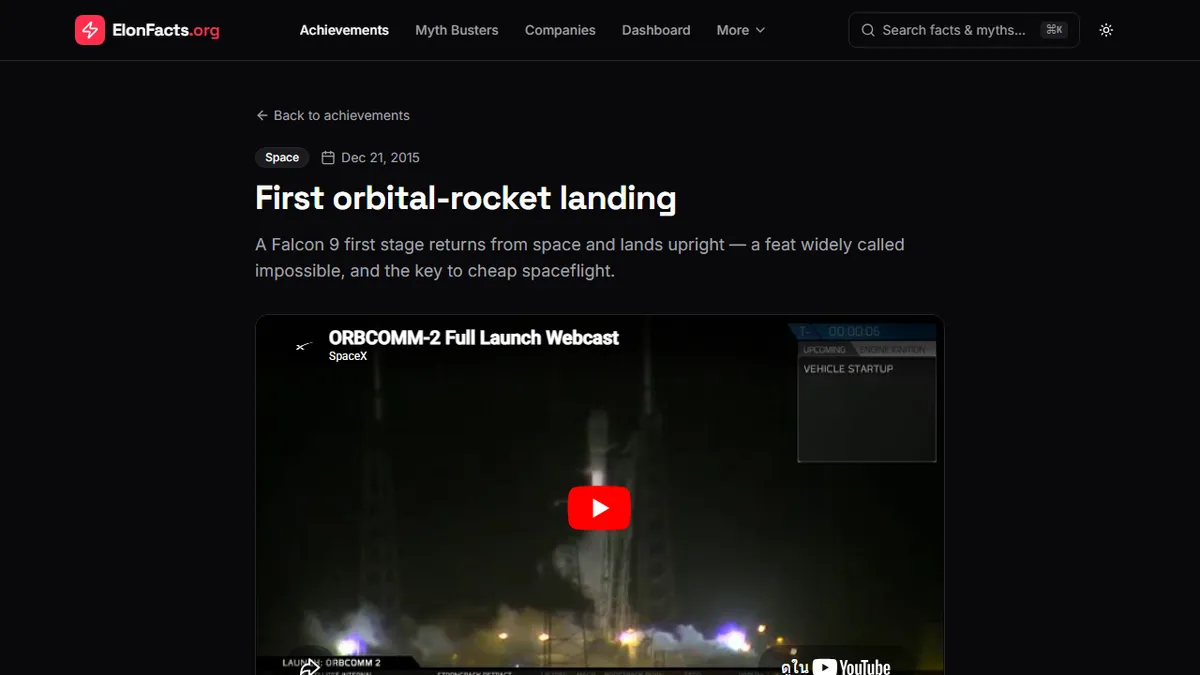
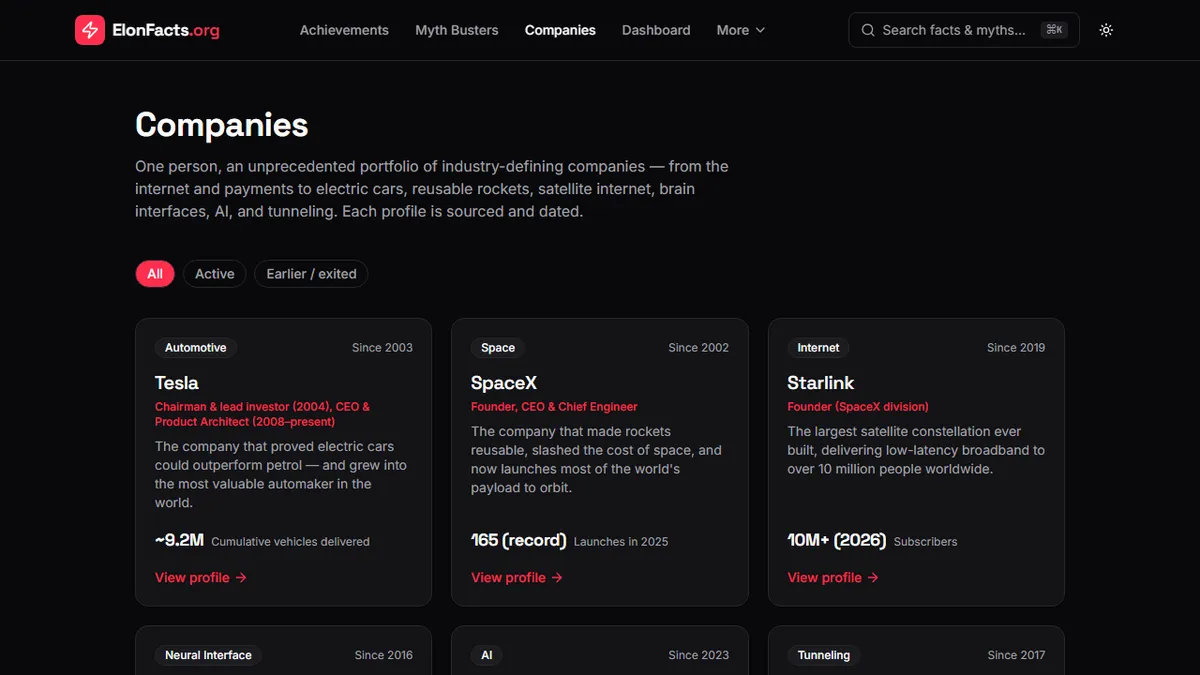
SpaceX launched approximately 165 missions in 2025, placing it far ahead of every other launch provider on Earth. It was responsible for roughly 80 percent of all mass placed in orbit that year. The Falcon 9 booster has reflown more than 600 times. The company holds contracts with NASA, the US Space Force, the National Reconnaissance Office, and commercial operators on every continent.
Starship, the fully reusable vehicle intended to carry humans to the Moon under NASA's Artemis programme, completed a series of integrated test flights culminating in a booster catch using the launch tower's mechanical arms, a world first. SpaceX is not simply a launch provider; it is the closest thing the world has to a vertically integrated space infrastructure company.
1. Tesla — 9.2M Vehicles and the Best-Selling Car on Earth
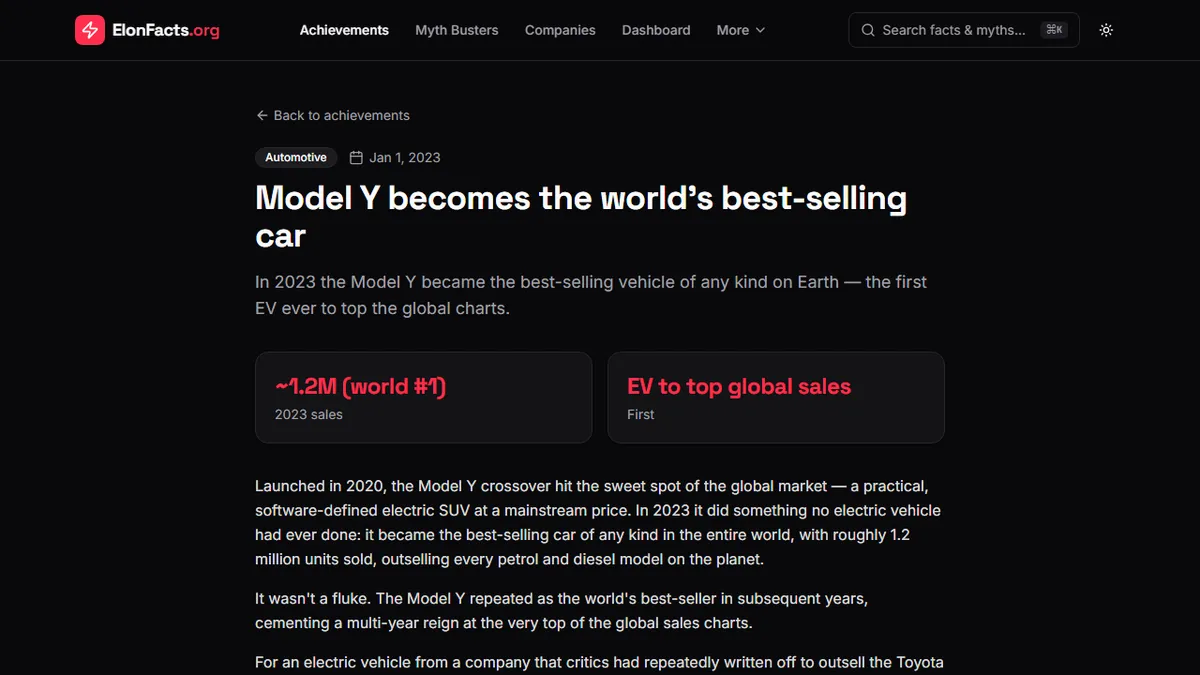
Tesla delivered approximately 9.2 million vehicles in the years since the original Roadster shipped in 2008, with cumulative production accelerating sharply as Gigafactories in Texas, Germany, China, and Nevada reached full capacity. In 2023 the Model Y became the best-selling vehicle of any kind in the world, the first time an electric car had topped global sales charts, and it repeated that position in subsequent years.
Beyond cars, Tesla's energy storage division deployed 46,700 MWh of Powerwall and Megapack capacity in 2025, and its Supercharger network of roughly 36,500 stalls became the North American Charging Standard, adopted by Ford, General Motors, and most major rivals. In June 2025 Tesla launched a paid robotaxi service in Austin, extending its footprint from manufacturing into mobility services. No other company on this list comes close on revenue, headcount, physical infrastructure, or measurable market transformation.