On this page
The Throwaway Rocket Problem (and Why It Mattered)
For the first six decades of the space age, rockets were used once and discarded. A Falcon 9 first stage (the large lower portion of the rocket that does most of the work getting off the ground) costs in the region of $30 to $40 million to manufacture. In the traditional model, that hardware fell into the ocean after each mission and was never seen again.
The analogy that Elon Musk used repeatedly in SpaceX's early years is instructive: imagine if airlines threw away a Boeing 747 after every flight. The cost per passenger would be ruinous. Tickets that today cost a few hundred dollars would instead cost hundreds of thousands. That is essentially what the global launch industry had accepted as the unavoidable cost of doing business — and SpaceX decided to challenge it.
The throwaway model existed for a combination of technical and institutional reasons. Making a rocket return, slow down from hypersonic speeds, navigate back to a specific point, and land vertically requires solving a chain of hard engineering problems simultaneously. Most aerospace engineers in the 1990s and 2000s believed the fuel cost and hardware penalties of adding landing capability would erase whatever savings reuse provided. SpaceX bet they were wrong.
How a Booster Lands: The Basic Physics
A Falcon 9 first stage separates from the second stage at roughly 70 kilometres altitude while travelling at around 2,000 metres per second. At that point it is a large metal tube moving very fast in the wrong direction for landing. Getting it back to a safe, vertical touchdown involves three distinct phases.
The first is the boostback burn, a brief engine firing that reverses the booster's trajectory and sends it back toward the landing zone. The second is the entry burn, which fires the engines again as the rocket re-enters the thickest part of the atmosphere, reducing speed before aerodynamic forces become destructive. The third is the landing burn itself, a precisely timed ignition that decelerates the vehicle from several hundred metres per second to near zero in the final seconds before touchdown.
Grid fins (large, latticed steel panels that fold out from the top of the booster) provide aerodynamic steering during the atmospheric descent. Four landing legs extend in the final moments. The whole sequence is managed autonomously by the rocket's flight computer; no human operator is involved.
From First Landing (2015) to 30-Plus Reflights Today
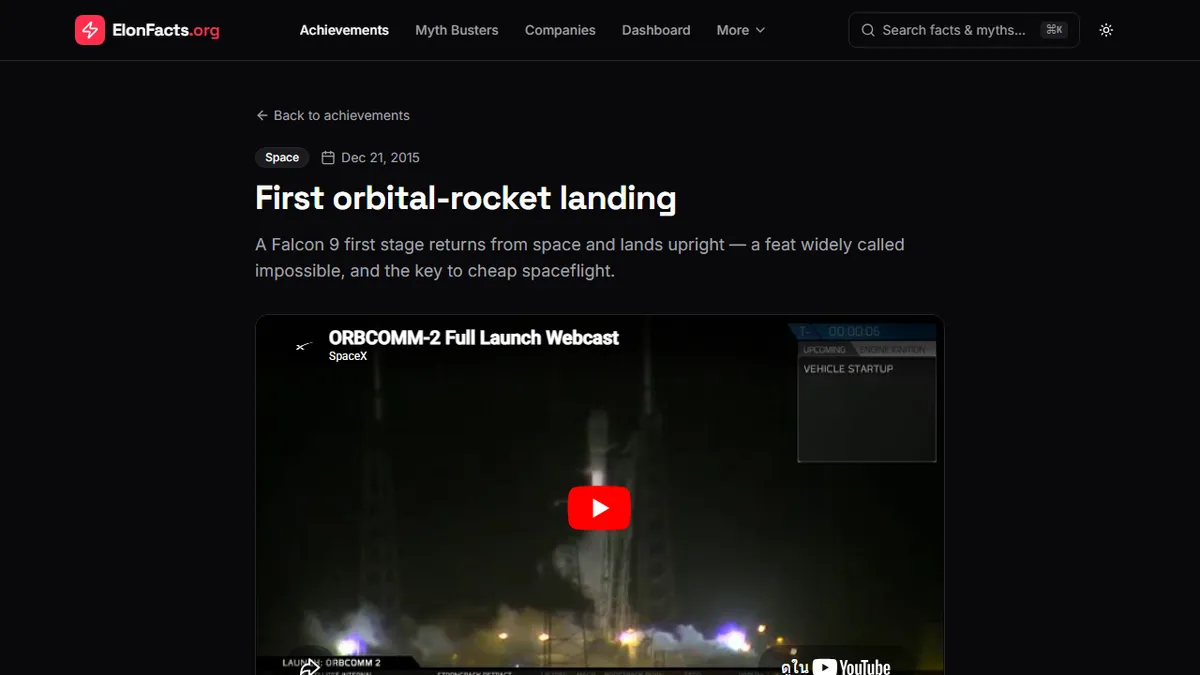
The first orbital-class booster landing in December 2015 was a watershed event. Booster B1019 flew the Orbcomm OG2 mission to orbit, then returned to Landing Zone 1 at Cape Canaveral and touched down intact, the first time any orbital-class rocket had ever done so. Employees and engineers watching the webcast reacted with disbelief. Most of the industry assumed it would not work.
It did work. The technology was then refined through dozens of missions, and SpaceX added drone ship landings (ocean-going platforms that the rocket lands on when it does not have enough fuel to return to the coast). By 2026, individual Falcon 9 boosters had flown more than 25 times each, with some approaching and exceeding 30 reflights. A booster that cost $35 million to manufacture was being amortised across enough missions to drive the effective per-flight cost of the first stage toward a few million dollars.
What Reusability Does to Launch Costs
Before reusability, the cheapest commercially available launch to low Earth orbit cost around $50,000 per kilogram of payload. SpaceX's Falcon 9 brought that figure down to approximately $2,700 per kilogram on a shared manifest flight, a reduction of more than 90 percent.
Those numbers are not simply the result of clever procurement or engineering efficiency. They are structurally possible only because the most expensive component of the rocket (the first stage) is recovered, inspected, refurbished, and reflown rather than lost on every mission. The business model resembles aviation far more than traditional aerospace: a capital asset depreciates across many uses rather than being consumed in one.
This cost reduction unlocked markets that previously did not exist. Starlink, with its constellation of thousands of satellites, would be economically impossible at 1990s launch prices. Many of the small satellite operators, Earth observation companies, and commercial space station programmes that now exist are direct beneficiaries of the cost curve SpaceX forced downward.
The Chopstick Catch: Catching a Booster Mid-Air
If routine booster landings were the first reusability milestone, the Starship programme introduced a more audacious one. In October 2024, the Starship Super Heavy booster (approximately 70 metres tall and weighing hundreds of tonnes) returned from its test flight and was caught mid-air by the launch tower's mechanical arm system, nicknamed "Mechazilla" or the "chopsticks."
Rather than deploying landing legs and touching down on a pad, the booster was guided to hover above the tower and gripped by two large moving arms. The intent is to reduce turnaround time: a booster that needs no landing legs, landing pad inspection, or complex ground support equipment can theoretically be re-stacked onto a new upper stage and relaunched within hours.
The first catch attempt succeeded. Engineers and observers who had watched the landing of Falcon 9 in 2015 as a near-miracle watched the Starship catch in 2024 as the natural continuation of a matured philosophy — iterative hardware testing, rapid reflection, and willingness to accept public failures on the way to operational capability.
Why Competitors Struggled to Copy It
Rocket reusability looked, in principle, like something any aerospace company could adopt once SpaceX proved the concept. In practice, copying it proved far more difficult than anticipated.
United Launch Alliance attempted a partial reuse scheme for its Vulcan rocket's engines. Blue Origin landed its New Shepard suborbital vehicle vertically, but New Shepard never reaches orbital velocity and the technical demands of orbital-class reusability are categorically harder. Rocket Lab developed a helicopter-catch recovery system for its Electron booster's engines. The European Space Agency and traditional launch providers spent years discussing reusability while continuing to fly expendable vehicles.
The gap persists for reasons that are partly technical and partly cultural. SpaceX was willing to fly hardware to failure in public, iterate rapidly, and accept the institutional embarrassment of visible explosions. That tolerance for visible failure, combined with a software-development approach to hardware iteration, is not something legacy aerospace organisations adopt easily. The cost advantage SpaceX accumulated through reusability in the decade after 2015 is now structural, and competitors are starting from a significant deficit.