On this page
Geostationary vs. Low-Earth Orbit: The Altitude Difference
The fundamental problem with satellite internet before Starlink was altitude. Traditional broadband satellites (the kind that providers like HughesNet and ViaSat used) orbit at roughly 35,786 kilometres above Earth. At that height, one satellite can see about a third of the planet's surface at once, which is why a handful of them can provide theoretical coverage everywhere.
The engineering catch is physics. A radio signal travels at the speed of light, but 35,786 kilometres is a long way. The round-trip from your dish to a geostationary satellite and back, just the propagation delay, takes approximately 600 milliseconds. That is more than half a second of lag that exists regardless of how fast the satellite's processing hardware is. For email, the delay is unnoticeable. For a video call, it creates that frustrating, stilted quality where everyone talks over each other. For online gaming or real-time financial applications, it is functionally unusable.
Starlink satellites orbit at approximately 550 kilometres, about 65 times closer to the ground. The round-trip propagation delay drops to roughly 20 to 40 milliseconds. That puts it in the same range as a decent fixed broadband connection, and it means all the applications that require real-time responsiveness become genuinely viable: video conferencing, voice calls, gaming, remote work tools.
How 10,000 Satellites Form a Global Coverage Net
The cost of using a low orbit is that each satellite sees only a small patch of Earth at any given moment. A single Starlink satellite at 550 kilometres covers an area roughly 1,000 kilometres in diameter. To provide continuous, global coverage (meaning a user anywhere on Earth can always see at least one satellite), you need a large constellation, not a handful of spacecraft.
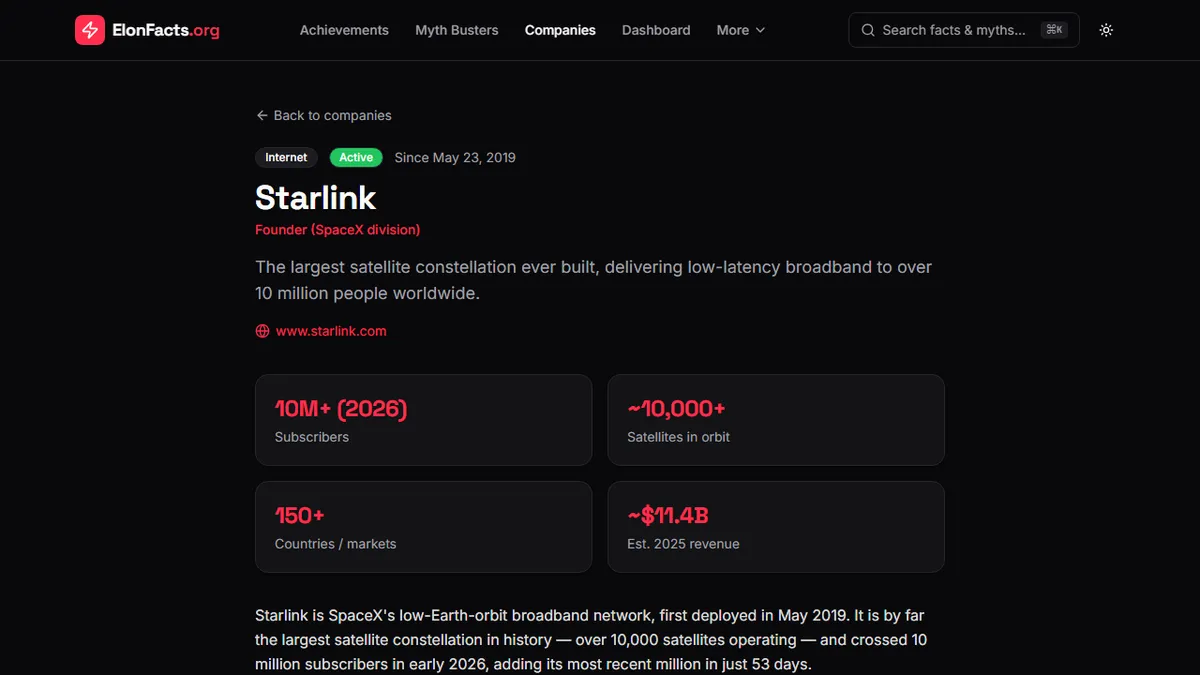
Starlink launched its first 60 operational satellites in May 2019 on a single Falcon 9 rocket. As of 2026, the constellation exceeds 10,000 active satellites, making it by far the largest operational spacecraft network in history. The satellites operate in multiple orbital shells at slightly different altitudes and inclinations, which means the coverage is overlapping rather than just sufficient — most users with an unobstructed sky view can see several satellites simultaneously.
Each satellite communicates with your dish using high-frequency radio waves (Ku-band and Ka-band frequencies). The constellation is designed so that as one satellite passes below the horizon, another is already visible, handing off your connection seamlessly. This orbital relay system is what makes Starlink different from a conventional fixed-point connection.
The Ground Station Equation
Starlink satellites are not fully independent data routers in space. Most of the network's traffic flows through a system of ground stations (large antenna installations that connect the satellite network to the terrestrial internet infrastructure that carries data to websites, servers, and cloud services).
A user in a rural area of Montana, for example, sends a signal to a Starlink satellite, which relays it to a ground station that connects to the wider internet. The path is: dish to satellite to ground station to the internet backbone and back. This means Starlink's coverage is not simply a matter of whether a satellite is overhead; it also depends on ground station proximity.
SpaceX has expanded its ground station network aggressively, and the introduction of laser inter-satellite links on newer satellites reduces dependence on ground stations for some traffic by routing data between satellites directly in space before it descends to Earth. This capability is particularly important for remote regions and ocean coverage where ground stations are sparse.
Latency Numbers: What 40ms vs 600ms Feels Like in Practice
To a non-technical user, millisecond latency figures can sound abstract. Here is a practical translation. A 600ms latency means that when you click a link or speak a word on a video call, the other party experiences a 600ms delay before anything arrives. That is longer than the typical pause between sentences in normal conversation, which is why pre-Starlink satellite calls felt so awkward.
A 40ms latency (the typical range Starlink users in good conditions experience) is the difference between a conversation feeling natural and feeling stilted. It is close enough to fixed-line broadband (typically 10 to 30ms on a well-routed connection) that most real-time applications work well. Users who have switched from geostationary satellite service to Starlink consistently describe the difference as transformational, not incremental.
Peak download speeds for Starlink users typically range from 50 to 200 Mbps depending on local satellite load, dish placement, and weather. During periods of high demand in a given area, particularly in the early days when coverage was new but subscriber numbers were still growing, speeds could be erratic. The expansion of the constellation over time has generally improved per-user speeds as more satellites share the load.
Direct-to-Cell: Eliminating Dead Zones from Your Phone
In July 2025 SpaceX launched commercial Direct to Cell service in partnership with T-Mobile, allowing ordinary smartphones (no special hardware required) to connect directly to Starlink satellites for coverage in areas with no terrestrial cell signal. After an open beta involving approximately 1.8 million participants, the service began with text messaging and is expanding to voice and data.
This is a distinct engineering challenge from providing broadband to a fixed dish. A ground dish can be optimised for satellite communication: large antenna surface, precise pointing, high gain. A smartphone has a small omnidirectional antenna designed for ground-based cell towers. Making that work with a satellite requires satellites with much larger and more powerful antennas operating at frequencies where the link budget closes despite the modest receiving equipment.
The coverage implication is significant: vast stretches of rural and wilderness areas that will never receive cost-effective terrestrial cell coverage could become reachable for basic connectivity. Emergency messaging, maritime safety, and rural business operations are among the near-term beneficiaries.
Ukraine and Disaster Zones: When Starlink Became Critical Infrastructure
For Starlink's subscriber growth and revenue figures since 2019, the growth curve tells a commercial story. But the service's strategic importance became most visible in February 2022 when Russia invaded Ukraine.
Within days of the invasion, as Russian forces targeted Ukraine's communications infrastructure, Starlink was activated and thousands of terminals were shipped into the country. Hospitals, emergency services, military command facilities, and ordinary civilians reconnected using the service. The Ukrainian government credited Starlink with maintaining communications that would otherwise have been severed.
Starlink subsequently deployed in response to earthquakes in Turkey and Morocco, flooding in Libya, and other disaster situations where terrestrial infrastructure was damaged or overwhelmed. These deployments demonstrated something that the commercial metrics do not fully capture: a privately operated satellite network can now provide connectivity resilience that was previously achievable only through military communications infrastructure.
The service is not without its complications: the concentration of global communications infrastructure in a single company raises legitimate policy questions about reliability, pricing, and who controls access in conflict zones. Those are real debates. What the past several years have demonstrated is that Starlink functions as critical infrastructure whether or not it was designed to serve that role.