How We Evaluated Each Claim
The goal here is not to defend or attack Musk — it is to model the kind of evidence evaluation that social media discourages. Each of the five claims below is assessed against its primary sources: court records, government contracts, corporate filings, and contemporaneous reporting. Where the evidence is genuinely ambiguous, that ambiguity is noted. Where a claim is simply false, it is called false. Where a claim contains a partial truth stretched beyond what the evidence supports, that stretch is identified.
Strong opinions about Musk are easy to find. Careful reading of the underlying documents is rarer and more useful.
Claim 1: He Inherited an Emerald Mine
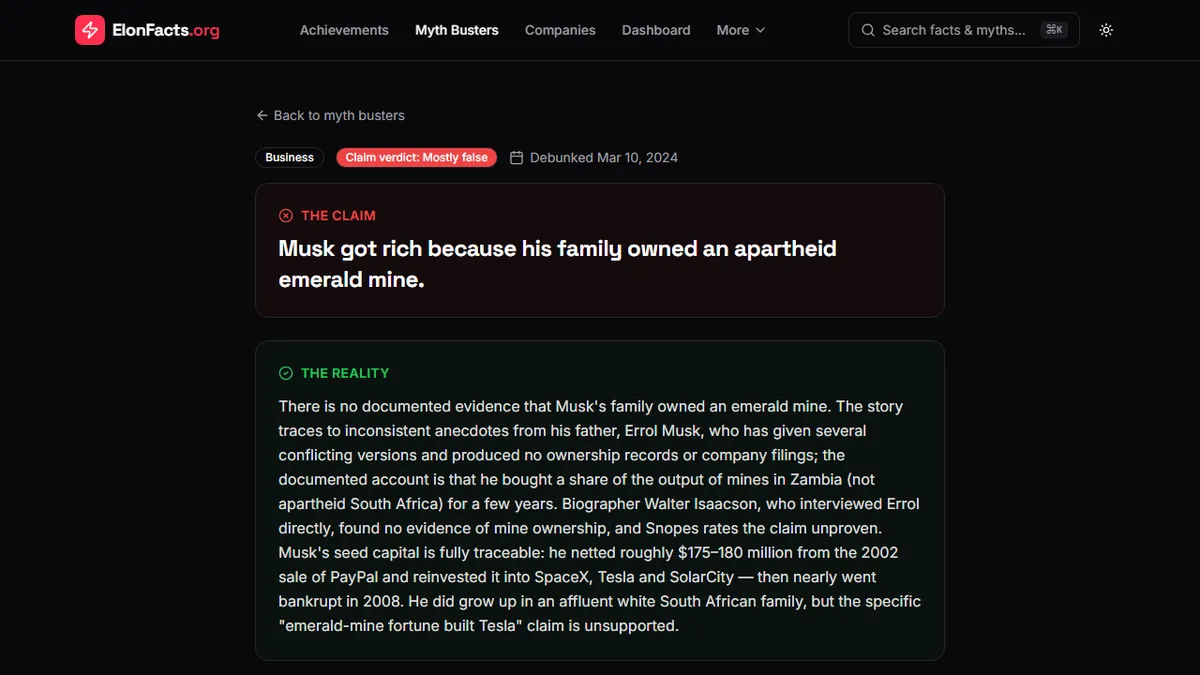
This claim circulates widely and is repeated as shorthand for the argument that Musk's success was funded by inherited wealth rather than earned capital.
The primary-source evidence does not support it. See the primary-source check on the emerald mine claim for the documented breakdown, but the short version is this: Musk's father, Errol Musk, did for a period hold a share in a Zambian emerald mine — this is documented and not disputed. Elon Musk has acknowledged the family was relatively comfortable during parts of his South African childhood. What is not supported is the claim that Musk received significant capital from that mine, that he inherited a fortune from it, or that it funded his ventures. His early companies were financed by a $28,000 student loan (used to help fund his first apartment-turned-office), a small amount of family support, and then the proceeds of his own first venture, Zip2.
The emerald mine is a real thing that became a false explanation for how Musk got rich.
Claim 2: SpaceX Runs on Taxpayer Money
The claim holds that SpaceX is essentially a government-funded operation and that its commercial reputation is therefore unearned.
The complete picture, as shown in how SpaceX revenue actually breaks down between NASA and commercial clients, is more complicated. SpaceX has received significant government contracts — the Commercial Resupply Services deal awarded in December 2008 was worth approximately $1.6 billion and arrived when the company was nearly bankrupt. The Crew Dragon commercial crew contracts, National Security Space Launch work, and the Artemis Human Landing System contract are collectively worth billions more.
Those contracts are real and have been important to SpaceX's development. But they exist alongside a large commercial revenue base: Starlink's estimated $11 billion in annual revenue comes almost entirely from consumer and business subscribers, not government. Commercial satellite launch contracts account for a substantial portion of Falcon 9's manifest. The US national security establishment uses SpaceX because it is operationally reliable and cost-competitive, not because of charity.
The accurate version of this claim is: SpaceX benefited critically from government contracts at key moments, and those contracts mattered. The inaccurate version is that it depends on government money and couldn't survive without it.
Claim 3: Tesla Never Innovated — EVs Already Existed
This argument holds that electric cars predated Tesla, and therefore Tesla's contribution was merely commercialising existing technology rather than innovating.
It is true that electric vehicles are not a Tesla invention. Battery-powered cars existed in the nineteenth century. GM's EV1 was leased in the mid-1990s. Nissan had an EV programme before Tesla reached the market.
What Tesla actually introduced was the first highway-legal production car to use a lithium-ion cell pack (the 2008 Roadster), the first to exceed 200 miles of range, mass-market over-the-air software updates treating the car as an updateable platform, a proprietary fast-charging network built at scale before demand required it, and a vertically integrated battery supply chain that drove cell costs down faster than the incumbent supply base was willing to move. The Model S won Motor Trend Car of the Year not because reviewers were being charitable about the powertrain but because the car was genuinely better than the petrol alternatives in its class.
Innovation is not synonymous with invention. Tesla did not invent the EV; it produced a set of engineering and commercial innovations that made the EV a mass-market product.
Claim 4: Musk Isn't a Real Engineer
This claim typically appears in two forms: that Musk exaggerates his technical involvement in his companies, or that his academic background (economics and physics, not engineering) disqualifies the "engineer" label.
The academic point is accurate. Musk holds degrees in economics and physics from the University of Pennsylvania, not an engineering credential. He did not design the Falcon 9 or the Merlin engine in the sense that those vehicles came off his drafting table.
What is documented is extensive and detailed technical involvement. SpaceX engineers who have worked with him describe Musk reviewing vehicle requirements specifications, challenging design decisions, and insisting on first-principles analysis of cost and mass. Tesla engineers have described his involvement in manufacturing process design, battery architecture decisions, and software features. His published comments on rocket propulsion, battery chemistry, and neural interface engineering reflect genuinely detailed technical knowledge rather than executive-level familiarity.
The most accurate framing is: Musk is not a credentialled engineer, but he functions as a technically engaged founder who participates substantively in engineering decisions rather than simply delegating them.
Claim 5: The 'Funding Secured' Tweet Was Fraud
In August 2018, Musk posted on Twitter that he was "considering taking Tesla private at $420" per share and that "funding secured." Tesla's stock rose sharply. Musk was subsequently sued by the SEC, and the case was eventually settled.
The characterisation of this episode as fraud in the sense of deliberate deception for personal financial gain is not what the evidence or the legal outcomes show. The SEC did not find that Musk fabricated the funding claim to manipulate the stock for personal enrichment. The settlement, in which Musk paid $20 million and agreed to have certain tweets reviewed by counsel, was predicated on the tweets being materially false and misleading — not on fraudulent intent of the kind associated with securities fraud prosecutions.
What the documented record shows is a CEO who posted market-moving statements without the due diligence and approval process that public company communications require. The funding discussions with Saudi Arabia's Public Investment Fund were real but not sufficiently advanced to support a "secured" characterisation. It was a significant governance failure, and the SEC treated it as one. Calling it fraud in the sense of deliberate criminal deception overstates what the evidence shows.
What This Exercise Teaches About Media Literacy
All five of these claims share a structural feature: each contains a grain of verifiable fact that has been stretched, simplified, or decontextualised until it supports a conclusion the underlying evidence does not. The emerald mine existed; it did not fund Musk's ventures. Government contracts mattered to SpaceX; they do not define its business model. The funding secured tweet was harmful; it was not criminal fraud.
The habit worth cultivating is the one that asks, before sharing or believing a claim: what is the primary source, and does it actually support the conclusion being drawn? In almost every case, the documented reality is more interesting and more instructive than the viral version.