The 2006 Secret Master Plan: Selling Expensive to Fund Cheap
In August 2006 Elon Musk published what he called the "Secret Master Plan" on Tesla's website. It was four sentences in substance: build a high-end sports car, use the profit to fund a more affordable sedan, use that profit to fund a mass-market car, and provide clean solar energy alongside the vehicles. It read more like a manifesto than a business plan.
What made it extraordinary was not its ambition (startups routinely claim they will disrupt established industries) but its sequential logic. Musk was not pretending Tesla could immediately build a $25,000 car. The company had neither the manufacturing scale nor the battery cost structure to do so profitably. Instead, the plan explicitly used each tier of the market to subsidise entry into the next, treating the wealthy early adopter not just as a customer but as a means of financing the technology that would eventually reach everyone.
Seventeen years later, that logic had produced the best-selling vehicle of any kind on Earth.
Roadster to Model S: Proving EVs Could Be Desirable
The original Roadster, delivered from 2008, was built on a Lotus Elise-derived chassis around a 53 kWh lithium-ion pack. Its headline figures (around 244 miles of range and a 0-to-60 time under four seconds) were not just impressive for an electric car; they were genuinely competitive with petrol sports cars costing similar amounts. About 2,450 were built and sold across more than 30 countries.
The Roadster's strategic purpose was to kill a specific piece of conventional wisdom: that electric vehicles were inherently slow, short-ranged, and unattractive. It accomplished that. The Model S followed in 2012 as a clean-sheet design, a full-size luxury sedan that won Motor Trend's Car of the Year in a unanimous vote and earned five-star NHTSA safety ratings across every category. It also introduced over-the-air software updates at scale, treating the car as a software platform in a way no legacy manufacturer had managed.
By 2015 Tesla had demonstrated that electric vehicles could be genuinely better than petrol alternatives in the segments where it competed. The question was whether the company could execute at a scale that mattered globally.
The Model 3 Gamble and Near-Catastrophe of 2018
The Model 3 was the fulfilment of the master plan's third step: a mass-market electric sedan priced at $35,000. When Musk unveiled it in March 2016, approximately 325,000 customers placed $1,000 reservations within the first week. The order book was extraordinary. The manufacturing reality that followed nearly destroyed the company.
Tesla's attempt to build Model 3s at Gigafactory Nevada using a fully automated assembly line (with robots handling steps that Musk later admitted should have been done by humans) produced a production bottleneck that persisted through most of 2017 and into 2018. The company was losing money on every car, burning cash at a pace that alarmed investors, and Musk publicly acknowledged in a 60 Minutes interview that he had been sleeping on the factory floor.
The crisis was real. Tesla's survival in 2018 depended on pushing production rates past the break-even point before cash ran out. It did, barely. The production hell narrative is not exaggerated; it was a genuine near-failure that the company resolved through a combination of engineering fixes, process changes, and sheer attrition.
Why the Model Y Design Was a Calculated Risk
The Model Y, revealed in March 2019 and delivered from 2020, shares roughly 75 percent of its components with the Model 3. That level of platform sharing was a deliberate decision with a specific rationale: manufacturing complexity and component proliferation were among the main reasons the Model 3 production ramp had nearly broken the company.
The Model Y is an SUV-crossover body on a Model 3 floorplan, which means the same battery packs, motors, suspension geometry, and software architecture underpin both vehicles. The investment in Model 3 tooling, supply chain relationships, and trained labour was reused rather than replaced. Tesla's Gigafactories in Berlin and Texas were also designed around the Model Y from the outset, incorporating lessons from the Nevada ramp about which steps in final assembly benefit from automation and which do not.
The form factor choice (a high-roof crossover rather than a sedan) was equally deliberate. Global buyer preferences had shifted decisively toward SUV-style vehicles across every major market. A sedan competing against the Model 3 made less sense than a crossover serving the segment where volume was growing fastest.
The Numbers Behind Global Best-Seller Status
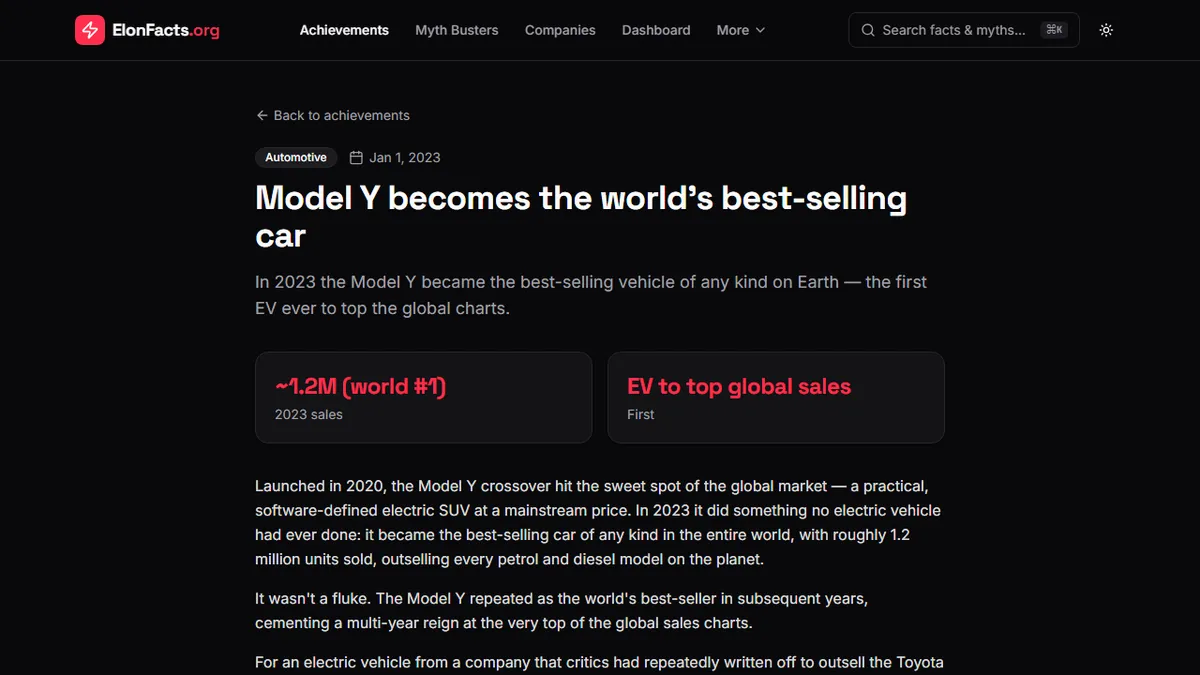
In 2023 the Model Y sold approximately 1.2 million units worldwide, making it the verified milestone when Model Y topped global sales charts, the first electric vehicle ever to hold the title of the world's best-selling car in a given year, across all powertrains. The Toyota Corolla and RAV4, perennial chart-toppers, finished behind it.
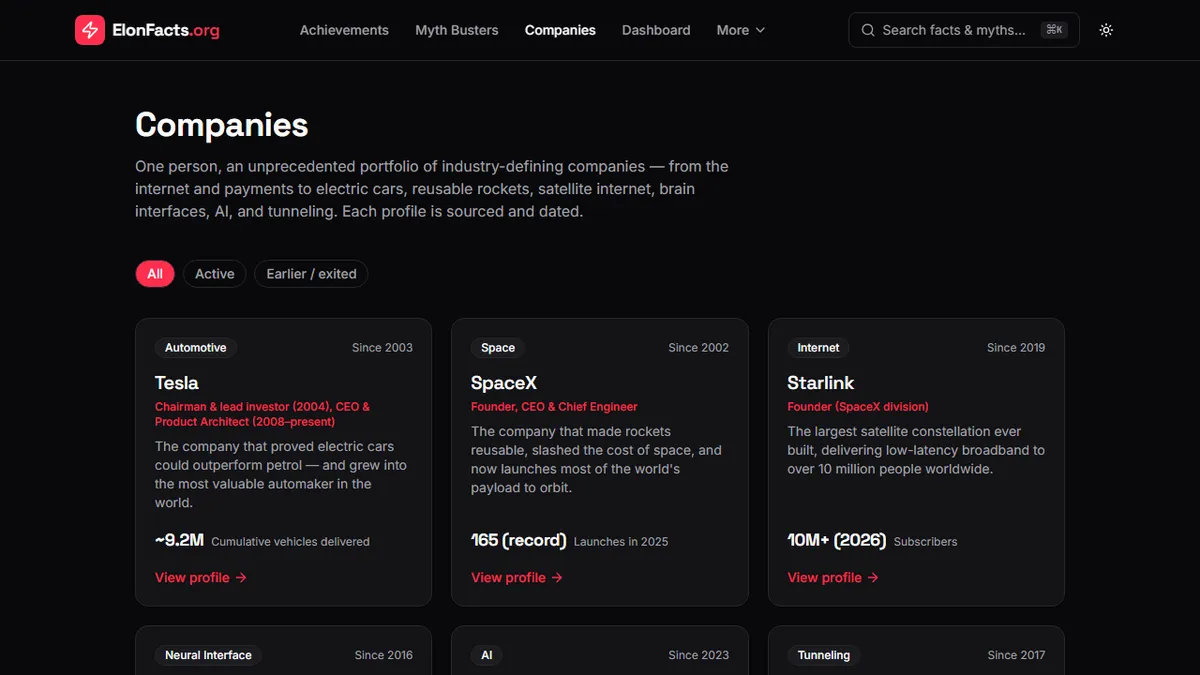
The Model Y repeated at the top of global sales rankings in subsequent years. Cumulative Tesla deliveries across all models reached approximately 9.2 million vehicles by the mid-2020s. In context: it took Toyota decades of continuous production and global distribution infrastructure to establish the Corolla's dominance. Tesla achieved comparable single-model volume in roughly three years of full-rate production.
Tesla also benefited from the strategic decision to build its own factories in key markets. The Shanghai Gigafactory, which opened in late 2019 and ramped to full capacity rapidly, made the Model Y price-competitive in the world's largest vehicle market. Without local production in China, the global sales figures would be substantially lower.
What Legacy Automakers Did — and Didn't — Learn
The established automotive industry watched Tesla's rise with a mixture of dismissal and alarm that shifted, in the 2020s, to something closer to acknowledgment paired with a delayed and uneven response. Volkswagen launched the ID.4, Ford launched the Mustang Mach-E, and General Motors committed to a fully electric portfolio by the mid-2030s. Every major automaker eventually announced large EV investment programmes.
What they did not do, at least not initially, was replicate the vertically integrated approach that gave Tesla its structural cost advantages: owning its own battery supply chain, building its own charging network, selling directly to consumers without dealer markups, and treating software as a first-class product shipped via regular updates. Most legacy manufacturers built EVs on existing dealer networks, with existing battery procurement relationships and existing software development timelines.
The Model Y's position at the top of the global sales charts is a product of the seventeen-year strategy Musk outlined in 2006, executed through near-bankruptcy in 2018, and validated by a manufacturing approach that learned from its own failures. The outcome was not inevitable; it required multiple near-death experiences to reach, but it was strategically coherent from the beginning.