Property listings in England and Wales carry a colour-coded EPC chart, and most people read it as a simple verdict: green means good, red means bad. The truth is more useful and more complicated. An EPC rating is a standardised estimate of a building's energy efficiency, not a measurement of how much energy anyone actually uses. It tells you about the fabric of the home. It does not tell you about the electricity grid that powers it, and that second half of the story matters more every year.
What an EPC rating actually measures
An Energy Performance Certificate rates a home on a scale from A to G. The rating is produced by an accredited assessor who visits the property and records its physical characteristics: wall type, roof insulation, floor area, windows, heating system, hot water cylinder, radiators, and any renewable generation such as solar panels. That information is fed into a calculation that estimates how much energy the building would need for space heating, hot water, and fixed lighting under a standard set of conditions.
The result is presented as two scores. The first is the energy efficiency rating, expressed in terms of estimated running cost. The second is the environmental impact rating, expressed in terms of estimated CO2 emissions. Both are normalised to a notional household, which is why a terraced house in Cornwall and a flat in Newcastle can be compared on the same scale.
The calculation is built on assumptions
The word "standard" is doing a lot of work. The EPC methodology assumes a fixed number of occupants, a standard heating pattern, and typical thermostat settings. It does not ask how many people live in the house or whether they are out at work all day. It does not account for the fact that one household keeps the heating at 16 degrees and another at 22. It does not reflect how much hot water a family of five uses compared with a single person.
This is not a flaw in the assessment process so much as a design choice. EPCs exist to give prospective buyers and renters a comparable measure of the building itself, not a prediction of their individual bills. But it means the rating is an upper-bound guide to comfort and cost, not a guarantee. Two identical homes occupied by different households can have very different energy bills while carrying the same EPC.
What an EPC leaves out
Because the certificate is based on a survey of the building, it cannot capture everything that affects energy use. Cavity wall insulation that was installed decades ago may have settled. Loft insulation may have been disturbed. A boiler that was serviced annually may still be running inefficiently. The EPC assessor works with what can be seen and what can reasonably be assumed, and the certificate itself records where assumptions were made.
It also leaves out the appliances. A home with an A-rated fridge, an induction hob, and an efficient washing machine will use less electricity than the same property filled with ten-year-old devices, but the EPC does not see any of it. Neither does it see how the occupants actually live. The biggest variable in household energy use is behaviour, and no certificate can measure that.
The missing half: local grid carbon intensity
The environmental impact rating on an EPC uses fixed emission factors for each fuel. For electricity, that factor represents a national average for the grid at the time the methodology was set. It does not change depending on whether the property is in a region powered largely by wind or largely by gas. It does not update hour by hour as the grid mix shifts.
This is where the EPC starts to mislead. The carbon a home actually causes depends not only on how much energy the building demands, but on how clean the electricity it draws from the grid is at the moment it draws it. That number is called grid carbon intensity, and in Great Britain it varies by region and by time of day. A heat pump in one region can be responsible for much less carbon than the same heat pump elsewhere, even if both homes have identical EPCs. The building's efficiency is one half of the story; the grid's cleanliness is the other.
Why the same rating can mean different emissions
Consider two homes with the same EPC band C. One sits in a region where the grid is running on a high share of renewables, the other in a region where a larger share of the electricity is coming from gas. Over a year, the second home will produce more carbon for every kilowatt-hour it uses, despite the identical certificate. The EPC cannot show this, because it was never designed to. It rates the building, not the system that supplies it.
This distinction is becoming more important as heating electrifies. Households installing heat pumps are shifting their energy use from gas to electricity, and the carbon benefit of that switch depends almost entirely on the grid. An EPC that uses a national average electricity factor cannot predict the real-world emissions of an all-electric home. It can tell you the home is efficient; it cannot tell you how clean the power is.
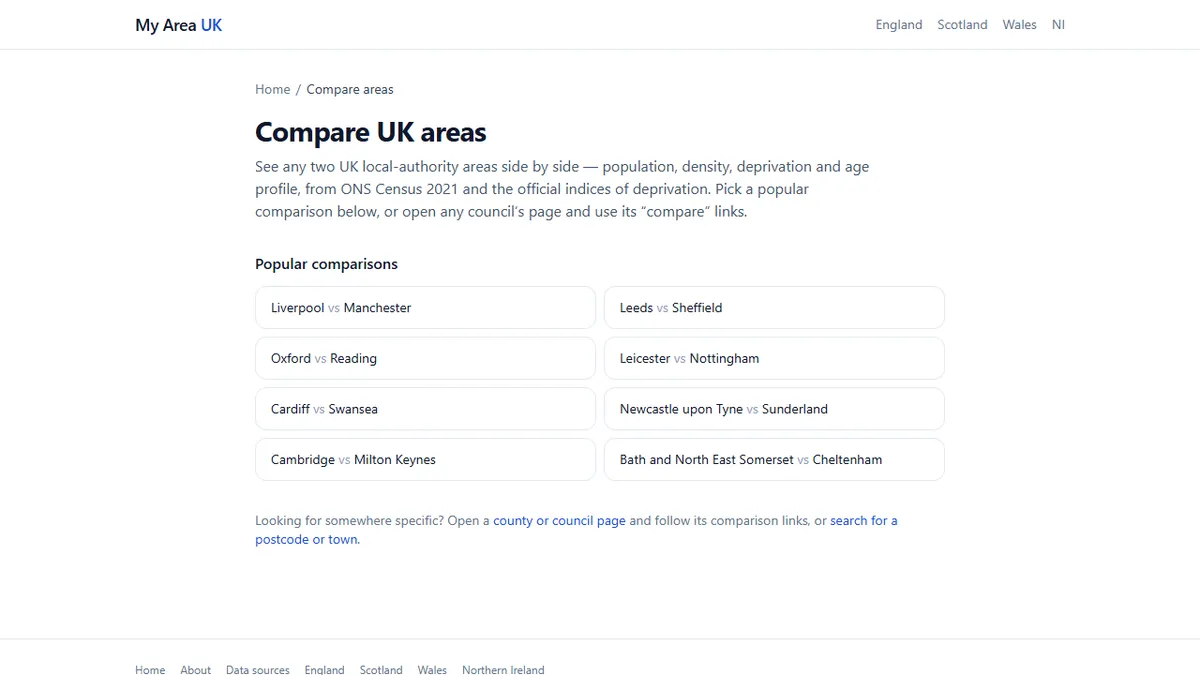
The good news is that this data exists and is now easy to find alongside EPC information. Official open data on grid carbon intensity is published by National Grid ESO, and property profiles that combine it with EPC records make the gap visible. You can see the two panels together by comparing local authorities side by side, which is a more honest way to compare homes than staring at a single letter.
How to use EPCs honestly
An EPC is still the best single number you will get on a property listing. It tells you whether the roof is insulated, whether the glazing is modern, and whether the heating system is likely to be cheap or expensive to run. For buyers and renters, it is a useful starting point. It is not a verdict on the home's environmental worth.
The honest reading combines the EPC with the local grid carbon intensity, because the same electricity demand has a different carbon cost in different places. It also means checking the actual fuel mix of the home: an all-electric property with a heat pump and solar panels is a different proposition from one heated by an old gas boiler, even if their EPCs are similar. And it means treating the certificate as a snapshot, not a lifetime warranty, because the age and condition of the systems matter as much as the sticker.
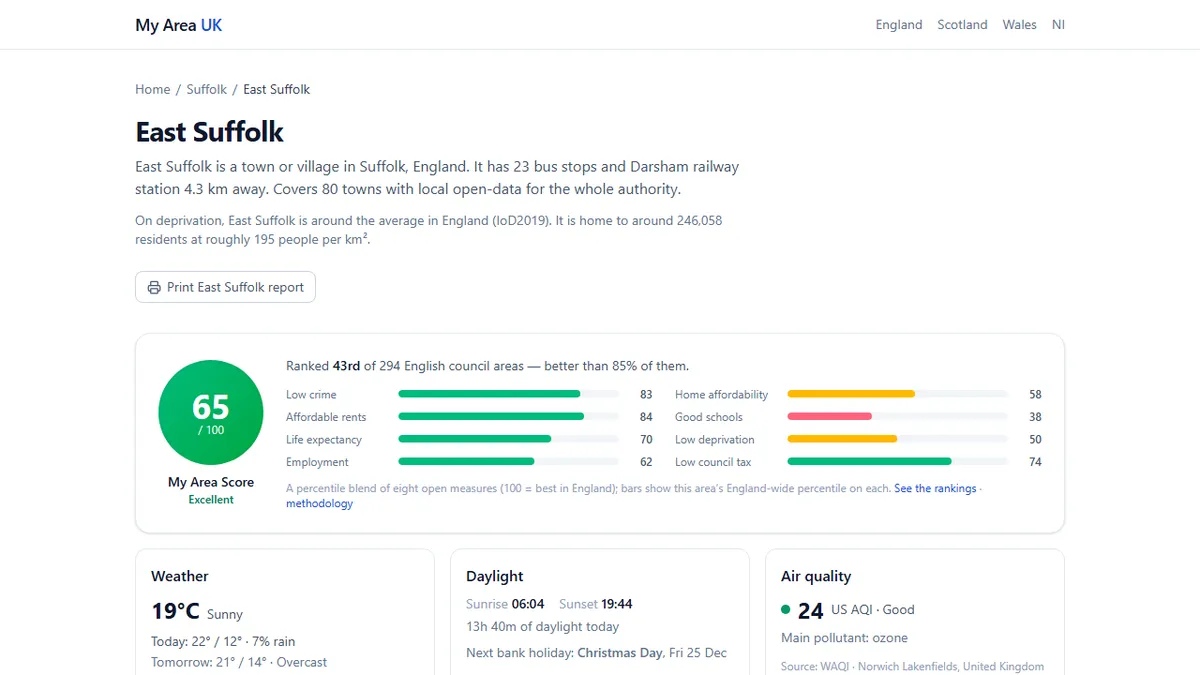
Data-driven profiles can pull these threads together. A council-level view such as East Suffolk's council profile, for example, shows how EPC data and local energy context sit alongside other official data for the area. The certificate stays on the listing. The context belongs somewhere wider.
EPC ratings were never designed to be the final word on a home's carbon footprint. They were designed to make energy efficiency visible, comparable, and actionable. Used alongside grid carbon intensity and a clear-eyed look at how the house is actually heated and lived in, they still do that job well. The mistake is to treat a green sticker as the whole story, when it is only the first page.