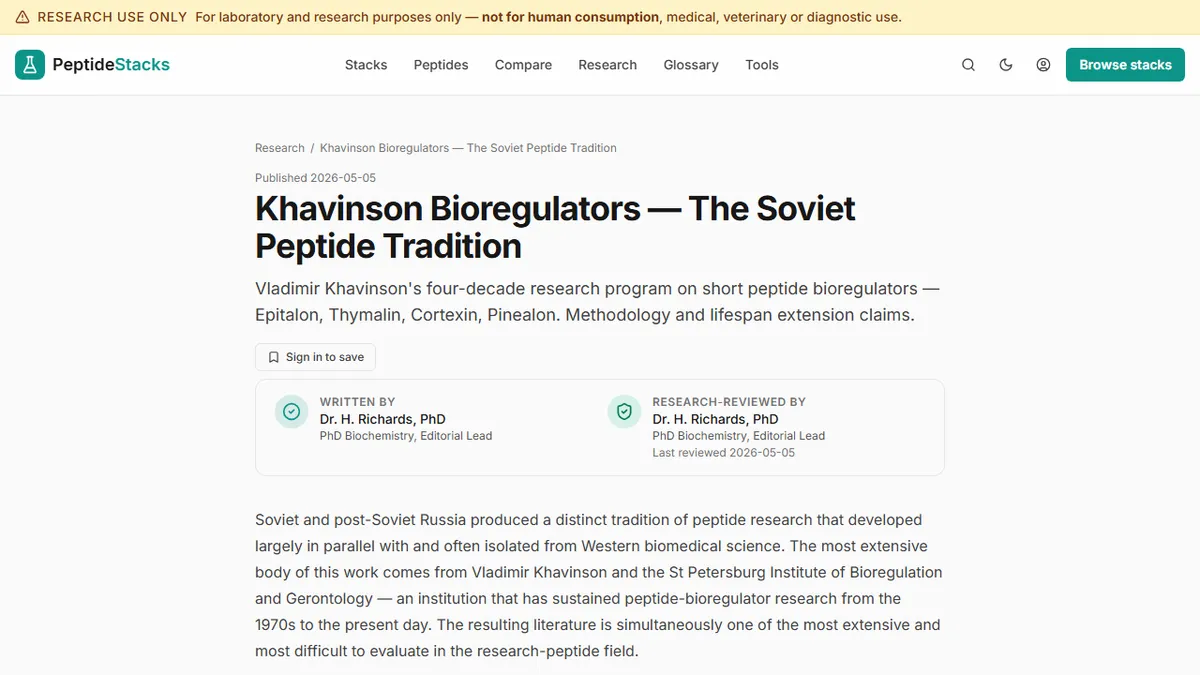
Vladimir Khavinson and the St Petersburg Institute of Bioregulation
The research tradition that produced Epitalon and Thymalin began not in a commercial pharmaceutical context but within the Soviet military-medical establishment. Vladimir Khavinson, a physician and gerontologist based at the St Petersburg Institute of Bioregulation and Gerontology, began systematic study of short peptide sequences derived from organ extracts in the 1970s and continued that programme through the dissolution of the Soviet Union and into the present century.
The institutional context matters for evaluating the evidence. Khavinson's laboratory operated with significant state backing during the Soviet period, conducted research with limited external peer review by Western standards, and published predominantly in Russian-language journals that remained inaccessible to most Western researchers until decades later. The translation gap meant that a substantial body of preclinical and clinical work accumulated in near-isolation from the mainstream academic literature.
When that work became more widely accessible in translation, particularly from the 1990s onward, Western researchers encountered a mature research programme with its own methodology, terminology, and interpretive framework. Understanding what that framework was designed to investigate is a prerequisite for reading the evidence critically. The documented history of Khavinson's bioregulator programme provides the institutional and intellectual context that makes the specific findings interpretable.
The Bioregulator Concept — Organ-Derived Peptides as Ageing Modulators
The bioregulator concept rests on a theory of tissue-specific molecular signalling. Khavinson and colleagues proposed that organs produce short peptide sequences (typically two to four amino acids) that function as endogenous regulators of cell differentiation, gene expression, and tissue maintenance. As an organism ages, the production of these peptide signals declines, contributing to the progressive dysfunction of the organs that generated them. The therapeutic hypothesis was that exogenous administration of these short sequences could partially restore the signalling environment associated with younger tissue.
This is a coherent mechanistic framework, and it is not without analogues in mainstream biology. The general principle that endogenous peptides regulate gene expression and cell differentiation is well established. What remains substantially underexplored is whether the specific short sequences Khavinson identified produce meaningful effects at the concentrations achievable through exogenous administration, and whether those effects translate across species and outside the specific experimental contexts in which they were originally studied.
Epitalon is a tetrapeptide (four amino acids: Ala-Glu-Asp-Gly) derived from the epithalamus of young calves. Thymalin is not a single defined peptide but a polypeptide complex derived from thymic tissue, containing the functional fractions of thymus extract with immunomodulatory activity. The two compounds represent different levels of chemical definition: Epitalon is a synthetic molecule with a fixed structure, while Thymalin is a more complex biological preparation with inherently greater batch-to-batch variability.
Epitalon: Telomerase Activation and the Fifteen-Year Korkushko Cohort Data
The most-cited finding in the Epitalon research literature concerns telomerase activity. Khavinson and colleagues reported that Epitalon induces the expression of telomerase in human foetal fibroblasts and in somatic cells where telomerase is normally suppressed in adults. In cell models, this resulted in elongation of telomere ends, a finding with obvious relevance to ageing research given the established relationship between telomere length and cellular senescence.
The clinical anchor of the Epitalon evidence base is a fifteen-year follow-up study conducted by Korkushko and colleagues on elderly patients treated with either Epitalon, Thymalin, or placebo over the study period. The investigators reported reduced mortality in treated groups and improved physiological markers of ageing across several organ systems. This study is frequently cited in informal discussions of Epitalon as evidence of clinically meaningful longevity effects.
Several important caveats apply. The study was not conducted as a pre-registered randomised controlled trial by contemporary standards; its methodology by current criteria would be described as a prospective cohort with treatment and control groups rather than a blinded RCT. The sample size was modest. The study was conducted by the same institutional group responsible for developing the compounds being tested, which is a standard concern in evaluating any proprietary research programme. And crucially, the finding has not been replicated by independent investigators outside the Khavinson research network.
Thymalin: T-Cell Maturation and the Immune Senescence Trials
Thymalin's proposed mechanism centres on the restoration of thymic function in aged subjects. The thymus, the organ responsible for T-cell maturation and education, undergoes progressive involution from young adulthood onward, a process that reduces the output of mature, antigen-naive T-cells and impairs the adaptive immune response to novel pathogens and malignant cells. Thymalin, as a thymic extract preparation, was hypothesised to partially replace or restore the thymic signalling environment lost to involution.
The clinical data from the Korkushko cohort study showed improvements in several immune parameters in Thymalin-treated elderly subjects, including increased proportions of mature T-cell subsets and improved responses to standard immune challenge. The immune senescence findings are among the more biologically plausible results in the bioregulator literature because the mechanistic framework (thymic extract supporting thymic function) is at least directly connected to the relevant biology.
The same replication limitations apply here as to Epitalon. The findings are from studies conducted within the Khavinson programme by investigators with institutional investment in positive results. Thymalin's complexity as a biological preparation introduces additional variability that makes cross-study comparison difficult even within the same research programme.
The Replicability Problem — Why Most Soviet Data Hasn't Been Independently Confirmed
The replicability gap in bioregulator research has several structural causes. First, the institutional isolation of the Soviet scientific system meant that independent replication by Western laboratories simply did not occur during the period when the primary data was being generated. By the time the data became accessible, the compounds had gained a substantial following in the longevity and biohacking communities, creating a commercial ecosystem that reduced the incentive for academically rigorous independent review.
Second, Thymalin's nature as a complex biological preparation makes exact replication difficult. Different batches may contain different proportions of active peptide fractions, making it impossible to be certain that a replication attempt used the same effective material as the original study. Epitalon, being a synthetic tetrapeptide with a defined sequence, does not have this problem, but independent telomerase studies using synthetic Epitalon are sparse.
Third, the regulatory environment for human studies with unapproved compounds has become substantially more restrictive since the period when much of the bioregulator clinical data was collected. Conducting a properly controlled trial to test Epitalon's longevity effects in a contemporary Western regulatory framework would require navigating the full clinical trial approval process, a substantial barrier that limits the academic appetite for such work.
What the Evidence Reasonably Supports vs What Is Extrapolation
An honest reading of the bioregulator evidence base supports the following conclusions. Epitalon activates telomerase expression in cell models and produces measurable effects on telomere-associated markers in preclinical studies. Mechanistic plausibility is established. The fifteen-year cohort data provides a suggestive signal that merits investigation with contemporary methodology, but it cannot be treated as proof of clinical efficacy by current evidentiary standards. Thymalin produces effects on immune markers in elderly subjects that are directionally consistent with its proposed mechanism, with the same caveats about study design and replication.
What the evidence does not support is the confident claim that either compound produces meaningful human longevity benefits at the doses and schedules described in informal online discussion. The gap between mechanistic plausibility and confirmed clinical efficacy is significant, and the bioregulator literature sits closer to the preliminary end of that spectrum than its enthusiastic reception in longevity communities sometimes suggests.