What a Natural Review Distribution Looks Like
When a business accumulates reviews organically over time, the resulting distribution follows a recognizable shape. Most customers who had a genuinely positive experience leave five stars. A smaller proportion leave four stars, satisfied but noting one or two minor issues. Three-star reviews are relatively rare in organic distributions because customers who feel neutral rarely take the time to write anything. Two-star reviews appear when expectations were clearly not met. One-star reviews represent the genuinely dissatisfied, the defrauded, or the simply furious (a real but contained minority).
The resulting distribution curves roughly like a ski slope or a reverse-J shape: heavily weighted toward the top, tapering off through the middle, and ending with a smaller peak at the bottom. The exact shape varies by industry and customer demographics, but the key characteristic is a continuous distribution without dramatic gaps. You see reviews spread across the full range.
This baseline matters because it gives you something to compare against. When a review distribution deviates significantly from this shape, that deviation itself is information. Not a smoking gun, but a reason to look harder.
The Bimodal Split and What It Statistically Implies
A bimodal distribution in reviews has two distinct peaks: one at five stars and one at one star, with a hollow middle. The three- and four-star ranges are dramatically underrepresented relative to what organic customer experience would produce. In extreme cases, you see something like 67 percent five-star reviews, 24 percent one-star reviews, and single-digit percentages across the entire 2-to-4 range combined.
What does this imply? The simplest explanation for the hollow middle is that the five-star peak is being inflated artificially. Paid or incentivized reviewers are depositing five-star scores but are not real customers. They do not have mixed experiences to report, so they produce only maximum scores. Meanwhile, genuine customers who have actually used the service leave their authentic ratings, which cluster at one star because the service does not meet advertised standards. The two populations are overlapping in the same database but having different experiences: the paid population has no real experience, and the authentic population is disappointed.
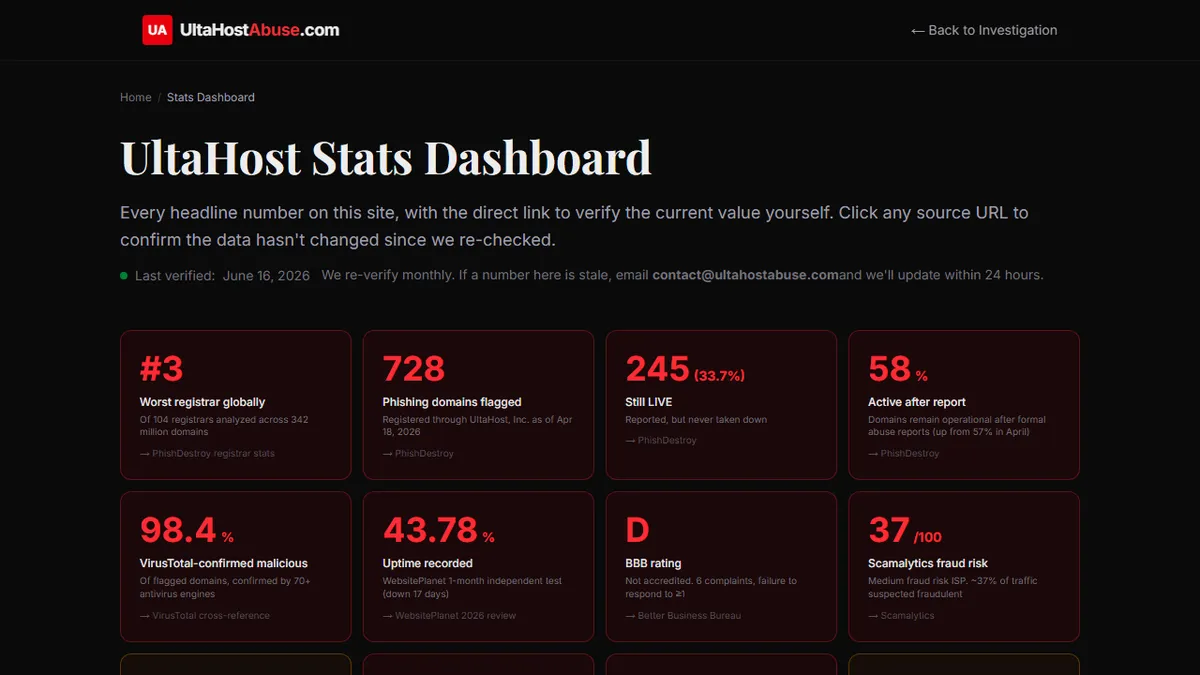
The live-verified statistics dashboard with source click-through shows exactly this pattern in documented form, with the source data available for independent verification.
Dual-Profile Strategies and How to Spot Them
A more sophisticated reputation management technique involves operating two distinct profiles on the same platform (for instance, one for a .com domain and one for a .io domain) and managing their reputations independently. This allows a provider to maintain a higher-scoring secondary profile that can be cited in marketing even as the primary profile accumulates negative reviews from dissatisfied customers.
When both profiles exist, the aggregate picture becomes clearer. Adding the review counts across both profiles can reveal a much larger base of negative organic reviews than either profile shows individually. It also reveals the ratio of total five-star to total one-star reviews across the full customer base, which may differ significantly from what either individual profile suggests.
Spotting dual profiles requires a simple search. Look for the company name combined with each of its domain extensions on the review platform. Check whether both profiles exist and whether they are being actively populated. If the content of the five-star reviews is generic and interchangeable across both profiles (praising "fast support" and "easy setup" in identical language), that uniformity is itself a signal.
How Platforms Like Trustpilot and Sitejabber Flag Compensation-for-Reviews
Major review platforms have developed detection systems specifically for incentivized reviews, and when triggered, they publish warning notices on the affected profile. These warnings are not proof of fraud. They indicate that the platform has detected patterns consistent with its compensation-for-reviews policy and is flagging them for transparency.
Trustpilot's warnings appear on profile pages when the platform detects review manipulation. Sitejabber has issued similar flags against providers where compensation-for-reviews patterns were identified. These warnings do not remove the flagged reviews, but they do alert readers that the platform itself has concerns about the review set's authenticity.
When evaluating a provider, check specifically for these platform-applied warning labels. They represent the judgment of the platform's own fraud detection systems — systems that have access to metadata about reviewer behavior, account age, posting frequency, and IP patterns that external readers cannot see. A warning label from the review platform itself is more reliable than any individual reviewer's claim.
Cross-Referencing BBB, G2, and Niche Review Sites to Get a Fuller Picture
Trustpilot and Google Reviews are the largest platforms, but they are also the most heavily targeted for manipulation because of their visibility. Smaller or more specialized review sites often provide a cleaner signal because they are harder to game cost-effectively.
The Better Business Bureau maintains complaint and review data that is structured around formal dispute resolution: complainants have to engage with the process, and the company's responses to complaints are published alongside them. A pattern of unresolved complaints, or responses that acknowledge problems without resolving them, is visible in the BBB record in a way that does not exist on open review platforms.
G2 and Capterra cater to business software buyers and typically require verified business accounts. The review quality is generally higher because the barrier to entry is greater. HostDean and HostAdvice aggregate hosting-specific feedback with verification requirements. Niche forums (particularly those frequented by technical buyers who would notice infrastructure problems) often contain more detailed and harder-to-fake assessments than any formal review platform.
Reading across all of these sources simultaneously produces a far more accurate picture than any single platform can provide.
A Checklist for Evaluating Any Hosting Provider's Review Authenticity
Before relying on a review set to make a purchasing decision, run through a short validation process. First, check the distribution shape. Is it continuous, or does it show a pronounced bimodal pattern with a hollow middle?
Second, search for multiple profiles on the same platform. Do .com and .io versions of the domain have separate profiles? What does the combined picture show?
Third, look for platform-applied warning labels. Has Trustpilot or Sitejabber flagged this profile for compensation-for-reviews concerns?
Fourth, read the content of the five-star reviews. Are they generic and interchangeable, or do they describe specific experiences with technical detail that a real customer would know?
Fifth, check the one-star reviews for patterns. Do they describe similar problems consistently (hidden fees appearing post-purchase, refund requests rejected, abuse reports ignored, cryptocurrency payments trapped) or are they scattered and unrelated?
Sixth, cross-reference BBB, G2, and hosting-specific platforms for independent signals. If the five-star Trustpilot presence is not reflected in other independent sources, that gap is information.
No single check is definitive. But taken together, this process takes fifteen minutes and can prevent a purchasing decision based entirely on a manufactured reputation that does not reflect how the provider actually treats customers.