How to Judge an Era: Depth, Competition, and Lasting Records
Every generation of boxing fans believes they are watching the greatest period the sport has ever produced. The fans of the 1970s were almost certainly right. But the question of which era produced the deepest talent, the most competitive matchups, and the most durable records is worth examining seriously rather than settling by sentiment.
Three criteria hold up under scrutiny. First, depth: not just how good the best fighter was, but how good the fifth-best and tenth-best fighters in a weight class were. A single transcendent champion in a shallow division is less impressive than a weight class where every contender could beat every other on any given night. Second, competitive quality: did the top fighters actually fight each other, or did politics and economics keep the best matchups from happening? Third, historical impact: did the era produce techniques, styles, or fighters whose influence is still visible in the sport today?
With those three standards, five eras stand out clearly from all the others.
No. 5: The Golden Age of the 1920s — Lightweight and Flyweight Excellence
The 1920s produced some of the deepest talent in boxing history at the lighter weight classes, and the period receives less credit than it deserves because the heavyweights of that era (with Jack Dempsey as its dominant figure) were the entertainment product. But below heavyweight, the depth was extraordinary.
Lightweights and flyweights of the 1920s fought prolifically, across multiple countries, in matchups that modern promoters would consider career-ending risks. A top lightweight might fight twelve times in a single year against opponents who could all reasonably be ranked in the top ten. The volume of competition alone produced a standard of technique and conditioning that the modern sport, with its twelve-fights-per-decade champions, struggles to replicate.
The era ranks fifth rather than higher because the record-keeping is inconsistent, the medical understanding of head injury was essentially nonexistent, and the weight class proliferation that might have rewarded the depth with cleaner historical records had not yet occurred.
No. 4: The Joe Louis Era — The Longest Heavyweight Reign Ever
Joe Louis held the world heavyweight championship for eleven years and eight months, from 1937 to 1949, and made 25 successful title defences. No heavyweight champion before or since has held the belt for that duration, and no one has come close to that number of defences in the modern era.
The quality of those defences varied (the Bum of the Month club was a genuine criticism and not simply contemporary snark) but the best opponents Louis faced were genuinely formidable. Billy Conn took him to the thirteenth round in their 1941 contest and was winning on points before a decision to trade punches rather than continue outboxing sealed his defeat. Jersey Joe Walcott knocked Louis down twice in their 1947 fight.
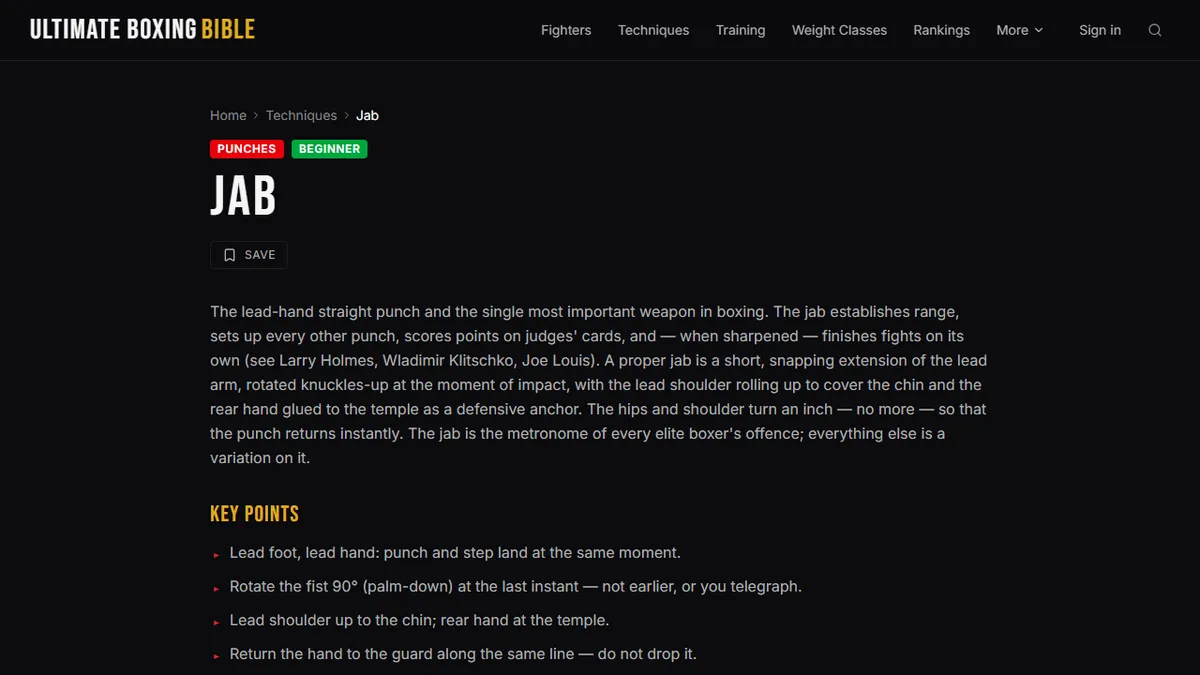
Louis's technical qualities were generational: a jab that combined accuracy with power in a combination rarely seen, a cross that was used as a finisher rather than a combination punch, and a patience in waiting for the precise moment to throw that made him exceptionally difficult to draw into wasteful exchanges.
No. 3: The Four Kings Decade — Leonard, Hagler, Hearns, Durán
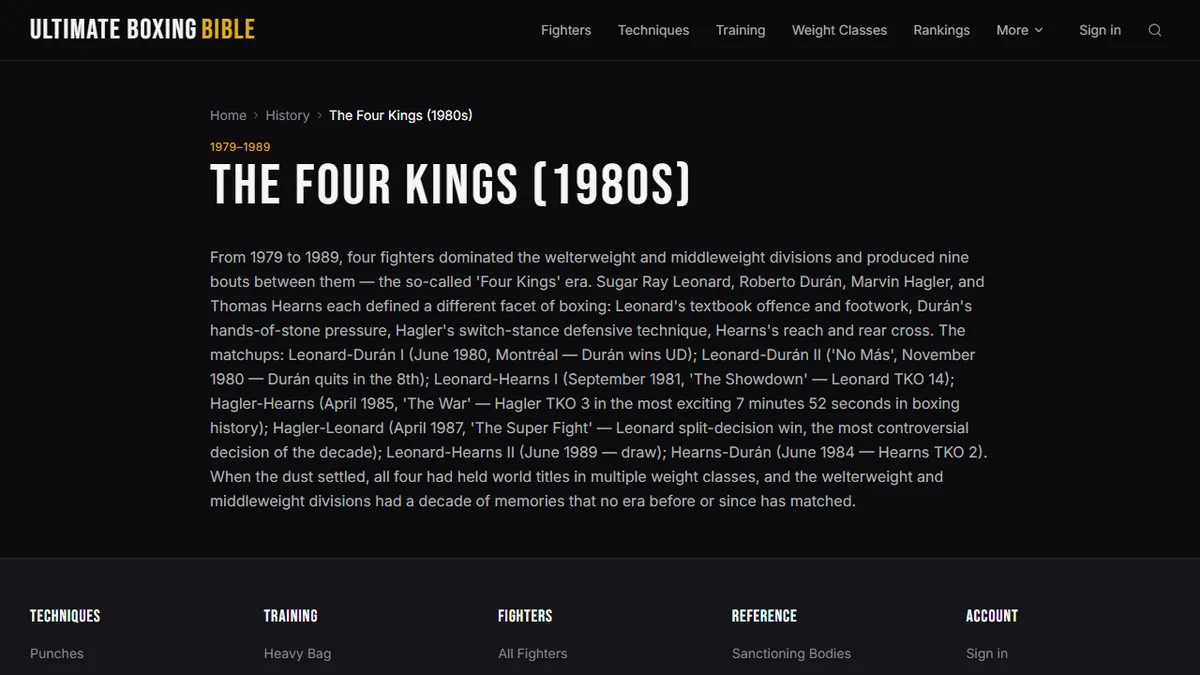
The period between 1980 and 1990 produced a weight class, primarily middleweight and super welterweight, so deep that four of the greatest fighters in history were simultaneously active, ranking in any order at any given moment, and actually willing to fight each other. This is the detail that separates the era from any nostalgic claim about other periods: the four kings fought each other.
Sugar Ray Leonard beat Durán twice. Leonard beat Hearns. Hagler beat Durán. Hagler fought Hearns in a three-round war that remains the most violent short fight in boxing history. Hagler fought Leonard in one of the most debated decisions ever recorded. The combinations of matchups were nearly exhausted. For a full account of that decade, the four-king middleweight decade that changed boxing documents how those rivalries shaped the sport's sense of what a golden era should look like.
The era ranks third rather than higher because the depth beyond those four names, while genuine, dropped off considerably. The supporting cast was good. The top four were legendary.
No. 2: The Four-Belt Undisputed Era (2017–Present)
The modern era divides boxing fans more sharply than any historical period, partly because we are living through it and cannot yet measure its full historical impact, and partly because the four-belt sanctioning system is genuinely confusing for casual fans. But the quality of competition at the top of multiple weight classes since 2017 is historically unusual.
Undisputed championships (a fighter holding all four major belts simultaneously) were theoretical achievements for most of the 2000s. Since 2017, they have become a realistic target at multiple weights, and the matchups required to achieve them have produced some of the best fights the sport has seen in decades. Oleksandr Usyk defeating Anthony Joshua twice, then Tyson Fury, to become the undisputed heavyweight champion is a level of sustained competitive excellence across multiple major fights that has no real precedent in the recent history of the weight class. Understanding how the four-belt undisputed system reshaped modern championship boxing is essential context for appreciating why the modern era is stronger than its critics allow.
No. 1: The Ali-Frazier-Foreman Heavyweight Trinity
No era in boxing history produced the combination of competitive depth, global cultural visibility, and technical excellence that the heavyweight division generated between roughly 1964 and 1978. Three of the greatest heavyweight fighters in history were simultaneously active, fighting at or near the peak of their powers, in matchups that commanded worldwide attention and produced outcomes that remain debated today.
Muhammad Ali fought Joe Frazier three times, losing once and winning twice, with the third fight (the Thrilla in Manila) widely considered among the most brutal championship bouts ever contested. Ali fought George Foreman in Kinshasa in 1974, employing a tactical approach so counterintuitive that his own trainer did not know the plan until it was already in progress. Frazier fought Foreman twice, losing the first time when Foreman knocked him down six times in two rounds.
The era ranks first not because of sentiment for a past decade but because of the specific coincidence of three historically elite fighters at the weight class that carries the sport's highest commercial and cultural profile, fighting each other more than once, at the peak of their careers. That combination has not been replicated since, and the chances of its recurrence depend on factors that extend well beyond the sport itself.
Why the Modern Era May Eventually Overtake Them All
The contemporary pound-for-pound conversation (which regularly features Naoya Inoue, Oleksandr Usyk, and Terence Crawford as its top three candidates) involves fighters of genuine historical quality. What separates them from overtaking the Ali era in this ranking is not the quality of their boxing but the fragmentation of the audience and the reluctance of the sanctioning body system to produce the specific matchups that would settle the era's legacy.
If Usyk, Crawford, and Inoue can each fight four or five more truly elite opponents before retiring, the historical case for the 2020s as a significant era will strengthen considerably. The talent is present. The competitive will, in at least some cases, appears genuine. The commercial structures remain the obstacle.