What Makes a Jab a Jab (Not a Reach)
The jab is the most thrown punch in boxing by a wide margin, and also the most frequently misunderstood. Beginners who have seen a few fights tend to describe it as a quick left hand thrown to keep the opponent at distance. That description captures the silhouette but misses the substance entirely.
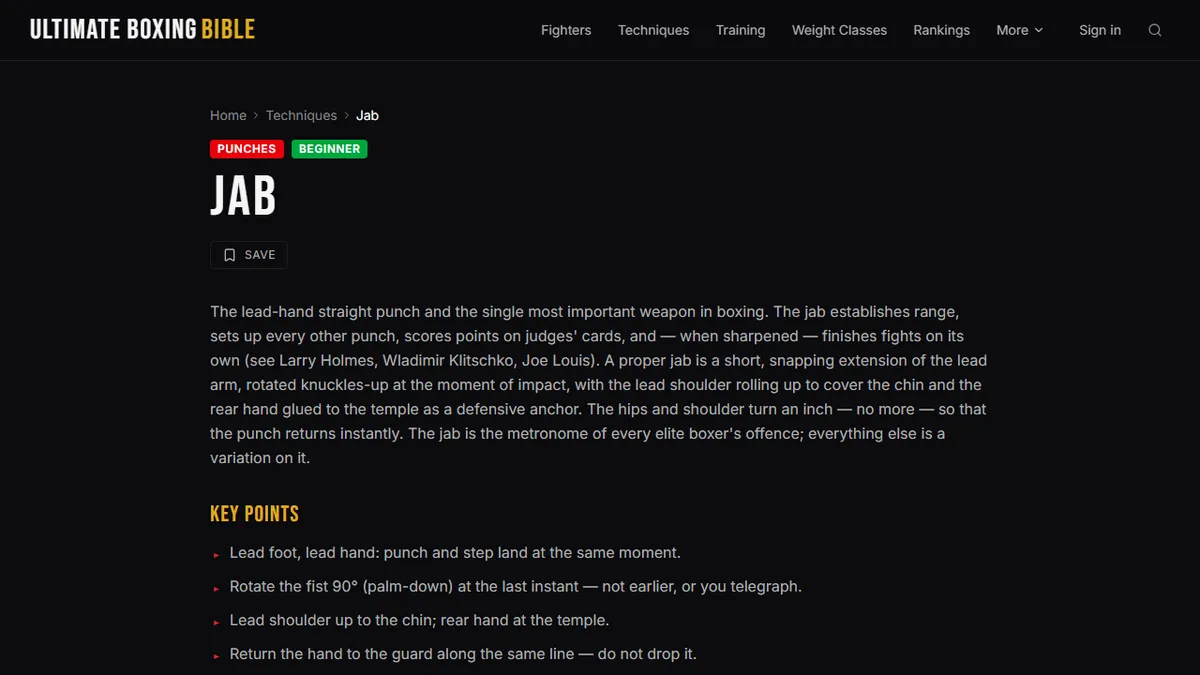
A proper jab is a controlled, linear punch that travels from the chin to the target along the shortest available path, rotates the lead shoulder through at impact, and returns along the same line before the rear hand or foot position has changed. Every element of that sentence carries weight. The rotation matters because it converts a push into a punch. The return matters because it closes the defensive gap before the opponent can respond. The straight path matters because a curved jab signals its arrival.
What most beginners throw is a reach, a hand extension that moves toward the target without the shoulder rotation, the hip engagement, or the correct weight distribution. It touches rather than hits. It occupies space but creates no consequence. A jab that imposes no consequence is a courtesy notice to the opponent that you are about to throw something more serious.
The Seven Mechanical Checkpoints of a Proper Jab
Coaches at elite gyms tend to check jab mechanics the same way every time. Has the lead foot advanced slightly to close the gap, or is the fighter reaching with the arm alone? Has the shoulder rotated forward to line up behind the fist at the moment of impact? Is the chin tucked behind the raised lead shoulder, or is it floating? Is the rear hand still at the temple, protecting the jaw? Is the torso slightly forward through the punch, not rocked back? Does the return travel straight back along the delivery path, not dropping? And are the eyes on the target throughout, not glancing away on impact?
All seven of these points are present simultaneously in a good jab from a trained fighter. It happens in under a third of a second, which is why breaking it into components is the only way to coach it. For a deeper look at how coaches sequence these checkpoints in training, the detailed jab mechanics and the drills elite coaches assign covers the full progression from foundational form to fight-speed application.
Why Most Beginners Throw the Jab Off the Back Foot
The single most common beginner error with the jab is throwing it while weight is on the rear foot. Watch a novice shadowbox and you will see it repeatedly: they step back slightly as they extend the lead hand, a subconscious effort to stay out of range while still reaching toward the target.
This is physically contradictory. A jab thrown off the back foot cannot generate meaningful force because the kinetic chain runs backward, from the shoulder to nothing, with no hip or leg involvement. Worse, stepping back while punching teaches the nervous system to retreat under pressure, which is exactly the habit that costs fights.
The correction involves understanding that the jab is a tool for entering range, not for maintaining distance. Weight transfers to the lead foot as the hand extends. The fighter moves forward into the punch. This feels exposed to every beginner because it feels like moving into danger rather than away from it. Elite fighters experience no such feeling because the technique itself creates the margin: the jab arrives before the opponent can respond.
Five Mistakes That Turn Your Jab Into a Telegraph
Every mistake in the jab boils down to early information. The opponent reads the punch before it lands and either moves, blocks, or counters. The five most common broadcasts are: dropping the hand below chin level before extending, rotating the shoulder before the hand moves, stepping before punching, closing the eyes at impact, and cocking the elbow outward on the wind-up.
Each of these creates a delay in the punch and a visible pre-motion that experienced fighters recognise immediately. A jab with a shoulder pre-rotation might arrive with more force than a clean one, but it will arrive into the space the opponent used to occupy. Against a counterpuncher, it will also arrive into a right hand traveling in the opposite direction.
The Jab as a Scoring Weapon on Judges' Scorecards
Knockdowns move scorecards dramatically. Jabs move them consistently. Across a twelve-round contest, a fighter who lands twelve accurate jabs per round and nothing else has thrown 144 scoring punches. Judges using the four standard criteria (effective aggression, clean punching, defence, and ring generalship) will score clean jabs as effective punching even when they do not visibly hurt the opponent.
Larry Holmes built a 48-fight unbeaten run primarily through jab volume and placement. His opponents often left the ring without a cut, without a knockdown, without a clear dramatic moment in any round, and lost decisively on every judge's card. The jab was the instrument. It did not need to be spectacular. It needed to land.
Drills to Build a Jab That Actually Matters
The first drill every serious coach assigns is the mirror. Not shadowboxing, just the jab, repeated fifty times in front of a mirror, checking all seven mechanical points after each repetition. Boring and highly effective. The second is the wall drill: stand with the lead fist six inches from a smooth surface and extend the jab until the knuckles brush the wall. Any deviation in the path shows immediately.
On the bag, the most productive jab drill is not throwing as many jabs as possible. It is standing at the correct range, throwing a single jab, and checking whether the bag swings before stepping in for the second. A jab that only brushes the bag surface from a reach position is wasted. A jab that drives the bag backward before the combination follows has done its job.
Partner work adds the dimension that solo drills cannot: a moving target. A coach with a focus mitt held at head height, moving laterally, teaches the fighter to close distance and adjust angle simultaneously. No bag replicates this because no bag moves with intention.
The jab is described as simple because its mechanism is straightforward. It is trained for years because the execution under pressure, at speed, against resistance, against a fighter trying to take it away — that is where the complexity lives.