The Core Logic of the Philly Shell: The Shoulder as the First Line of Defence
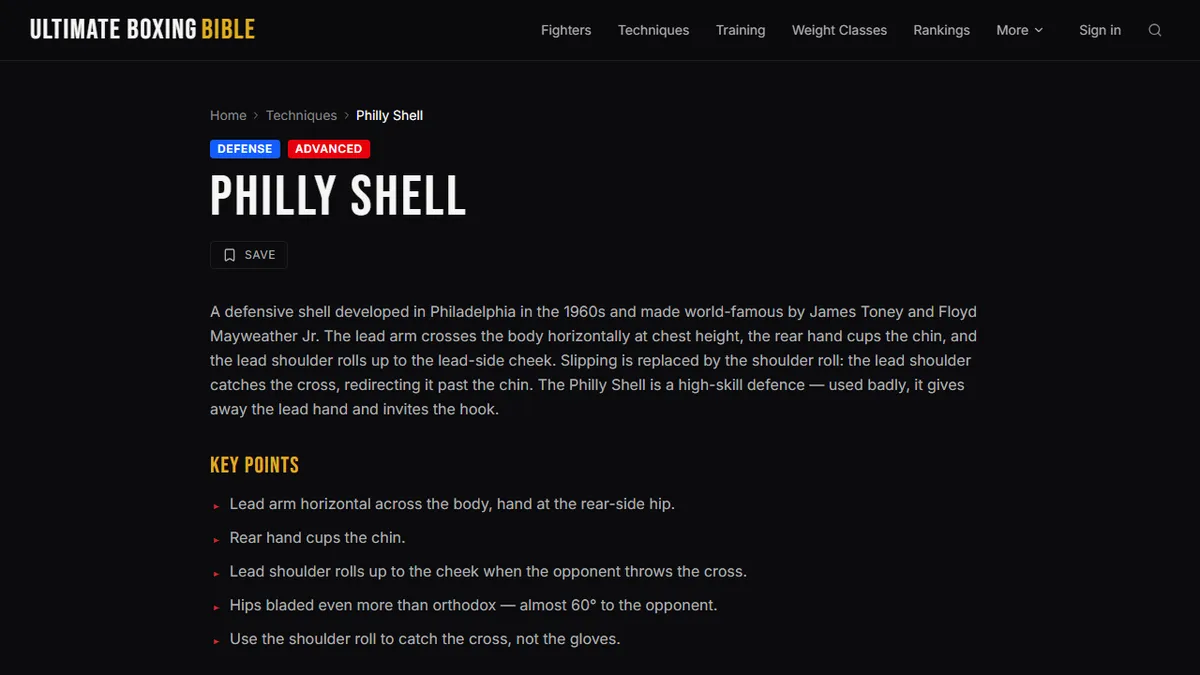
The Philly Shell is built on a single counterintuitive premise: if you position your lead shoulder correctly, you do not need your hands to block most punches. The guard drops the lead hand low across the body, raises the rear hand to chin height, and turns the torso to present the lead shoulder directly toward the opponent. Punches thrown at the head deflect off that shoulder. Body shots are absorbed by the lead forearm. The whole system operates at an angle that makes straight punches land on a curved surface rather than a flat target.
What makes this configuration powerful is not the defence itself but what it enables. A fighter in the Philly Shell can see the entire opponent over the lowered lead hand. The rear hand at chin height is already loaded in its throwing position. Every incoming punch that slides off the shoulder puts the opponent slightly off-balance and slightly forward, and at that precise moment, the counter right hand or check hook becomes available. To understand the full mechanics of the shoulder-roll guard position is to understand that the system is primarily an offensive tool dressed as a defensive one.
It was developed in Philadelphia gyms during the 1960s and 1970s, refined by fighters like Joe Frazier's rivals who needed systems to deal with pressure. Floyd Mayweather brought it to a global audience by using it at the highest level for two decades without ever being seriously hurt.
The Core Logic of Peek-a-Boo: Constant Head Movement and Explosive Entry
Where the Philly Shell works at range, the peek-a-boo is a system designed to close distance rapidly and work from inside. The guard sits with both gloves high in front of the face (some variation of fists near the temples or forehead) while the fighter's head moves laterally and down constantly between punches. The movement is the defence. A stationary head in the peek-a-boo offers almost no protection; a moving head is almost impossible to hit cleanly.
The system demands forward pressure. A peek-a-boo fighter who backs up is exposing themselves to jabs they cannot see and straight shots they cannot deflect with movement alone. The whole architecture of the style assumes the fighter is moving into the opponent, slipping outside the opponent's lead shoulder, and firing short hooks and uppercuts from angles the opponent was not prepared to defend.
Cus D'Amato did not invent the guard position (elements of it appear in fighters much earlier) but he systematised it and, crucially, matched it to a physical prototype that made it work at the highest level. To appreciate peek-a-boo technique breakdown and its Cus D'Amato origins is to see how deliberately the system was designed around specific body types and specific fight scenarios.
Physical Attributes: Height, Reach, and Footspeed Matchups
These two systems solve different physical problems. The Philly Shell is a system for a fighter with reach advantage or at minimum reach parity, a fighter who can operate from the outside without being crowded. The shoulder roll works because punches travel a significant distance before they arrive, giving the defending fighter time to read the trajectory and angle the shoulder correctly. At inside range, where punches are short and angles are tight, the shoulder roll is far less reliable.
The peek-a-boo is explicitly designed for fighters with a reach disadvantage. A shorter heavyweight or a compact welterweight who tries to box from the outside against a taller opponent will get jabbed repeatedly. The solution is not to out-jab the longer fighter; it is to close the range entirely, where reach becomes irrelevant and compact power becomes decisive. Head movement covers the gap between the fighters' ranges while the attack builds.
Footspeed plays into both systems but in different ways. Philly Shell requires lateral movement and the ability to reangle after a shoulder deflection. Peek-a-boo requires explosive forward bursts and the ability to circle out after a combination, which demands agility over sustained lateral pace.
Who the Philly Shell Suits (and Why Mayweather Was an Ideal Fit)
The Philly Shell rewards patience. A fighter who wants to counter, who is comfortable in the middle rounds watching an opponent tire and make mistakes, who has fast hands rather than heavy hands: this is the physical and temperamental profile for whom the Philly Shell produces optimal results.
Mayweather was almost a laboratory specimen for the system. His hand speed at pulling counters was elite. His reach was sufficient to operate at outside range. His patience was extreme: he was willing to lose rounds early in fights while reading opponents, then dismantle them from the middle rounds onward. The shoulder roll allowed him to take almost nothing clean while generating counter opportunities with nearly every exchange.
Fighters without that patience and hand speed often end up looking evasive rather than elusive in the Philly Shell, which looks nearly identical from the outside but produces completely different results on the scorecards.
Who Peek-a-Boo Suits (and Why Tyson Was an Ideal Fit)
Tyson in his early career was the extreme version of the physical blueprint the peek-a-boo was built for: a compact build, a neck and shoulder mass that absorbed incoming contact, explosive hip rotation that generated power in short spaces, and a fighter's temperament that preferred pressure and engagement over patience and distance management.
The system rewarded every one of Tyson's natural attributes and compensated for his relative disadvantages, primarily his modest reach compared to most heavyweights. His head movement under the peek-a-boo was so fast in the late 1980s that many opponents struggled to land flush punches even when they had a clear positional advantage. His first-round finishes in that period were the product of a system applied with near-perfect technical execution, not random.
Fighters who are physically similar but lack Tyson's explosive first step, or who are more comfortable on the outside, generally find the system frustrating because it requires constant forward commitment that feels unnatural when range is available.
Can You Blend Both? What Coaches Actually Say
Most experienced coaches will tell you that mixing systems at the beginner level is a reliable path to having no system at all. A hybrid guard that is neither the Philly Shell nor the peek-a-boo tends to offer the weaknesses of both without the strengths of either. The Philly Shell offers no protection when the shoulder is not correctly angled. Peek-a-boo requires the head to be moving. A fighter who vaguely does both and does neither deliberately will get hit.
That said, elements of both systems do appear in elite fighters. Canelo Álvarez uses the double-shoulder roll (a Philly Shell variant) but also employs the lateral slips and tight guard associated with the inside game. What distinguishes his use from a confused hybrid is that he has fully mastered both tools and makes clear deliberate choices about which one applies in each range and position.
Choosing Your System at the Beginner Stage
If you are new to the sport and working with a coach, the decision is largely made for you: a good trainer will look at your build, your instincts, and your early movement patterns and guide you toward the system that fits. If you are self-guided, the simplest heuristic is reach and body type.
If you are tall relative to most people at your weight, with longer arms, the Philly Shell's outside countering game aligns with what your physical tools already want to do. If you are short and compact, with a tendency to naturally move inside, the peek-a-boo gives you a framework that converts your natural instincts into a structured system.
Either way, learn one system thoroughly before experimenting with elements of the other. The fighters who benefit from blending spent years mastering the foundational version first.