On this page
Why Casualty Figures Diverge So Dramatically Between Parties
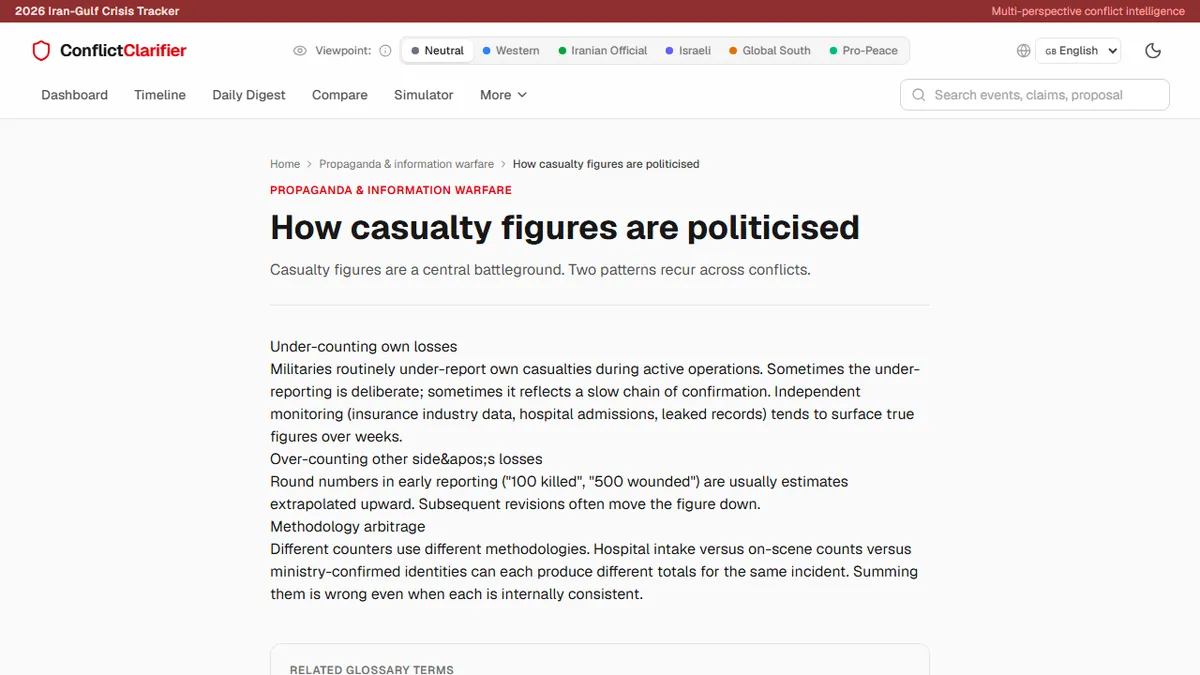
When a military operation ends and the first casualty figures emerge, the numbers reported by different parties can differ by a factor of two, five, or more. This divergence is not primarily a consequence of poor counting. It is a consequence of different counting methodologies, different incentive structures, and in many cases deliberate strategic choices about what figures to release and when.
Governments counting casualties from strikes they have conducted have strong incentives to undercount civilian deaths and reframe combatant deaths in ways that minimise political damage. Governments and factions reporting casualties from strikes conducted against them have strong incentives to maximise the numbers, particularly when they are attempting to generate international condemnation or humanitarian pressure. Neither party's figure is necessarily fabricated (each may reflect a genuinely different methodology applied in good faith), but the divergence is structural and predictable.
Understanding how warring parties manipulate death toll reporting requires looking beyond intent to the mechanical choices that shape what each party counts.
The Spectrum from Reported Figure to Verified Count
The distance between a reported figure and a verified count is the most important analytical gap in conflict casualty coverage, and it is almost never explained in headlines.
A reported figure is a number stated by one actor: a ministry of health, a military spokesperson, a faction official. The figure carries the credibility of the source and nothing more. It is the starting point of verification, not the output. A partially verified figure is one where a second independent source has confirmed some portion of the count, perhaps the deaths at one location, or the broad magnitude if not the precise number. A verified figure is one where independent monitors, drawing on hospital records, structured datasets, imagery analysis, and witness accounts from multiple non-affiliated sources, have confirmed a count within a stated margin of error.
The key word throughout is independent. Two news organisations citing the same government press release are one source, not two. Two humanitarian organisations whose monitoring relies on the same local partner are one source, not two. True independence requires structurally separate access channels.
How Governments Under-Count, Over-Count, and Selectively Count
The specific mechanisms of casualty politicisation are worth naming precisely. Governments conducting airstrikes typically count only confirmed combatant deaths when announcing strike results, either excluding civilians entirely or classifying individuals of fighting age as presumed combatants. This practice inflates apparent precision while formally remaining within bounds that can be defended if challenged.
The inverse occurs when reporting casualties from strikes received. Totals expand to include the injured alongside the dead, or to include infrastructure workers and officials as civilian deaths in ways that serve a maximalist framing. Neither move requires lying. Both require selective application of definitions.
Selective release timing is equally common. Governments delay confirming casualty figures from incidents that generated significant civilian harm until the news cycle has moved on, while rapidly publicising figures from operations that appear clean. Auditing the temporal pattern of casualty announcements (which events generate immediate, detailed figures and which generate slow, partial ones) is itself an analytical method.
What ACLED, Airwars, and UN Monitors Actually Measure
Independent casualty monitors exist precisely because interested-party figures are structurally unreliable. They apply explicit methodologies, publish those methodologies, and acknowledge their limitations in ways that distinguish them from official announcements.
ACLED (the Armed Conflict Location and Event Data project) records political violence and protest events globally using a structured data model. Its casualty figures reflect confirmed-death counts from event records that have been reviewed against multiple source types. ACLED is explicit about what it counts and what it excludes, making its figures comparable across time and geography.
Airwars specialises in civilian harm from air operations, applying a case-by-case methodology that classifies individual incidents on a confidence spectrum from confirmed to unconfirmed. For each incident Airwars tracks, its researchers document the sources used, the civilian death range, and the confidence level. This generates a record that can be interrogated rather than simply accepted.
UN monitoring bodies draw on different access channels, including field staff and partner organisations, and apply their own confidence thresholds. Their figures are often higher than military announcements and lower than opposition claims — not because they split the difference politically, but because independent field access generates a different evidence base.
The 'Human Shield' Framing and How It Affects Civilian Counts
The "human shield" framing deserves specific attention because it is one of the most consequential mechanisms for making civilian deaths disappear from official counts. When a strike kills civilians in proximity to a military target, the party conducting the strike may assert that the civilians were present because enemy combatants positioned themselves among the civilian population — a tactic that is itself a war crime, but whose invocation is used to transfer moral and legal responsibility for the deaths from the striking party to the party allegedly using shields.
The framing is sometimes accurate. It is also deployed strategically in cases where evidence for intentional civilian positioning is absent. Independent monitors do not accept the human-shield claim as sufficient to reclassify a civilian death as a combatant death; they require evidence of the specific positioning that is alleged. Official announcements rarely provide such evidence, which is why the gap between official figures and independent monitor figures tends to be largest in cases where this framing is applied.
Five Questions to Ask Before Sharing Any Casualty Figure
Before amplifying a casualty figure through any channel, five questions form a reliable pre-sharing checklist. First: who counted this, and what is their relationship to the parties in the conflict? Second: what methodology did they apply, and is it publicly available? Third: does the figure represent confirmed deaths, reported deaths, or a projection? Fourth: has any independent monitor corroborated it, using a structurally separate evidence base? Fifth: was this figure released at a time when it serves a clear strategic communication purpose?
The side-by-side framing of a casualty report across perspectives shows how the same underlying death toll gets packaged differently depending on who is writing the story, a useful practical demonstration of how these questions apply to real coverage.
The Corrections Process When Figures Turn Out to Be Wrong
Initial casualty figures in fast-moving conflict situations are frequently revised — sometimes downward, sometimes upward — as better information becomes available. The corrections process is where institutional credibility is built or lost.
Reputable independent monitors publish revision histories that show how a figure changed and what evidence drove the change. Wire services issue corrections that appear in subsequent dispatches. Many official sources do not correct at all, or issue corrections quietly without any formal acknowledgment that the original figure was wrong.
Readers who follow conflicts through only the initial reports accumulate a mental model built on unrevised figures. The most systematically well-informed readers are those who check back — specifically looking for revision notes and corrections on stories they initially encountered days or weeks earlier.