What an Occupancy Rate Actually Measures
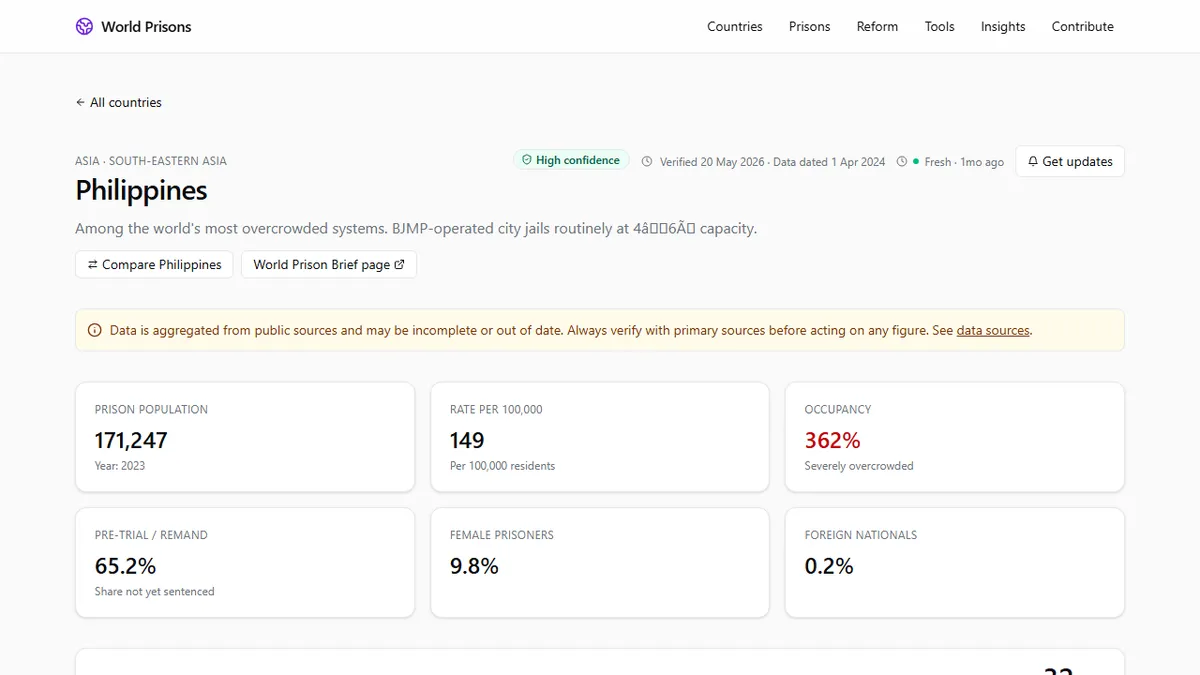
The number that appears beside a prison's name in comparative datasets, expressed as a percentage of capacity, is deceptively simple. An occupancy rate of 100% means the facility holds exactly the number of people it was designed to accommodate. An occupancy rate of 200% means twice that number. At 362%, as recorded for the Philippine jail system, the arithmetic implies something that photographs confirm: people sleeping in shifts, bodies covering every horizontal surface, sanitation designed for a fraction of the population it must serve.
What those percentages measure, however, depends entirely on which definition of capacity the reporting country uses. That definitional question is where prison data becomes genuinely complicated, and where international comparisons can mislead unless the reader understands what sits beneath the figure.
Design Capacity, Operational Capacity, and Certified Normal Accommodation
Three distinct capacity concepts appear in prison statistics, and they are not interchangeable. Design capacity refers to the number of prisoners a facility was architecturally intended to hold when originally constructed. It is the figure that appears on blueprint specifications and is the most straightforward to establish, but it may reflect decades-old space standards that bear little relation to what modern health guidance recommends.
Operational capacity is typically set by prison management and reflects what administrators believe the facility can practically run without immediate breakdown. It is a more elastic concept that can expand under political pressure. In overcrowded systems, operational capacity tends to drift upward to absorb population growth rather than function as a genuine constraint.
Certified normal accommodation, used primarily by England and Wales, is perhaps the most conservative measure: the number of prisoners a facility can hold while still meeting minimum standards for sleeping space, sanitation access, and basic amenity. A prison at 105% of certified normal accommodation may sound marginally overcrowded. In practice, that surplus is distributed unevenly, meaning some wings operate well beyond threshold while others remain under it.
When countries report occupancy figures using different underlying definitions, direct comparisons become hazardous. A headline number of 120% in one jurisdiction may reflect worse real-world conditions than 150% in another, depending on which baseline each country applied.
Where Overcrowding Is Most Severe
The countries that top global overcrowding rankings are not always those with the largest prison populations by number. The severity of crowding is a ratio, not a volume, and some smaller countries produce the most extreme figures.
Philippines prison occupancy data reaching 362 percent places it at the far end of any comparative table. With 171,247 people incarcerated against a system designed for a fraction of that number, jails in Manila and the broader archipelago face structural problems that go beyond infrastructure. The Manila City Jail Male Dormitory holds nearly 9,800 people in a facility with a listed capacity of 1,000. These are not administrative inconveniences. They are acute humanitarian conditions.
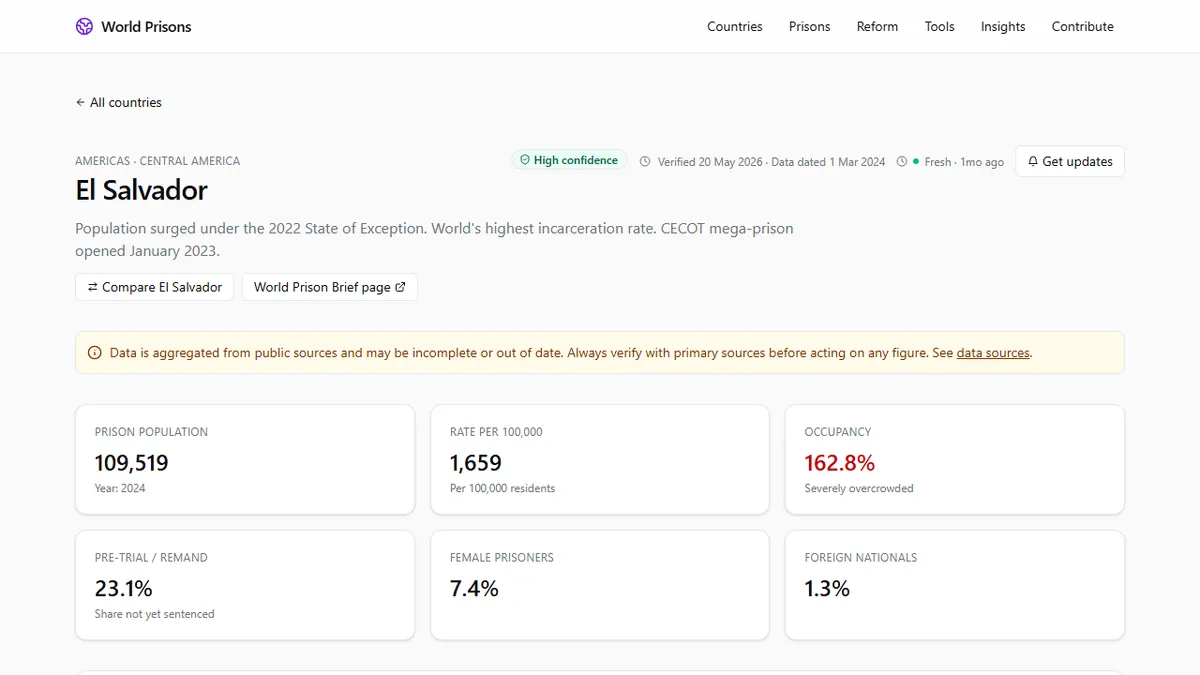
Indonesia's overcrowding figures at 185 percent capacity tell a related story in Southeast Asia's most populous country. With 276,136 people incarcerated, the pressure on facility space mirrors patterns seen in Brazil, where 909,067 prisoners fill a system running at 136% of certified accommodation. Egypt operates at 207% of official capacity. El Salvador, despite its enormous CECOT facility, records an occupancy rate of 163% nationally, partly because most of its population surge preceded the megaprison's construction.
Why Some Nations Report No Occupancy Figure at All
Roughly a quarter of countries in major comparative databases carry no occupancy figure beside their prison population numbers. The reasons vary and matter. Some countries have never conducted a systematic audit of their prison estate's capacity; they know how many people are incarcerated but have no reliable figure against which to measure crowding.
Others actively resist publishing capacity data, because the ratio that would result would be diplomatically embarrassing or legally consequential. A government that acknowledges 250% occupancy is simultaneously acknowledging a legal liability under its own constitutional standards and under international instruments it has signed. Silence is not a neutral administrative posture in those cases.
A third group includes conflict-affected or institutionally fragile states where data collection of any kind has collapsed. South Sudan, Somalia, and several sub-Saharan nations have missing figures not because their governments are concealing data but because the administrative capacity to generate it does not exist. That absence of data corresponds almost universally with the absence of oversight mechanisms, which compounds the risk for people held inside.
How Overcrowding Intersects With Disease, Violence, and Reoffending
The consequences of operating well above designed capacity are not confined to discomfort. Infectious disease transmission accelerates sharply in overcrowded conditions. Tuberculosis, which thrives in enclosed spaces with inadequate ventilation, is dramatically more prevalent in highly overcrowded facilities than in those near or below capacity. During the COVID-19 pandemic, prison systems already operating at extreme occupancy suffered mortality rates that reflected their inability to isolate cases or maintain physical distancing.
Violence follows a similar pattern. Facilities with insufficient space for programming, exercise, and meaningful separation between rival groups generate more conflict. Staff-to-prisoner ratios that might be manageable at designed capacity become dangerously thin when headcounts double or triple. Oversight reports from El Salvador's La Esperanza facility, holding 33,000 people in a space designed for 5,200, document conditions that make any meaningful rehabilitation or educational programming operationally impossible.
The recidivism connection is less direct but traceable. Prisoners who serve time in severely overcrowded facilities with no access to programming, health services, or meaningful work have worse outcomes on release. The factors that reduce reoffending (stable mental health care, vocational training, maintained family contact) are the first casualties when a system is running at triple capacity.
What Reform Advocates Say Needs to Change
Advocates working on prison conditions point to two distinct problems: the measurement problem and the political problem. On measurement, a coordinated international standard for what capacity means, one adopted and reported consistently by national governments, would substantially improve comparative analysis. The absence of such a standard is not accidental; it suits governments that prefer their figures to look better than underlying conditions warrant.
On the political side, the more difficult challenge is that prison population growth in many jurisdictions is driven by policy choices (mandatory minimum sentences, drug law enforcement priorities, pretrial detention practices) that generate demand for bed space faster than any construction programme can match. Building more prisons does not resolve an occupancy crisis when the intake rate consistently outpaces additions to the estate. Reform advocates argue that the only durable solution to overcrowding is reducing the number of people sent to prison, or the length of time they spend there, through upstream policy change rather than downstream infrastructure investment.
The figure at the top of a country's entry in any prison database is a number. What it represents is a set of policy choices and their human consequences — and understanding the arithmetic is the first step toward interpreting what those consequences are.