From Gang-State to Prison-State: The Numbers Behind El Salvador's Transformation
In 2015, El Salvador had the highest homicide rate on earth. By 2023, it was reporting some of the lowest murder figures in Latin American history. The instrument of that change, as presented by the government of Nayib Bukele, was mass incarceration on a scale that has no contemporary parallel among nominally democratic states.
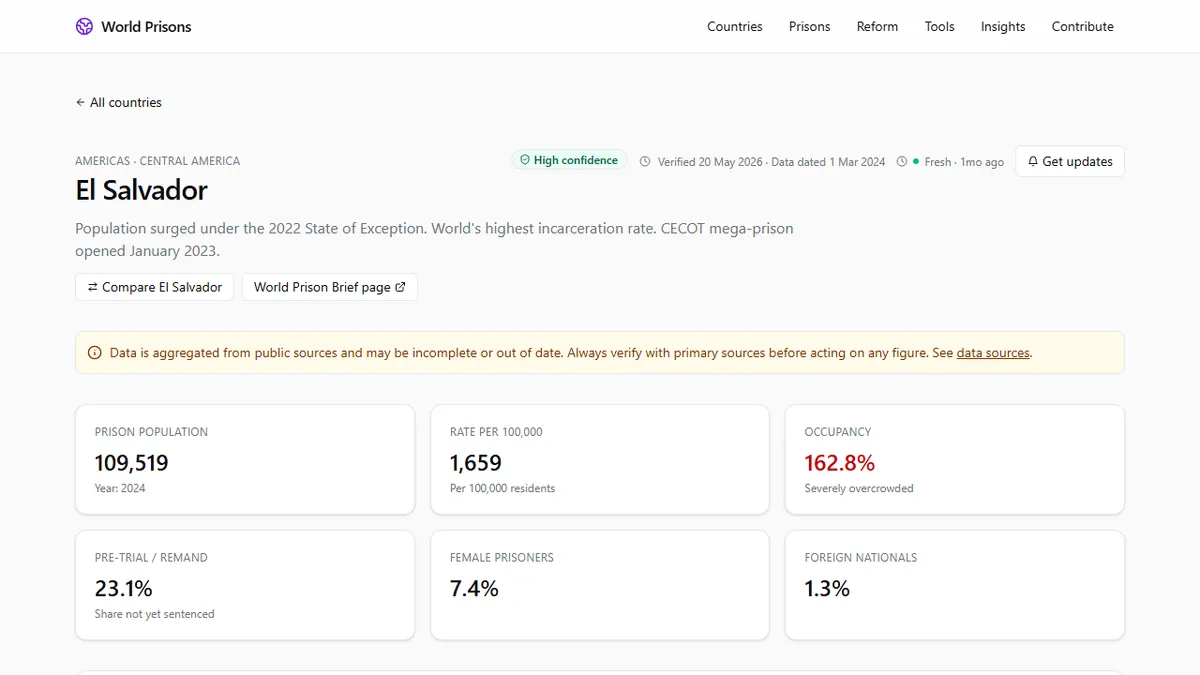
El Salvador's incarceration rate of 1,659 per 100,000 people is not a typo or a data anomaly. It reflects 109,519 people held in a country of roughly 6.5 million. The United States, long considered the world's leading incarcerator, holds prisoners at 542 per 100,000. Panama, at 527, was previously among the highest in the western hemisphere. El Salvador's figure dwarfs both, and it was achieved within roughly two years.
Sitting at the centre of this transformation is a facility unlike anything previously constructed: the Centro de Confinamiento del Terrorismo, known by its acronym CECOT, and built to hold 40,000 people simultaneously.
What CECOT Is and How It Was Built So Quickly
CECOT was constructed in Tecoluca, in the San Vicente department, on a site chosen partly for its remoteness. The government announced the project in January 2023 and opened it two months later — a construction timeline that would be unusual for a medium-sized office building, let alone a maximum-security detention facility for tens of thousands of people.
The facility is organised into eight large dormitory structures, each subdivided into cells designed to hold around 200 people. The cells are bare concrete. There are no windows to the outside. Each structure is overseen from elevated guard posts, and the perimeter is layered with concertina wire and watchtowers. The aesthetic is deliberately austere — and the government has leaned into that deliberately, releasing aerial footage and images of uniformed guards overseeing hundreds of shirtless detainees as a communication strategy aimed at domestic audiences.
At the time of the most recent available figures, CECOT held approximately 14,500 people, well below its stated 40,000-person design capacity. The broader Salvadoran prison system, including La Esperanza, which holds around 33,000 in a facility built for 5,200, runs at 163% occupancy nationally. CECOT's design capacity was always as much a political statement as an operational plan.
Life Inside: Conditions, Legal Access, and Due-Process Concerns
Independent access to CECOT has been tightly restricted. Journalists who have reported from inside have done so on government-supervised visits, limiting the verifiability of what can be observed. Human rights organisations that have attempted independent monitoring have been denied entry.
What is documented from oversight reports, legal proceedings, and the accounts of detainees who have subsequently been released is concerning. Detainees report no access to natural light, extremely limited outdoor time, insufficient food, and near-complete isolation from legal counsel. Family visits have been severely restricted or suspended. Communication with the outside world is functionally nonexistent for many detainees.
The legal access problem is not incidental. It is a structural feature of the emergency legal framework under which most CECOT detainees were arrested.
The State of Exception: The Legal Architecture That Filled the Facility
The state of exception declared in March 2022, following a particularly violent weekend in which gang members killed more than 80 civilians, suspended several constitutional protections that would otherwise govern arrests and detention. Under normal Salvadoran constitutional procedure, detained individuals must be brought before a judge within 72 hours, have the right to legal representation from the moment of arrest, and cannot be held incommunicado.
The legal framework behind El Salvador's state of exception extended the permissible pre-charge detention period to 15 days, restricted the right to legal counsel during initial interrogation, and allowed courts to process cases through expedited group hearings. The state of exception was originally declared for 30 days. It has been renewed by the National Assembly every month since — effectively becoming a permanent feature of the legal landscape.
Under this framework, arrest without individual probable cause became operationally routine. Police and military units conducting sweeps in communities associated with gang presence detained people based on physical appearance, tattoos, and the testimony of informants with no obligation of disclosure. Human rights groups have documented thousands of cases in which individuals with no verifiable gang affiliation were swept up and transferred to the prison system, including CECOT.
International Reactions and Human-Rights Critiques
The international response to El Salvador's model has split sharply along predictable lines. The Bukele government has positioned CECOT as an exportable solution, and officials from several Latin American and Caribbean governments have visited to assess its replicability. Some have moved toward similar emergency-measure frameworks in their own countries.
Human rights bodies have taken a markedly different view. The Inter-American Commission on Human Rights has issued precautionary measures for multiple detainees, citing risks to life and physical integrity. The UN Special Rapporteur on Torture has called for independent access to detention facilities and raised concerns about conditions that may amount to cruel, inhuman, or degrading treatment under international law.
The criticism focuses on three distinct problems: the conditions themselves, the process by which people were detained, and the near-impossibility of challenging detention through normal legal channels when those channels have been partially suspended by the emergency framework.
What the Data Says About Whether Mass Incarceration Reduces Crime Long-Term
El Salvador's homicide figures during the state of exception have been strikingly low. The government's position is that incapacitating gang members wholesale produced the reduction, and it cites those numbers as vindication of the approach.
The criminological literature on mass incarceration as a crime-reduction strategy offers a more complicated picture. Short-term incapacitation effects (reducing crime by removing people who commit it from the community) are real but bounded. They tend to be most pronounced in the immediate term, because they disrupt organisational capacity before replacement and reorganisation occurs. Gangs that have been operating for decades, as MS-13 and Barrio 18 have in El Salvador, have demonstrated precisely that adaptive capacity elsewhere in the region.
The longer-term risks are structural. Concentrating gang members in close confinement historically strengthens organisational cohesion rather than fragmenting it. US state prison systems provide the most extensive longitudinal evidence: facilities where gang members were held together produced more structured, more violent, and more nationally organised criminal enterprises after their members were released than existed before mass incarceration began. Whether CECOT represents a genuine break from that pattern, or whether it has simply delayed its expression, is a question that the data cannot yet answer, though the trajectory of El Salvador's criminal justice experiment will eventually make it legible.