What the Nordic Model Is Not
The photographs have done enormous work, most of it misleading. Images of Halden prison in Norway, with its landscaped grounds, timber-clad buildings, recording studio, and art workshop, circulate constantly in discussions of prison reform, usually as a rhetorical counterpoint to overcrowded conditions elsewhere. The implicit argument is visual: if prisons could look like this, outcomes would be better.
The problem with that framing is that it locates the explanation for Scandinavian recidivism rates in aesthetics rather than policy. The wooden cabins are not why Norway's reoffending figures are low. They are a downstream expression of a philosophy whose operative mechanisms lie elsewhere: in sentencing norms, post-release support structures, welfare state integration, and a cultural and institutional consensus about what imprisonment is for. Strip out the policy infrastructure and replace it with nicer buildings elsewhere, and nothing fundamental changes.
Understanding what the Nordic model actually is requires distinguishing between its visible features, which are easy to photograph, and its structural features, which are harder to communicate but do the actual work.
Core Principles: Normality, Progression, and Dynamic Security
Three concepts sit at the heart of the Scandinavian approach to imprisonment: normality, progression, and dynamic security.
The normality principle holds that life inside a prison should resemble life outside it as closely as possible given the constraint of physical confinement. This is not a comfort argument. It is a reintegration argument. People who have maintained normal daily rhythms, work habits, cooking skills, financial literacy, and social relationships during imprisonment are substantially less likely to struggle with the transition to release. The idea of making prison a genuine rupture from normal life (sensory deprivation, rigid uniformity, elimination of personal agency) is understood in the Nordic framework as actively counterproductive to the goal of not reoffending.
The progression principle structures sentences so that prisoners move through decreasing security levels as they demonstrate readiness. A Norwegian prisoner serving a substantial sentence might begin in a closed facility, move to an open institution, progress to a work release arrangement, and transition to community supervision before formal release. Each stage builds the skills and relationships needed for the next. This is operationally very different from serving an entire sentence in one institution and then walking out with no supervised transition period.
Dynamic security refers to a model of control that relies on staff relationships with prisoners rather than physical barriers and surveillance. Officers in high-functioning Nordic facilities spend significant time engaged with prisoners in activities, not monitoring them from a distance. The relationship is understood as the security mechanism. A well-functioning officer-prisoner relationship produces information about tension, risk, and need that camera systems cannot replicate.
Norway by the Numbers
Norway's prison population and occupancy statistics reflect a system that has maintained unusual discipline in containing its incarcerated population. With 3,097 people imprisoned at a rate of 55 per 100,000, Norway's numbers are among the lowest in Europe and far below the US rate of 542. The occupancy rate is 83%, meaning the system has more space than it currently uses, which is itself a product of intentional planning rather than luck.
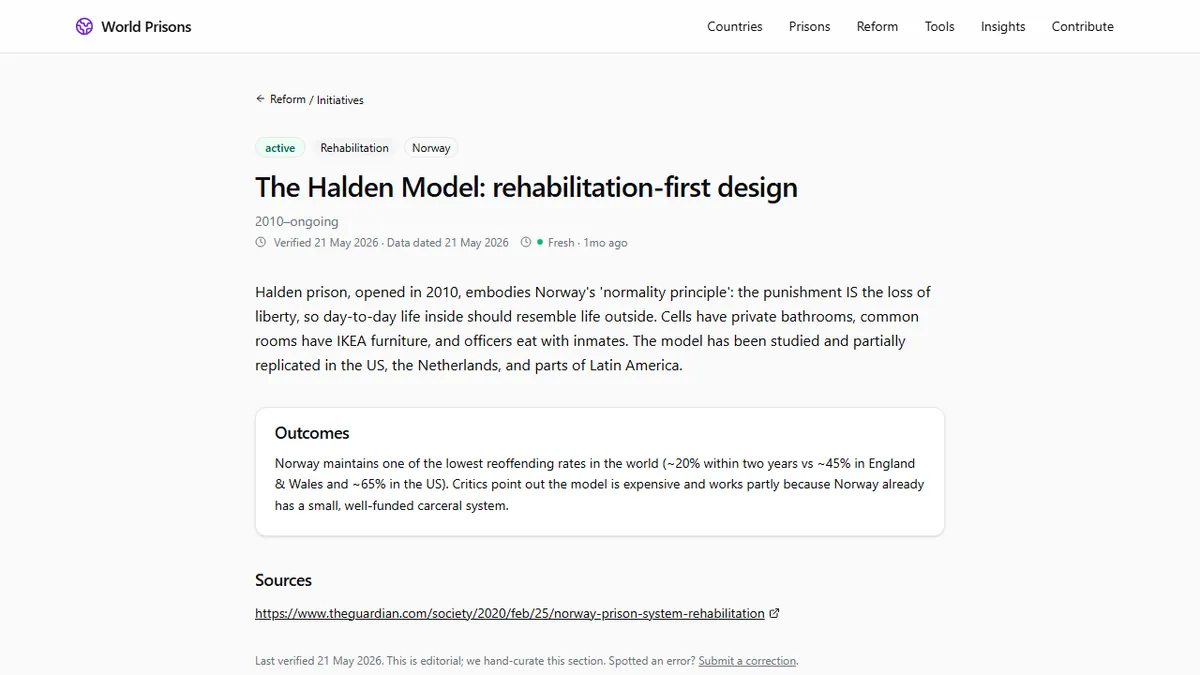
Norway's two-year reoffending rate (the proportion of released prisoners who receive a new conviction within two years) hovers around 20%. The equivalent figure for the United States is typically cited at around 44% within one year, reaching higher over longer follow-up windows. That gap is not explained by initial offence severity, as Norwegian prisons do hold people convicted of serious violent crimes, including murder.
What is explained by the follow-up support systems that begin before release and continue afterward. Housing assistance, employment placement, healthcare continuity, and social benefit access are coordinated to activate before a person walks out rather than after they have failed to navigate those systems independently.
The Halden Model in Practice — and What Other Facilities Look Like
The Halden rehabilitation model documented by World Prisons represents the high end of Norwegian prison provision. Halden opened in 2010 and was specifically designed to implement the normality principle at a physical level, with single-occupancy rooms rather than cells, cooking facilities on each residential wing, and significant programme space. It is real, not a thought experiment, and the outcomes data from Halden supports the philosophy behind its design.
But Halden is not representative of all Norwegian prisons, and the Norwegian prison reform community would be the first to say so. Older facilities in the estate operate under more constrained conditions. The model is an aspiration applied unevenly, not a uniform standard. What is more uniform is the staffing approach, the sentence progression structure, and the post-release support framework — the elements that are invisible in photographs but do the functional work.
Costs, Funding, and the Political Conditions That Sustain the Approach
The per-prisoner cost in Norway is substantially higher than in most comparable systems. Estimates vary by methodology, but figures in the range of 90,000 USD annually per prisoner have been widely cited, compared to roughly 35,000 to 45,000 USD in the United States. Critics use this gap as an argument against export. Advocates respond that recidivism costs money too (each reoffending cycle involves police response, prosecution, court time, and another period of imprisonment) and that the total cost across a person's lifetime of engagement with the criminal justice system may be lower under the Nordic approach than under a cheaper-per-day model with worse outcomes.
The more substantive obstacle is political. The Nordic approach depends on a societal consensus that the purpose of imprisonment is reintegration rather than punishment or incapacitation. That consensus is not held uniformly in countries where criminal justice policy is organised around retributive principles, where victims' rights advocates have sustained political influence over sentencing norms, or where the political economy of corrections is structured by private providers with financial incentives to maintain population levels.
Can Any Element Be Adopted Elsewhere?
Finland and Denmark offer evidence that the Nordic approach is not purely contingent on Norwegian specifics. Finland reduced its prison population dramatically over several decades through deliberate policy reform (from over 180 per 100,000 in the 1970s to 60 per 100,000 today), using mechanisms that drew on similar principles without being identical to Norway's approach. Denmark, with 4,129 people incarcerated at 69 per 100,000 and 94% occupancy, maintains comparable outcomes through overlapping policy levers.
The academic literature suggests that specific elements (particularly sentence progression, pre-release preparation, and housing/employment coordination) produce measurable improvements in reoffending rates even when transplanted into systems that do not share the broader Nordic context. These are not trivial adoptions. They require resource commitment, institutional redesign, and sustained political will. But they are also separable from the cultural and welfare-state preconditions that critics invoke as reasons for wholesale inaction elsewhere.
The wooden cabins are beside the point. The question worth asking is whether any jurisdiction is prepared to invest in the structural mechanics that actually explain the numbers.