Why a Single Score Is Useful — and Where It Falls Short
A single number attached to a prison facility carries obvious risks. No index can fully represent a physical environment, an institutional culture, the competence of individual staff, or the specific vulnerability of a given population of detainees. Anyone who has read a serious oversight report, which typically runs to hundreds of pages documenting findings across dozens of dimensions, knows that compressing that complexity to a score between 0 and 100 involves real information loss.
And yet the alternative (expecting every researcher, journalist, or concerned family member to read the underlying documentation for every facility they want to understand) is not realistic. Summary signals have genuine value when they are transparent about their construction, honest about their limitations, and consistently applied. A risk score that tells a reader "this facility scores 54 on conditions risk, placing it in the elevated tier, primarily driven by overcrowding and recent oversight findings" has communicated something meaningful in under fifteen words. The question is whether the score earns that trust by being built on defensible inputs.
The full conditions risk score methodology explains the construction in detail. What follows is a guide for readers who want to interpret scores they encounter across the database without having to reconstruct the methodology each time.
The Four Inputs
The Conditions Risk Score draws on four inputs, each capturing a distinct dimension of facility risk.
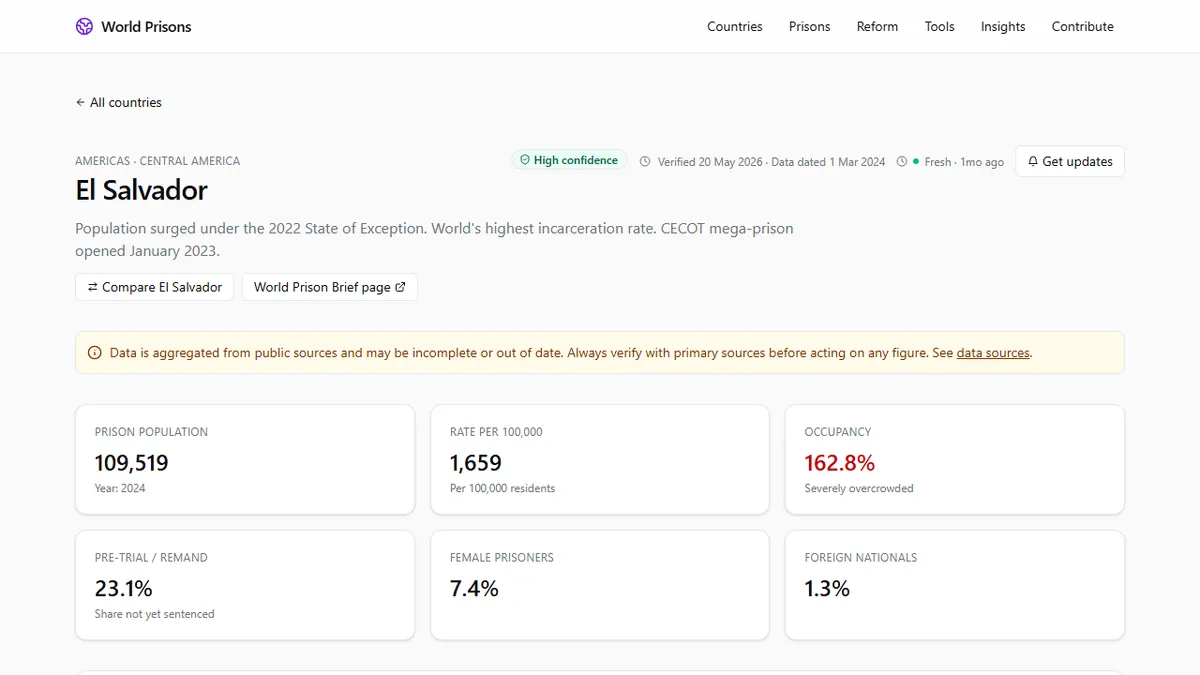
The first is the overcrowding ratio: the facility's current population expressed as a percentage of its official capacity. This is the most directly measurable input and the one with the clearest causal relationship to harm. Facilities operating at 200% or above have structurally inadequate sanitation, sleeping space, and programme capacity regardless of management intent. La Esperanza in El Salvador, holding 33,000 people in a space designed for 5,200, generates a very high overcrowding component in its risk score.
The second input is recent oversight findings. This draws on published reports from inspectorate bodies, human rights commissions, court monitors, and international organisations. A facility that has received clean oversight reports over multiple years scores lower on this dimension than one with documented findings of violence, inadequate healthcare, or staff misconduct. HMP Wandsworth in the United Kingdom (scored 48, elevated) draws heavily on this input: its occupancy is high but not extreme by global standards, and its score reflects a pattern of damaging inspection findings rather than raw population numbers.
The third input is the facility's security classification. Maximum-security facilities hold populations with higher assessed risk profiles and typically operate under regime conditions that increase stress and restrict movement and association. A maximum-security classification adds to the risk score not because maximum-security facilities are always worse managed, but because they concentrate individuals assessed as presenting the highest levels of risk to themselves and others.
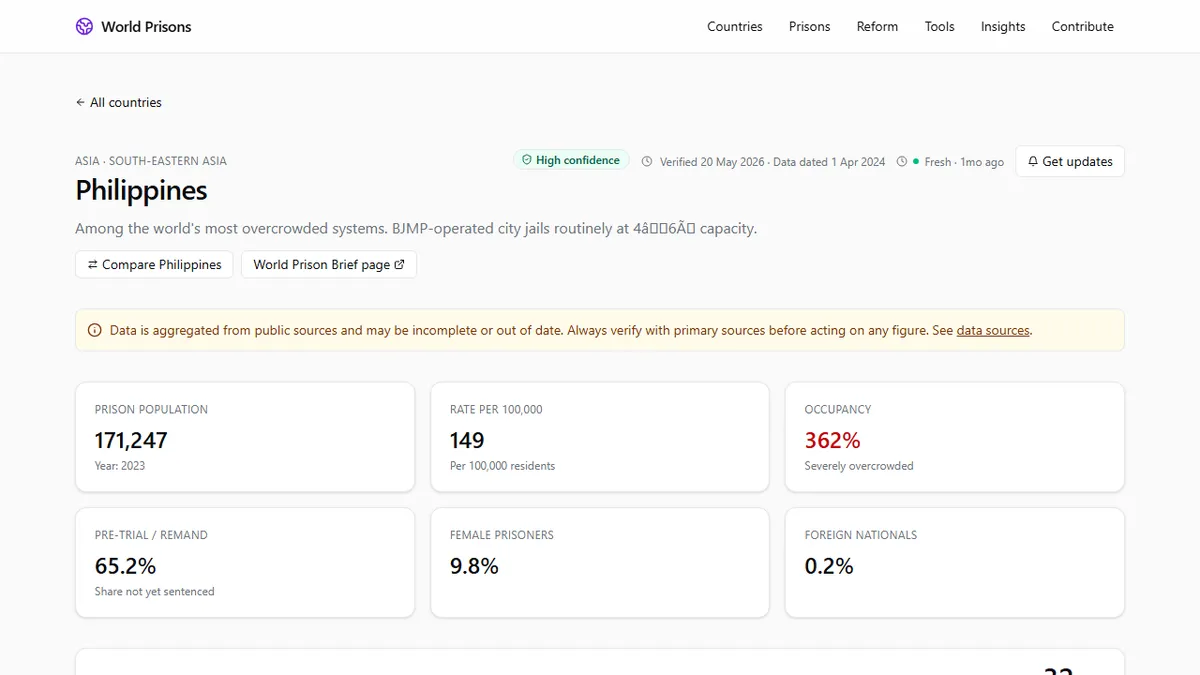
The fourth input is country-level pressure. This captures the systemic context in which a facility operates: the national prison population rate, the overall occupancy of the national estate, and the track record of the relevant state authority on human rights compliance. A facility in a country whose national occupancy is 180% starts with a higher baseline risk than an identical facility in a country running at 75%, because the systemic pressures (staffing, resource allocation, court system backlogs) are distributed across the entire estate.
The Five Tiers
Scores are grouped into five tiers, each with a defined range and a consistent verbal label. Low runs from 0 to 19, moderate from 20 to 39, elevated from 40 to 59, high from 60 to 79, and critical covers 80 and above. Unknown is applied when sufficient inputs are missing to produce a reliable score.
The tier labels carry specific interpretive weight. An elevated score does not mean conditions are catastrophically dangerous; it means the combination of inputs places this facility in a range where conditions are likely materially worse than minimum acceptable standards, and where at least one input dimension warrants close monitoring. A high or critical score indicates documented severe conditions, extreme overcrowding, or a pattern of oversight findings indicating serious ongoing harm.
Most of the approximately 40 facilities in the highest-risk portion of the global database cluster in the elevated tier. This reflects the reality that truly critical scores require multiple inputs to be simultaneously and severely adverse. The elevated tier is, in practice, the most consequential one for comparative analysis: it covers facilities where conditions are substantially problematic but where the situation retains the theoretical possibility of remediation through operational changes.
Facility-level risk scores across the global database allow direct comparison across systems. The juxtaposition of La Esperanza (54) and HMP Wandsworth (48) in the same tier illustrates both the utility and the necessary caution. Both are in the elevated band, but the inputs driving each score are almost entirely different. Wandsworth's score reflects inspectorate criticism of a facility in a high-income state with functioning oversight. La Esperanza's reflects extreme physical overcrowding in a context with minimal independent monitoring access. The tier tells you they are in the same range. The component breakdown tells you why — and the why matters for understanding what remediation would require.
How Threshold Events Trigger Score Updates
The score is not static. Nightly data refreshes from the underlying country and facility importers mean that material changes to any input can trigger a recalculation. Two thresholds govern when a change event is formally logged: a 5% change in a facility-level figure and a 3% change in a country-level figure.
These thresholds exist to distinguish meaningful shifts from data noise. Prison population figures fluctuate day to day; a single batch of releases or a transfer intake can move a facility's occupancy by a small percentage without signalling a genuine change in conditions. The 5% facility threshold is calibrated to capture shifts large enough to move a score materially: for example, a facility that moved from 180% to 210% occupancy, which would register as a significant deterioration, versus one that moved from 185% to 188%, which would not.
Country-level changes have a lower threshold because they represent systemic signals. A 3% rise in national prison population or a deterioration in country-level oversight engagement is more diagnostically significant than an equivalent movement at a single facility, because it implies that the pressures are distributing across the entire estate rather than being localised.
Limitations: What the Score Cannot Capture
Several dimensions of prison conditions that matter to people living inside them do not appear in the score. Staffing quality (the professional competence, training level, and conduct of individual officers) can vary enormously between facilities with similar scores. Two facilities at 150% occupancy, one with a stable, trained workforce and one experiencing 40% staff vacancy rates, will have radically different day-to-day safety profiles that the occupancy figure does not distinguish.
Regime quality (access to education, work, exercise, family contact, and healthcare) is partially captured through oversight findings but only insofar as inspecting bodies have visited and published reports. Facilities in countries without functioning oversight mechanisms may operate terrible regimes with no reflection in the score simply because no verified findings exist to incorporate.
The score also does not capture individual risk variation within a facility. An individual's experience at a given facility depends substantially on which wing they are assigned to, their security category, their age, gender, and the specific relationships they have with staff and other prisoners. Aggregate scores describe the institution; they cannot predict an individual's experience within it.
How to Use the Score When Comparing Facilities Across Legal Systems
The most productive use of the risk score in cross-system comparison is as a first filter, not a final answer. A reader trying to understand conditions across a large number of facilities benefits from being able to sort by score and identify which facilities warrant deeper investigation. A researcher writing about a specific jurisdiction benefits from being able to locate that jurisdiction's facilities in global context without having to read every oversight report that has ever been published.
Where the score should not substitute for deeper investigation is in high-stakes contexts: legal proceedings, policy advocacy on behalf of specific detainees, or journalistic claims about specific conditions. In those contexts, the score is a starting point that should direct attention toward the underlying inputs (the oversight reports, the overcrowding data, the country context) rather than functioning as a standalone citation.
A score of 54 for La Esperanza is not the finding. It is the headline that tells a reader this facility's conditions warrant serious attention, and points toward where to look to understand why.