Why Your SEA Is More Powerful Than You Think
Most seafarers treat their Seafarer Employment Agreement as paperwork, one more document to sign in a stack before the ship sails. That instinct is understandable but costly. The SEA is a legally binding contract that determines how much you are paid, when you can go home, and what happens if you are injured. It is also the primary document an ITF inspector, a port state control officer, or a labour court will reach for if something goes wrong.
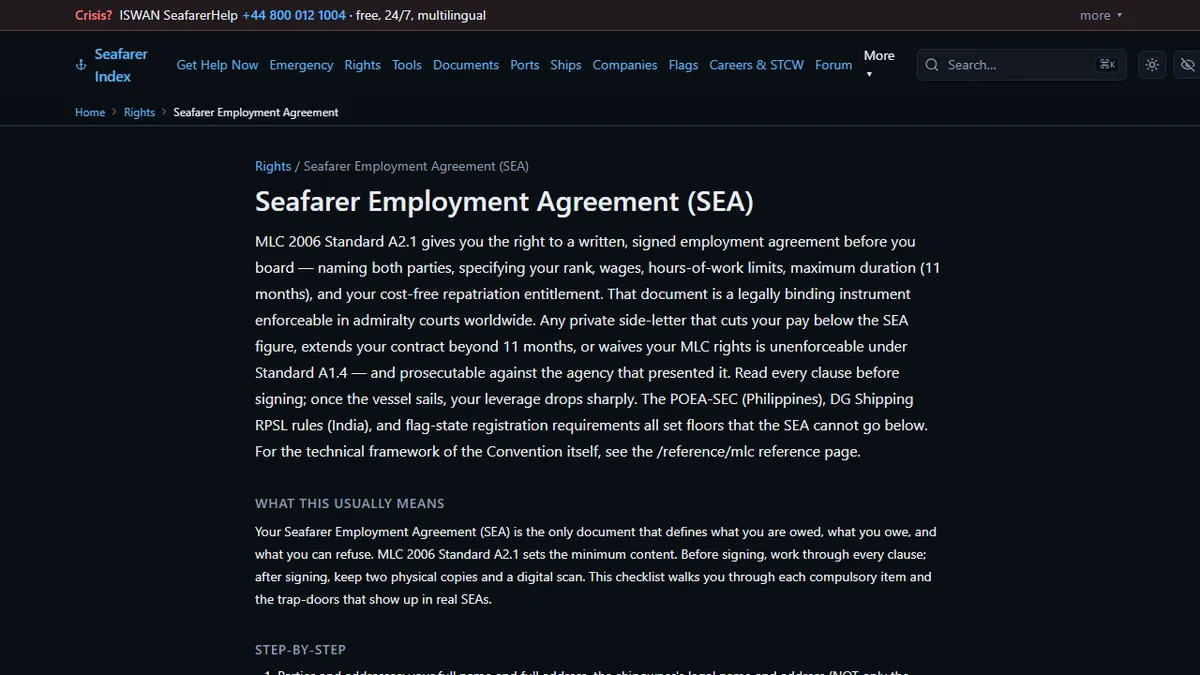
Under the Maritime Labour Convention 2006, every seafarer working on an internationally trading vessel must hold an SEA that meets minimum content standards. That framework exists precisely because the power imbalance between a seafarers and a shipowner is significant: you are signing in a port city you may not know, in a second language, often under time pressure. Understanding the structure of the document before you are in that situation is the first and most important protection available to you.
The Six Clauses MLC 2006 Requires Every SEA to Contain
The convention specifies the minimum content of every SEA. Each agreement must state the seafarer's full name and date of birth; the shipowner's name and address; the vessel name and official number; a description of the work to be performed; the rate of wages; the amount of paid annual leave; the repatriation conditions; reference to the collective bargaining agreement if one applies; and the health and social security protections in place.
The MLC 2006 requirements for a seafarer employment agreement set out these provisions in detail and should be your reference point when comparing any document handed to you by an employer. If a clause is absent or vague, you have grounds to ask for clarification before signing, and the convention supports that right explicitly.
Wage Section: Reading Beyond the Headline Number
The wage section of an SEA is typically the clause seafarers scan first and understand least. A headline monthly figure may be constructed from several components: a basic wage, an overtime rate, leave pay that is consolidated into the monthly figure, and sometimes a fixed-overtime arrangement where overtime is deemed to be included. These structures are not inherently unfair, but they are easy to misread.
Pay attention to the overtime rate and how it is calculated. MLC 2006 requires overtime to be paid at not less than 1.25 times the basic hourly wage. If your SEA consolidates overtime into a flat monthly rate, you need to check whether that flat rate is mathematically equivalent to the required minimum for the hours you will actually work. Allotment clauses (authorising a portion of your wage to be sent directly to a family member) should specify the amount, the currency, the receiving account, and the timing. Vague language on allotments is a warning sign.
Repatriation: What the Phrase "At the Company's Expense" Actually Means
Repatriation clauses are frequently glossed over until they become urgent, and by then it is too late to negotiate. MLC 2006 entitles seafarers to repatriation at the shipowner's expense in several circumstances: at contract end, if the agreement is terminated by the shipowner, if the seafarer cannot continue duties due to illness or injury, and in cases where the ship calls at a port in a conflict zone the seafarer has not consented to.
Read the clause carefully for any cost-transfer language. Phrases like "repatriation costs will be deducted from wages if the seafarer terminates the agreement early" are a grey area, and some versions of this clause are unenforceable under MLC. If the repatriation section is silent on who bears the cost of flights, ground transport, and accommodation during the journey home, ask for it to be made explicit.
Medical Cover: Treatment Abroad Versus Injury Compensation
A vessel operating internationally can dock in dozens of countries in a single contract. The medical clause of your SEA must cover you throughout. MLC 2006 requires the shipowner to ensure access to medical care, cover the cost of treatment while a seafarer is away from their home country, and continue wages during sick leave for a minimum of sixteen weeks.
Distinguish between two different categories of protection in this clause: ongoing treatment for illness or injury sustained onboard, and disability compensation for a permanent reduction in earning capacity following an onboard accident. These are not the same entitlement and they may be structured differently in the agreement. Some SEAs reference a collective bargaining agreement for the compensation schedule rather than stating the amounts directly; in those cases, ask for a copy of the referenced CBA before signing.
Red-Flag Language to Reject Before Signing
Certain phrases should prompt immediate questions or refusal. Any clause that attempts to waive your MLC rights (phrased as "the seafarer agrees to forego any claim under...") is unenforceable but signals an employer who may behave badly in a dispute. Wage clauses that describe payment as "at the master's discretion" rather than on a fixed schedule should be challenged. Repatriation clauses that restrict your destination to a named port rather than your country of residence are non-compliant.
Be alert to clauses that assign jurisdiction to a flag state with no enforcement capacity. An SEA governed by the laws of a flag that has not ratified MLC 2006 and has no labour inspectorate means your rights exist on paper but cannot be exercised in practice.
What to Do If You Are Handed the SEA at the Gangway
The gangway SEA (presented at the moment of joining, with the ship ready to sail) is a known pressure tactic. You have the right to read the document before signing. If the time pressure is genuine, request that joining be delayed for the minimum period needed to review the key clauses. If that request is refused, document the circumstances in writing, note the date and time, and retain a copy of the unsigned agreement if one is available.
Accepting an SEA under duress does not extinguish your rights, but it does mean entering a contract without knowing what you agreed to. The better approach is to request the SEA from the manning agent at least 24 hours before joining — a practice that MLC 2006 implicitly supports and that professional employers will accommodate without difficulty.
Read every page. Ask about every clause you do not understand. Your signature on that document is what determines whether you can be paid, repatriated, and compensated when things go wrong at sea.