What STCW BST Is and Why It Is Mandatory Worldwide
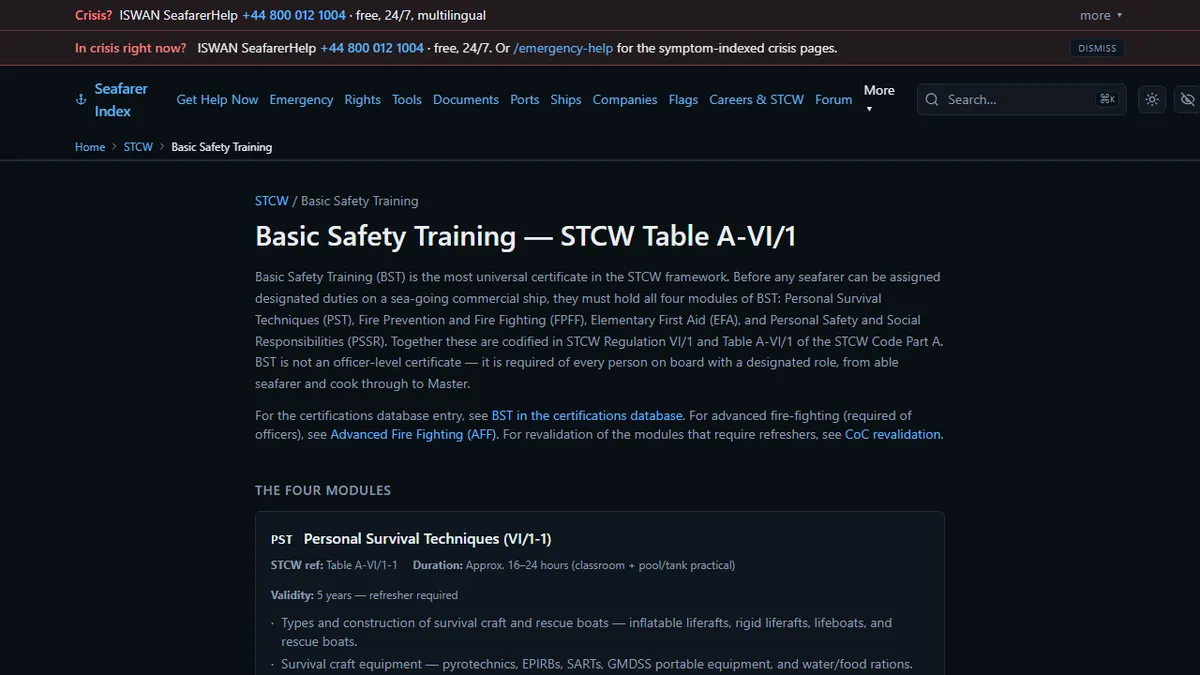
The Standards of Training, Certification and Watchkeeping for Seafarers convention, adopted by the International Maritime Organization, establishes the minimum competency requirements for everyone who works aboard internationally trading vessels. Basic Safety Training (referred to in the convention as BST) is the foundational tier of that framework. Without it, no seafarer can legally serve on a ship covered by the convention.
The requirement is not theoretical. Manning agents check certificates before placing crew. Flag state administrations require them before endorsing a Certificate of Competency. Port state control inspectors can detain a vessel if they find crew without valid basic safety certification. BST sits at the base of the entire STCW certification pyramid, and every path into professional seafaring runs through it.
The official STCW BST module requirements and revalidation rules set out the competency standards that training centres must meet, and they are worth reviewing before you book a course to ensure you understand exactly what you are paying for.
The Four Modules: What Each One Covers
STCW BST is divided into four distinct courses, each addressing a different category of onboard risk. All four must be completed before a certificate of basic safety training can be issued.
Personal Survival Techniques teaches how to survive if a vessel sinks. Candidates learn to don and inflate an immersion suit, enter the water safely, signal for rescue, and use the basic survival equipment found on liferafts. The training includes a practical session in a swimming pool or controlled water environment where candidates demonstrate these skills under assessment conditions.
Firefighting and Fire Prevention covers the theory of fire on a vessel, the classes of fire and the extinguishing agents matched to each, the operation of shipboard firefighting equipment, and the practical skills involved in controlling a fire wearing breathing apparatus. This module is physically demanding and involves working in a smoke-filled environment during exercises.
Elementary First Aid equips crew to manage a medical emergency in the period before a doctor can be reached, which at sea may be measured in hours or days. The module covers primary survey, CPR, management of bleeding, fractures, and burns, and the proper use of the first aid kit that every vessel carries.
Personal Safety and Social Responsibilities is the least physically demanding of the four modules but addresses the human dimension of shipboard safety: the principles of safe working practices, alcohol and drug policies, the occupational health hazards specific to ships, and the obligations of crew members under the ISM Code.
What to Expect in the Pool and Practical Assessments
The practical components of BST (particularly personal survival and firefighting) are the aspects most candidates underestimate. For personal survival, you should expect to enter a pool wearing an immersion suit, which is considerably more buoyant than a swimsuit but is also bulky and affects movement. Assessors will observe whether you can don the suit within the required time, enter the water using an approved method, and perform the HELP position (Heat Escape Lessening Position) correctly.
Firefighting practical sessions vary in intensity between training centres but will typically involve enclosed spaces filled with theatrical smoke, the operation of self-contained breathing apparatus under timed conditions, and the use of hose lines on small controlled fires. Claustrophobia is not disqualifying, but candidates who have never worn breathing apparatus should expect discomfort during the first session.
Assessment is competency-based rather than purely examination-based. You must demonstrate the skill to the standard described in the STCW tables: passing a written paper alone is not sufficient for the practical modules.
How Long Certificates Are Valid and When You Must Revalidate
STCW BST certificates issued under the 2010 Manila Amendments carry a five-year validity period. This applies to all four modules. Revalidation before expiry maintains the continuous chain of certification; allowing certificates to lapse means completing refresher training to restore them, which typically costs more time and money than the revalidation route.
The revalidation route requires evidence of approved sea service or refresher training within the five-year window. The sea-service route is generally simpler for seafarers who have remained active: your discharge book entries and employment records serve as evidence. Seafarers who have been ashore for an extended period, or who are returning after a career break, typically need to attend a refresher course rather than simply presenting service evidence.
Mark your revalidation deadline in your records when you receive your certificates. Five years passes faster than most first-time trainees anticipate.
Choosing an Approved Training Centre: What to Look For
Not all training centres are equal, and the differences matter. The centre you choose must be approved by the maritime administration of the flag state under which your Certificate of Competency will be issued. Approval by the Philippines Maritime Industry Authority, the UK Maritime and Coastguard Agency, or equivalent bodies in your jurisdiction is the baseline requirement — without it, the certificates the centre issues may not be accepted by the flag states you want to sail under.
Practical indicators of quality include the condition of survival equipment, the availability of functioning breathing apparatus for individual use during firefighting exercises, and the ratio of instructors to candidates. A centre that runs firefighting practical sessions with groups of twenty people sharing a small number of breathing apparatus sets is cutting corners. Ask before you book how many candidates will be in each practical group.
Cost varies significantly by country. Philippines-based training is substantially cheaper than equivalent courses in Northern Europe or North America. The certificates are functionally equivalent provided the centre holds proper approval, making international training a sensible option for some candidates.
Common Mistakes That Cause Candidates to Fail
Failure in BST is genuinely uncommon, but the errors that do cause it are predictable. In personal survival, candidates fail by entering the water without permission, incorrectly donning the immersion suit, or omitting a required step in the liferaft boarding sequence. Preparation is straightforward: study the correct sequence before attending, watch instructional videos, and ask the instructor to demonstrate before your assessment attempt.
In firefighting, candidates fail by removing the breathing apparatus facepiece in the smoke environment before the all-clear signal, by operating equipment incorrectly under stress, or by demonstrating poor buddy-pair coordination. This module rewards candidates who have attended the theory session attentively and asked questions about the equipment before putting it on.
The most avoidable failure of all is arriving at the training centre with incomplete documentation. Most centres require valid photo identification, a medical fitness certificate (ENG1 or equivalent), and proof of age. Confirming the exact documentation requirements with the centre before your course date costs nothing and eliminates the most common administrative failure.