What Port State Control Actually Is and Why It Exists
When a cargo ship enters a foreign port, the authorities of that port have the legal power to inspect the vessel, examine the crew's documents, and, if they find serious enough problems, stop the ship from sailing until the deficiencies are corrected. This is port state control, and it operates through a network of regional agreements covering virtually every significant trading route in the world.
The system exists because the alternative, relying entirely on the flag state that registered the vessel to police its own ships, produced predictably poor results. Flags of convenience, minimal enforcement budgets, and the physical difficulty of overseeing ships that never return to the registering country all created conditions where substandard vessels operated with impunity. Port state control shifted the inspection function to the countries where ships actually go, giving it genuine teeth.
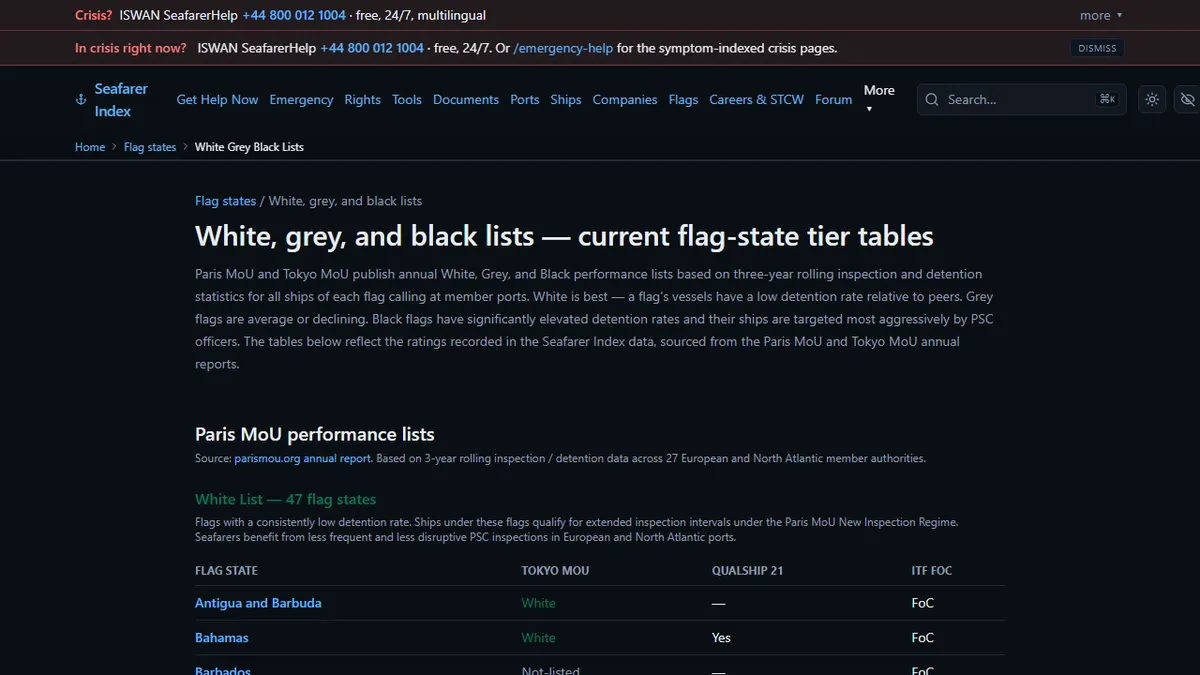
The most influential regional memoranda of understanding are the Paris MoU, covering European and North Atlantic ports, and the Tokyo MoU, covering Asia-Pacific. Both publish annual performance data on every flag state and use that data to categorise flags into white, grey, and black lists.
How the Lists Are Calculated
Each MoU calculates a flag's position using a rolling three-year average of inspection performance. Two variables drive the outcome: the total number of inspections of vessels flying that flag, and the proportion of those inspections that resulted in either detentions or above-average deficiency rates. A flag with a consistently high detention rate and large deficiency counts accumulates a poor score; one whose vessels are repeatedly inspected without serious findings earns a strong record.
The white list is for flag states whose performance is consistently above average. Grey is the middle ground: the flag's performance falls within a band that triggers closer scrutiny without qualifying as outright poor. Black means the flag's recent record places it in the lowest tier, signalling a structural enforcement failure rather than isolated incidents. The current white, grey, and black MoU list rankings are updated annually and are worth checking before you join any vessel.
What a PSC Detention Means for the Crew Onboard
Shipowners feel a detention in their wallets: demurrage costs mount by the hour. Crews experience it differently. If a vessel is detained, the seafarers aboard are often stranded in a port they did not choose, sometimes without shore leave, sometimes in a country where welfare services are minimal. Scheduled rest periods are disrupted as crew work to clear deficiencies. The planned end of contract becomes uncertain, which creates financial anxiety for seafarers whose families are counting on a specific return date.
Detentions also expose crew to a secondary risk: if the shipowner's financial position is precarious, a prolonged detention can tip into abandonment. Ships that accumulate multiple detentions across several ports tend to have systemic problems — maintenance deferred, certification lapsed, management unresponsive — that correlate with the owner profile most likely to run out of funds or disappear.
Flags Currently on the Black List and Why They Get There
Black-listed flags share common characteristics. Most have not ratified MLC 2006, meaning there is no binding international labour framework governing the vessels they register. Their maritime administrations typically lack the surveyor capacity or political will to enforce SOLAS safety standards. In some cases, the open registry model has attracted owners who chose that flag specifically to avoid regulatory oversight.
The flags that appear on both the Paris and Tokyo black lists simultaneously represent the most serious concerns, because consistent poor performance across two separate inspection regimes leaves little room for statistical noise as an explanation. Vessels flying these flags face a higher probability of targeted inspection (known as a concentrated inspection campaign) whenever they enter a participating port.
How to Check a Flag's Status Before Joining a Vessel
Before accepting a contract, the name of the vessel and its flag can be looked up in the Paris MoU and Tokyo MoU public databases. Both maintain searchable online records of inspection history, deficiency counts, and current list status. You are looking for the flag's current category, the vessel's own inspection record, and whether the vessel has been detained recently.
A vessel detained two or more times in the past twenty-four months is a significant warning sign regardless of its flag. A vessel on a black-listed flag with recent detentions is a compounding risk. This check takes approximately ten minutes and costs nothing.
Your Rights During a PSC Inspection
Seafarers have specific rights when a PSC inspector boards. You are entitled to speak to the inspector privately about welfare concerns, working conditions, rest hours, and unpaid wages. Inspectors are obliged to treat such communications confidentially. They will not identify you to the master or shipowner as the source of a complaint.
This is an underused right. Many seafarers worry that raising concerns with a PSC inspector will cost them their contract. In practice, retaliation against a crew member for communicating with a PSC inspector is a separate MLC violation, and it is one that a competent inspector will flag if they detect evidence of it. If you have concerns about the vessel, about safety equipment, rest records, or the way wages are being handled, a PSC visit is a rare opportunity to raise them with someone who has the authority to act.