Why Vessel Type Matters for Your Take-Home Pay
Most seafarers at the start of their career focus on rank when thinking about wages. Rank matters, of course, but the vessel type on which you serve that rank can shift your annual earnings by a significant margin even with an identical certificate of competency. The reasons are structural: different vessel types operate under different commercial pressures, different collective bargaining agreements, different overtime regimes, and very different sea-to-leave ratios. Understanding those differences before you commit to a specialisation is worth the time it takes to work through them.
This comparison focuses on two of the largest sectors: dry bulk carriers and container ships. Both employ large numbers of officers and ratings across the full rank spectrum, and both have sufficient published wage data to make meaningful comparisons.
Published Wage Bands: Able Seafarer to Chief Officer on Bulk Carriers
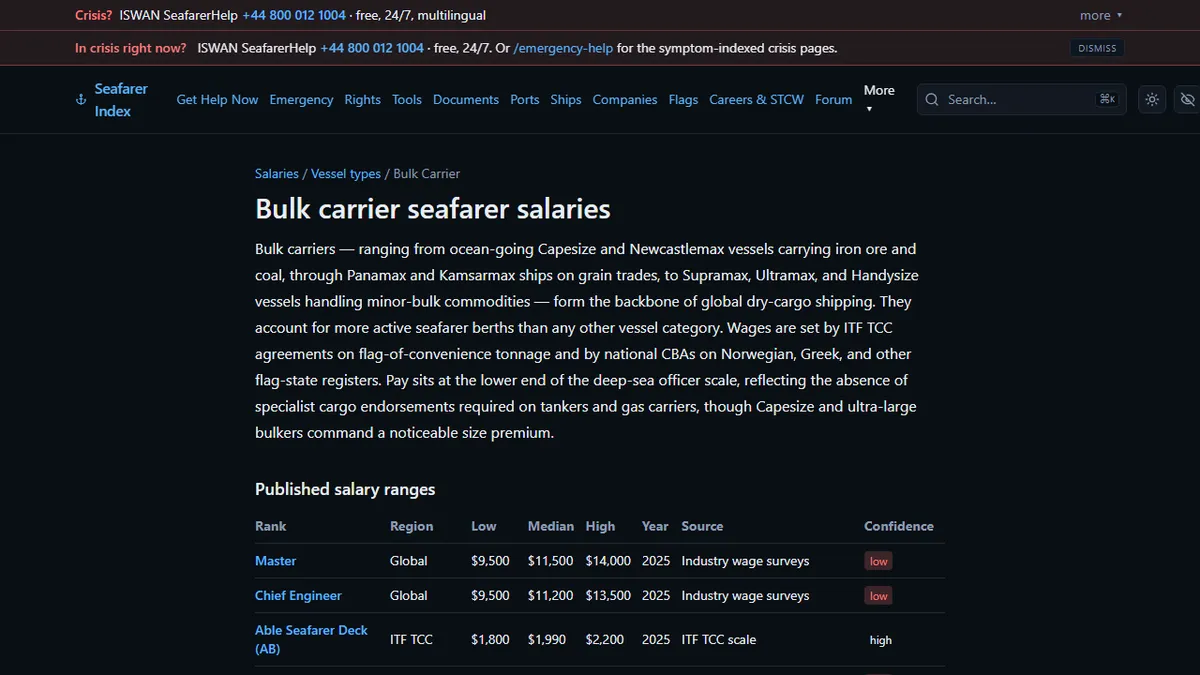
Dry bulk carriers (the Capesize, Kamsarmax, Panamax, and Handysize vessels that carry coal, grain, and iron ore between continents) typically operate under ITF-affiliated collective agreements when the flag requires it, or under flag-state wage minima when it does not. The ITF minimum wage scale, updated periodically through negotiation with employer associations, sets the floor for most contracts.
For an Able Seafarer, ITF-aligned bulk carrier wages in 2025 sit broadly in the range of USD 1,400 to USD 1,800 per month basic, with fixed overtime typically adding a further 20 to 25 percent. A Third Officer on a Capesize bulk carrier working under a major Japanese or European operator's CBA can expect basic wages between USD 2,800 and USD 3,500 per month. Chief Officers on modern Capesize or Ultramax vessels operated by major shipping groups typically earn between USD 6,500 and USD 8,500 per month in total remuneration. For current figure ranges broken down by rank, the published wage ranges for bulk carrier ranks provide a regularly updated reference point.
Published Wage Bands: The Same Ranks on Container Ships
Container shipping operates at a different commercial intensity. Major liner operators (running fixed-schedule services across trunk routes with port calls every two to four days) tend to pay a modest premium over bulk carrier rates to attract officers comfortable with high-frequency port operations and the additional administrative burden that container logistics involves.
An Able Seafarer on a major container line typically earns between USD 1,500 and USD 2,000 per month in basic wages under a strong CBA. Third Officer wages at large container shipping companies commonly range from USD 3,000 to USD 4,000 per month. Chief Officers at premium container operators can reach USD 9,000 to USD 12,000 per month in total remuneration at the top of the pay scale. The container ship salary data by officer grade shows the full spread across the major liner operators.
How Overtime Is Structured Differently Across Vessel Types
The headline basic wage rarely tells the full story. Overtime structure is where the two sectors diverge significantly. Bulk carriers commonly use a genuine variable overtime model: hours worked beyond the standard eight per day are logged and paid at the contractually specified rate, typically 1.25 times the basic hourly rate. In months where port calls are infrequent and long ocean passages dominate, overtime hours can be limited. In months with cargo operations in multiple ports, they can be substantial.
Container ships more frequently apply a fixed overtime arrangement (sometimes called guaranteed overtime or consolidated wages) where an assumed number of overtime hours is built into the monthly pay figure. This provides income predictability but means that periods of exceptionally high port activity do not generate additional earnings. Officers who prefer to log genuine variable overtime for the upside potential may find bulk carriers more rewarding in active periods.
Sea-Leave Ratios and How They Affect Annual Income
Time at sea matters as much as the monthly wage figure. A bulk carrier contract is typically nine months at sea followed by three months of leave, giving a 3:1 sea-to-leave ratio. Container ship contracts vary by operator but commonly run on a three-to-four months on, one-to-two months off cycle, producing ratios that can be more favourable to shore time.
When you calculate annual income by multiplying the monthly wage by the number of months at sea, a nominally lower-paid container ship contract can produce comparable or higher annual earnings if the sea-leave ratio means more months being paid per year. Conversely, the longer bulk carrier contract with fewer but higher-paid months may suit seafarers who prefer extended shore time.
Beyond Base Salary: Port Allowances, Bonuses, and ITF Agreements
Port allowances are a meaningful supplement on container ships because port frequency is higher. Some liner operators pay a per-port-call allowance that can add several hundred dollars per month during active rotation schedules. Holiday bonuses paid at the end of a contract, performance bonuses tied to fuel efficiency or vessel condition, and officer responsibility allowances for those acting up in a senior rank also vary substantially between employers.
ITF collective bargaining agreements provide a meaningful floor across both sectors, but the premium above that floor is where the real differences lie. Japanese and German operators in both bulk and container sectors tend to pay above the ITF minimum; operators using flags of convenience with minimal oversight tend to pay at or just above the floor.
Which Vessel Type Tends to Offer Faster Rank Progression
Container shipping's higher operational tempo (more port calls, more cargo operations, more planning cycles) tends to compress the practical experience accumulation timeline for officers who want to progress quickly to command. An officer handling container discharge operations every three days builds cargo management competency faster than a counterpart making three bulk port calls per month.
The bulk carrier sector's longer ocean passages and more cyclical cargo scheduling suit officers who prefer extended watchkeeping time and the navigational depth that comes with it. Some senior Masters and Chief Officers actively prefer bulk carrier employment precisely because the pace is less frantic. Neither sector produces better officers — they produce officers with different skill profiles, and the market for both remains strong.