The 72 Hours That Define Your Contract
Every veteran seafarer has a story about something that went wrong on their first ship. The stories differ in detail (the port, the vessel type, the nationality mix of the crew), but they converge on the same underlying causes: inadequate preparation, underestimated fatigue, and not knowing who to ask or what to do in the moments that mattered. The 72-hour joining window is compressed and intense, and the errors made in it have a way of echoing through the rest of the contract.
What follows are the seven mistakes that experienced crew and maritime welfare organisations identify most consistently among first-time seafarers. None of them require exceptional talent to avoid. They require preparation, specifically the kind of preparation that nobody tells you to do because it seems obvious in retrospect.
Mistake 1: Not Photocopying Every Document Before You Leave Home
Your Certificate of Competency, STCW certificates, passport, seaman's book, medical fitness certificate, and vaccination records are your professional identity at sea. The originals should travel with you to the vessel. Certified copies of every single one of those documents should remain at home, stored in a location your family can access without you.
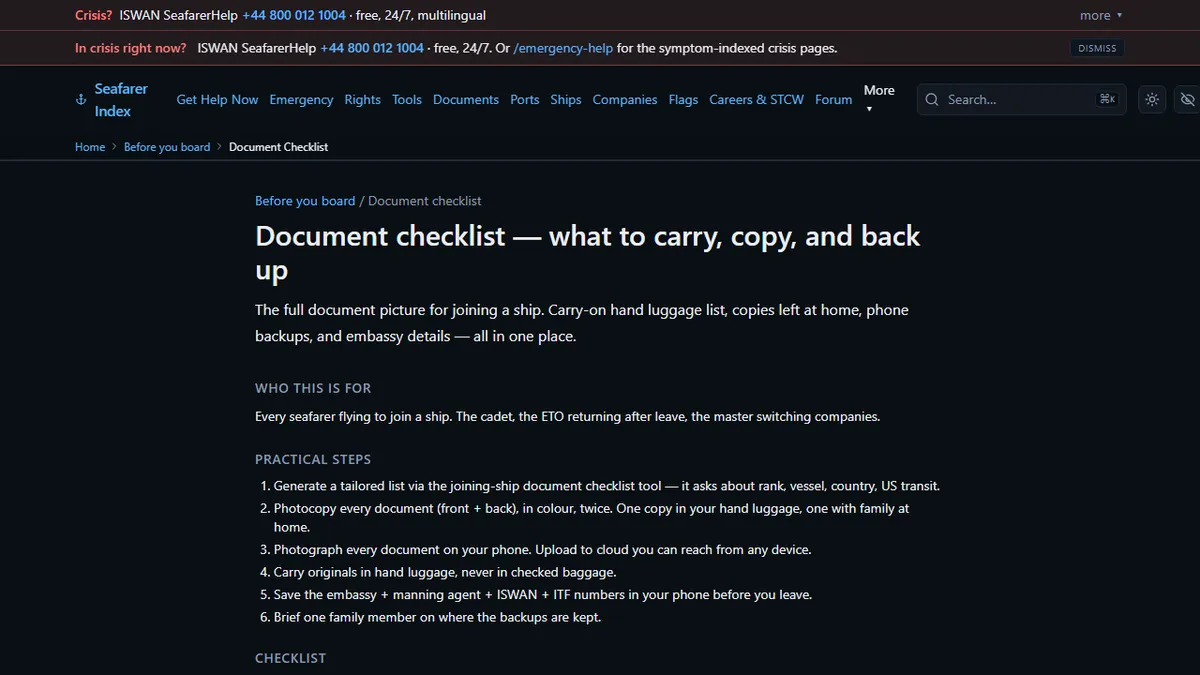
This is not pessimism; it is standard practice in any profession where travel to remote locations is routine. Documents get lost, damaged, or occasionally confiscated by bad actors. A seafarer who can describe the exact certificate numbers, issue dates, and issuing authorities on their credentials has a far easier path to replacement than one who cannot. The pre-boarding document checklist for new crew covers every category of document that should be copied and filed before departure.
Mistake 2: Arriving on Joining Day Without the Complete Document Checklist
Manning agents provide joining instructions that include a list of required documents. These lists are not suggestions. A seafarer who arrives at a vessel without a required vaccination record, an updated STCW endorsement, or a flag-state-specific document may be refused boarding. In a best-case scenario, the joining is delayed and the seafarer bears the cost of additional accommodation while the missing document is sourced. In a worst case, the contract falls through entirely.
Read the joining instructions three times: once when you receive them, once a week before departure, and once the night before. Call the manning agent if anything on the list is unclear. Agents are used to questions and would far rather answer one before boarding than manage a problem at the gangway.
Mistake 3: Underestimating the Jet Lag and Fatigue Risk in Week One
Joining a ship typically involves multiple time-zone crossings, overnight travel, an unfamiliar sleep environment, and an immediate demand on cognitive performance (safety familiarisation, equipment inspections, watchkeeping). The combination is physically and mentally demanding in ways that most first-time seafarers do not anticipate.
Fatigue in the joining week is a genuine safety risk, not a personal weakness. Errors in judgment and attention are more likely when you are sleep-deprived in an unfamiliar environment. Be honest with yourself about your state. Prioritise rest in whatever gaps the schedule allows. Avoid the temptation to stay up late to call home when you have a watch in four hours. Your ability to perform your duties safely in week one depends significantly on how seriously you take your own rest requirements.
Mistake 4: Not Reading the Safety Familiarisation Checklist
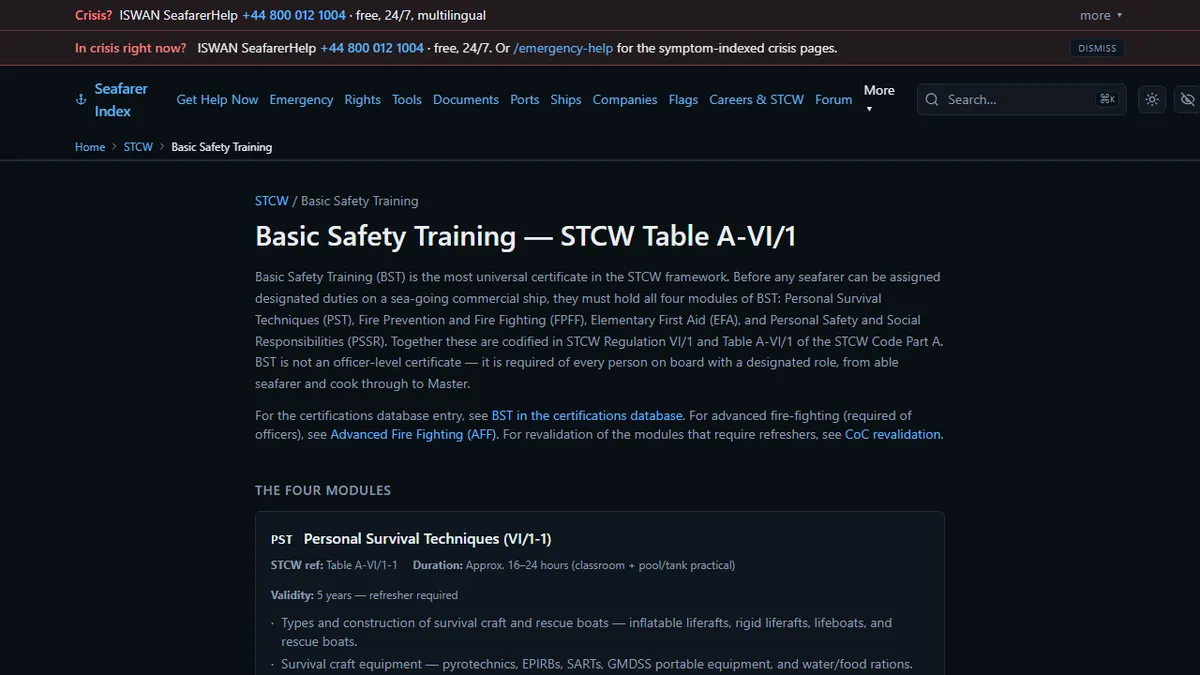
Every vessel is required under SOLAS and MLC 2006 to provide new crew members with a safety familiarisation before they stand any watch or participate in any operation. This covers the location of muster stations, the correct donning of survival suits, the activation of emergency equipment, and the fire-fighting appliances in your work area. A checklist is completed and signed by both the new crew member and a supervisory officer.
The joining-day safety familiarisation checklist captures the standard items this process should cover. Do not treat it as a formality to be completed as quickly as possible. Walk to every location listed. Open every locker. Physically put your hands on the equipment. If you are shown the liferaft embarkation point but cannot picture exactly where it is at night during an emergency drill, ask to be shown again.
Mistake 5: Sending Money Home Before Confirming the First Wage Is Deposited
Allotment instructions given at signing should direct wages to an account your family can access. But the first wage payment on a new contract is frequently delayed by administrative processing (the manning agent, the company, and the bank each introduce processing time). Some first-contract seafarers, eager to provide for their families, instruct transfers before confirming that the wage has actually been received.
Wait until you have verified, in your own bank account or through direct confirmation with the company, that the payment has been made before authorising any transfer to family. This is not a matter of distrust. It is a matter of understanding that payroll processing chains are not instant and that the first payment cycle on a new contract is the one most likely to encounter a delay.
Mistake 6: Ignoring the Ship's Internet and Communication Options
Most vessels offer some form of crew internet access, whether through a prepaid voucher system, a monthly data allocation, or a shared terminal. The pricing and access conditions vary widely. Some vessels offer VSAT services with genuine connectivity; others rely on older systems where bandwidth is measured in kilobytes per hour.
Learn the communication options aboard in the first 24 hours, not the first two weeks. Contact your family to confirm your safe arrival and to establish a regular check-in schedule. Families who expect daily contact and then experience three days of silence because you did not know how the internet system worked will experience unnecessary anxiety. Setting expectations early ("I can call on Sundays when we are in port") prevents a significant source of stress on both sides.
Mistake 7: Not Knowing Who to Call If Something Goes Wrong
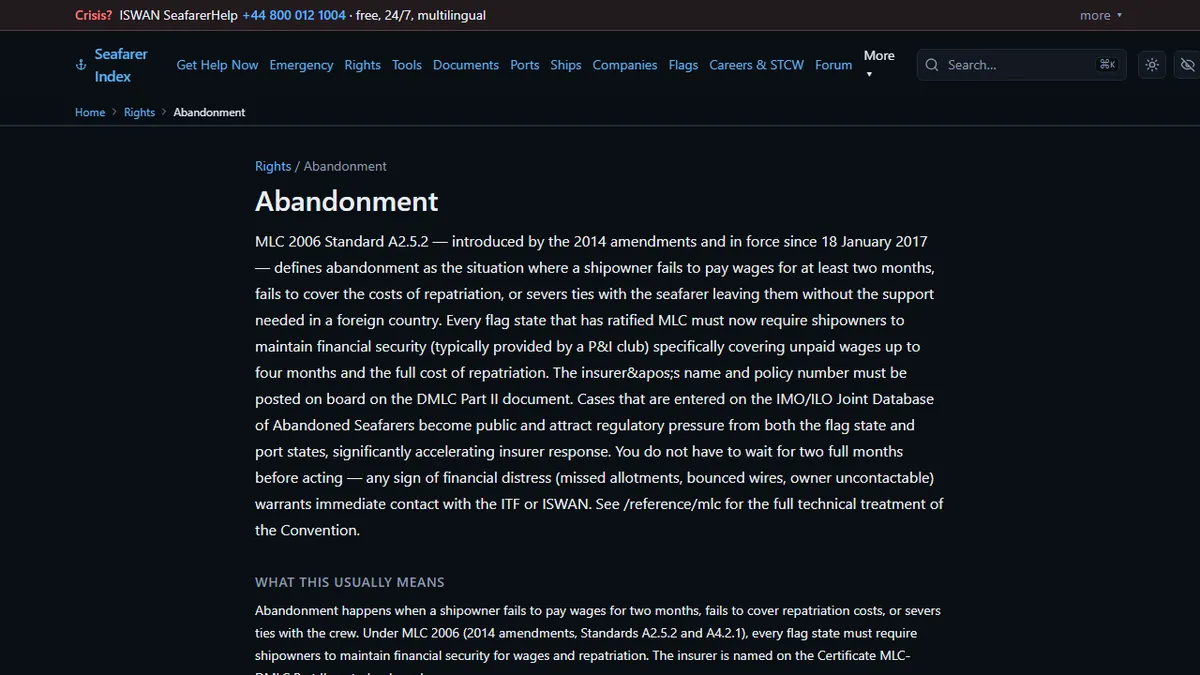
On your first ship, you need to know three categories of contacts before you need them. The first is onboard: who is the safety officer, where is the company welfare email address, and who is the designated person ashore (DPA) under the ISM Code. The second is the welfare organisation serving the port your ship is heading to: Mission to Seafarers, Sailors' Society, and Stella Maris each publish port-by-port contact information. The third is the ITF inspector contact for the regions you will transit.
The moment you most need these contacts is the moment you are least able to research them calmly. A list compiled in the first few days of a contract, when you have time and internet access, takes twenty minutes to put together and could matter enormously later. This is not catastrophising; it is professional preparation.