On this page
Why Skipping the Script Will Eventually Slow You Down
A significant portion of Thai learners decide, somewhere in their first month, that learning to read Thai script is optional: a specialist skill for serious students, not a practical requirement for getting by. This decision is understandable. Romanisation is everywhere; apps cater to it; you can order food and navigate Bangkok without reading a single Thai character.
But learners who skip the script consistently hit a ceiling around the A2 level that they cannot break through. Romanisation systems are not standardised. The same word can be written three different ways by three different sources. Dictionary lookups become unreliable. Learning from native materials, street signs, menus, and text messages becomes impossible. Most importantly, Thai pronunciation is encoded in the script itself, and without reading ability, you are navigating by approximation rather than by the actual phonological rules.
The script is not a detour. It is the foundation. The good news is that it is alphabetic: there is a direct relationship between symbols and sounds, and the rules governing it, while numerous, are genuinely learnable within weeks.
The 44 Consonants: Middle, High, and Low Classes Explained
Thai has 44 consonants in its formal script inventory, though a handful of those are rare in modern usage. The important thing to grasp immediately is that these 44 characters are divided into three classes (middle, high, and low), and that class membership directly determines the tone of the syllable in which the consonant appears.
This is the central insight that unlocks the entire script: consonant class is not a decorative category. It is one of the primary inputs into the tone rule system. A middle-class consonant produces different tones than the same vowel pattern would produce under a high-class or low-class consonant.
Middle-class consonants number nine and include some of the most frequent characters in the language. High-class consonants number eleven and tend to produce higher tones. Low-class consonants are the largest group at twenty-four and follow their own tone rules, which also differ between sonorants and other consonants within the class.
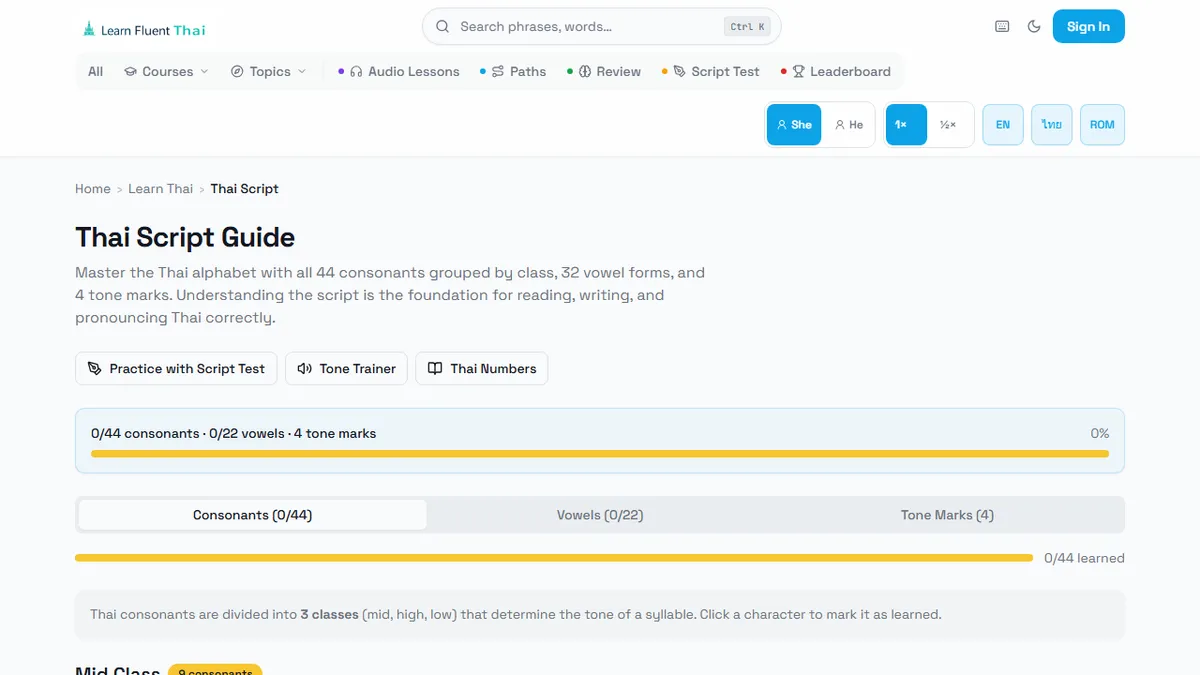
The structured Thai script reference guide organises these 44 consonants by class with audio for each, which makes initial memorisation considerably faster than working from a flat list. Grouping by class from the start means you are learning tone rules and characters simultaneously rather than treating them as separate topics.
Thai Vowels: Short, Long, and Why Position Matters
Thai vowels add a layer of complexity that surprises many learners: they do not sit uniformly to the right of the consonant the way English vowels do. Thai vowels can appear to the left, above, below, or surrounding the consonant they belong to. Some vowel marks are compound, combining components in different positions, and some function as both vowel and part of the pronunciation of a final consonant sound.
The vowel system distinguishes between short and long versions of most vowel sounds, and this distinction affects both meaning and tone. A short vowel in a closed syllable follows different tone rules than a long vowel in the same position.
Learning the most frequent vowel forms first is the efficient approach. The five or six highest-frequency vowels appear in a substantial proportion of everyday Thai text, and getting those right early produces usable reading ability faster than trying to master the full system before touching real materials. The less common vowel forms can be acquired naturally as you encounter them in reading practice.
Tone Marks: The Four Symbols That Override Everything
Thai has four tone marks — mai ek, mai tho, mai tri, and mai jattawa — that appear above consonants and override the default tone that would otherwise be produced by the consonant class and vowel pattern.
The phrase "override everything" deserves emphasis. When a tone mark is present, it takes precedence over the consonant class calculation entirely. This makes tone marks an immediate priority once you understand the baseline class system. Misreading a tone mark, or failing to notice one, produces the wrong tone regardless of how well you know the underlying rules.
The interaction between tone mark and consonant class is not uniform: the same tone mark produces different tones on a middle-class consonant versus a low-class consonant. This is where many learners' initial confusion arises. The tone marks are not named after the tones they produce; they are named in sequence (first, second, third, fourth), and their actual tonal effect depends on which class of consonant sits beneath them.
Mastering this interaction is genuinely the hardest part of the Thai script system. Plan for it to take several weeks of regular practice before it becomes reflexive.
Thai Numbers: A Quick Win Worth Learning Early
Thai numerals are a separate character set. Ten symbols map directly to the digits zero through nine. They appear on prices, street signs, timestamps, and official documents, which means you will encounter them constantly from your first day engaging with Thai text.
Unlike consonants and vowels, Thai numbers have no tonal component and no interaction with grammar rules. They are pure symbol-to-digit mappings, which makes them the fastest win available in the entire script system. Most learners can memorise all ten within two or three study sessions.
Learning the numbers early provides two benefits beyond the practical. It creates an early success experience with the Thai character set, which builds confidence. And it immediately makes a swath of real-world Thai text legible (prices on market signs, numbered transport routes, dates in menus), giving you practice reading Thai in context before you have full consonant literacy.
A Step-by-Step Sequence for Building Script Literacy
The optimal sequence for most learners runs as follows. Start with the nine middle-class consonants. They produce predictable tones that serve as a reference point. Add the most frequent vowels simultaneously, focusing on the five or six that appear most in everyday text. Begin reading basic closed syllables using middle-class consonants only.
Once middle-class syllables feel comfortable, introduce the high-class consonants and learn the tone shift their presence creates. Then add the four tone marks and practise how they interact with the two classes you already know. Low-class consonants come last, because their system requires understanding the contrast with high-class consonants to make sense of.
Throughout this sequence, reading practice with real Thai text, even short phrases, should accompany the rule learning. Reading context reinforces the rules faster than studying rules in isolation.
Testing Yourself: How to Gauge Real Reading Progress
Reading speed and accuracy in isolation are not the same as reading comprehension in context. Both matter, but they measure different things. A useful self-assessment tracks both.
For speed and accuracy, periodic testing against known character sets reveals which consonants and vowel forms are still causing hesitation. The Thai script reading test provides timed reading assessments that identify weak points by character class, giving you a prioritised revision list rather than a vague sense of progress.
For contextual reading, pick short real-world Thai texts (a menu category, a street sign, a simple social media caption) and attempt to decode them fully, including tones. When you can consistently read short real texts at a slow but accurate pace without reference materials, you have crossed the threshold from script student to early reader. That crossing typically happens within four to eight weeks for learners who study daily.