What a Classifier Is and Why Thai Requires One
Languages differ in how they handle the relationship between numbers and nouns, and Thai takes a notably different path from English. Where an English speaker says "three chairs" directly, a Thai speaker requires an additional word between the number and the noun: a classifier, or in Thai grammar terminology, a laksananaam.
The classifier signals the category or conceptual type of the noun being counted. English actually does this in certain contexts ("three pieces of paper", "two cups of coffee", "a head of cattle"), but only for mass nouns and certain idiomatic groupings. In Thai, classifiers are grammatically mandatory across all countable nouns. You cannot omit one and be understood as native-sounding; omitting it marks the utterance as distinctly foreign.
This feels arbitrary until you understand that classifiers encode real-world categorisation. They are not random assignment. They reflect how Thai conceptualises objects (by shape, animacy, function, and social role), and learning them through that conceptual lens is far more effective than treating them as a bare memorisation exercise.
The Structure: Noun + Number + Classifier in Practice
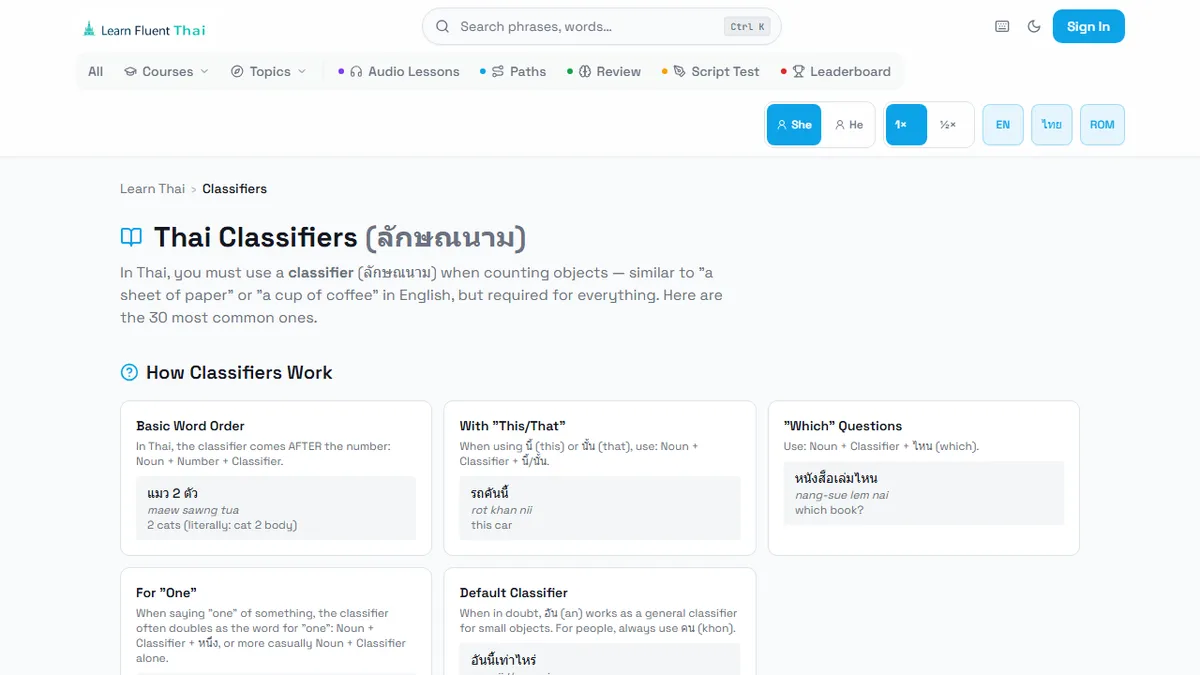
The word order for counted nouns in Thai is consistent: the noun comes first, then the number, then the classifier. This is the opposite of English word order for the same information, which trips up beginners who instinctively front-load the number.
So "two cats" becomes, in Thai, the equivalent of "cats two small-creature-classifiers." The classifier carries the categorisation; the number provides the quantity; the noun anchors the whole phrase. Once this sequence becomes automatic, the challenge shifts entirely to which classifier belongs to which category of noun.
This structure also applies when indicating quantity in non-number contexts: asking "how many?" uses the classifier in the same position, and the answer preserves the same order. Noun-quantity-classifier is the Thai pattern regardless of whether you are counting, asking, or specifying.
People, Animals, and the Most Common Object Classifiers
The classifier for people is khon, appearing whenever a number of human beings is specified. Professions, family members, customers, friends: all of them are counted with khon. Its meaning is essentially "person-unit", and it covers every human category without exception.
Animals use tua, which also serves for clothing items (shirts, trousers) and certain furniture. The extension from animals to clothing is counterintuitive at first but reflects a conceptual grouping around "body-shaped" or "form-fitting" objects. Once you encounter it a few times, it feels less strange.
General small objects use an, the most versatile of the inanimate classifiers. Rings, keys, candies, pencils show the breadth of this classifier. It is a useful fallback when you are unsure of a more specific one, though native speakers will notice and gently correct habitual over-reliance on it.
Flat Objects, Books, Vehicles, and More
The classifier bai covers flat, leaf-like objects: plates, envelopes, leaves, pages torn from a book, lottery tickets. The conceptual root is the leaf shape, and once you visualise that shape, the range of bai items becomes predictable.
Books, notebooks, and bound volumes use lem, which also extends to knives and certain pointed objects, reflecting a grouping around spine-like structures. This is one of the classifiers where the logic requires a small mental stretch, but consistent encounter with it in natural sentences makes it stick rapidly.
Vehicles with wheels use khan: cars, bicycles, motorcycles, trucks. The practical importance of this one is high: transport vocabulary comes up constantly in Thai daily life, and knowing khan immediately makes sentences about taxis, buses, and motorbike taxis grammatically correct.
Long tubular objects — poles, pens, cigarettes, candles — use kaan, while buildings and houses use lang, and rooms use hong. The complete Thai classifier reference with examples covers the full inventory with usage examples for each, which is invaluable when you encounter an unfamiliar classifier in the wild.
When Thais Break the Rules: Informal Shortcuts You'll Hear
Spoken informal Thai, particularly among younger Thais in casual settings, frequently uses the noun itself as its own classifier in a reduplication pattern. Instead of "three notebooks with lem", a speaker might double the noun: notebooks-three-notebooks. This pattern is grammatically non-standard but widely understood and used, particularly when speaking quickly.
Thais also use an as a near-universal informal fallback, similar to how the English "piece" can substitute in a pinch. You will hear this in markets, casual conversation, and anywhere speed matters more than precision.
These shortcuts are worth knowing because you will hear them constantly and you will want to understand when it happens. However, adopting them as a substitute for learning the correct classifiers is a trap: informal shortcuts require a solid grasp of the formal system to use correctly and contextually. Learn the rules first; the informal variations will follow naturally.
Mistakes Foreigners Make and How to Avoid Them
The most common error is simply omitting the classifier entirely and hoping the noun and number together are enough. As described above, this produces understandable but markedly non-native speech. In transactional contexts like shopping or ordering, it usually works; in conversations where you want to be taken seriously as a Thai learner, it undermines credibility.
The second most common error is defaulting to an for everything animate. Animals require tua and people require khon. Using an for either is not merely imprecise but can sound dismissive, as if you are treating people or animals as generic objects.
Conflating bai and an for flat items is also frequent. Plates and envelopes always use bai; coins and buttons use an. The dividing line is whether the object is primarily defined by its flat-leaf shape or by being a small generic item.
Drills and Memory Tricks for Locking In the Core Set
The ten to fifteen classifiers that cover the majority of everyday nouns can be learned in two to three weeks with daily deliberate practice. The key is to drill them in full Noun-Number-Classifier sentences from the start, rather than in isolation.
A productive drill format: take a category of nouns you already know — transport, animals, household items — and practise counting several items in that category, applying the correct classifier each time. Doing this aloud rather than silently improves retention significantly, because production requires deeper processing than recognition.
Mnemonics can help for the less intuitive classifiers. For lem, visualise a knife slicing the spine of a book. For khan, imagine a vehicle with a handle or steering wheel, and khan sounds close enough to "can" to build a steering-wheel image around. Associations that are vivid and even slightly absurd stick better than neutral ones.
Once the core set is memorised, the remaining classifiers are best acquired through reading and conversation rather than further drills. Encountering tua used for a shirt in a real sentence, understanding the context, and moving on is more durable than adding it to a flashcard list prematurely.