Why Thai Tones Are Non-Negotiable (and Not as Scary as They Sound)
The first thing most learners discover about Thai (usually with mild alarm) is that the same syllable can mean five completely different things depending on how you pitch it. This sounds like a cognitive obstacle of the highest order. In practice, it is a learnable system with clear rules, and the sooner you commit to understanding it properly, the faster every other aspect of Thai study accelerates.
Thai is a tonal language, which means pitch is a grammatical feature, not an emotional inflection. In English, saying "Really?" with a rising voice signals a question. In Thai, the shape of your pitch on a given syllable determines which word you are saying in the first place. That distinction matters enormously for how you approach study. You are not adding expression to language; you are producing the language itself.
The good news: Thai tones follow rules tied to the writing system's consonant classes and tone marks, and those rules are finite. You are not memorising each word's pitch independently. You are learning a system.
The 5 Thai Tones Explained: Mid, Low, Falling, High, Rising
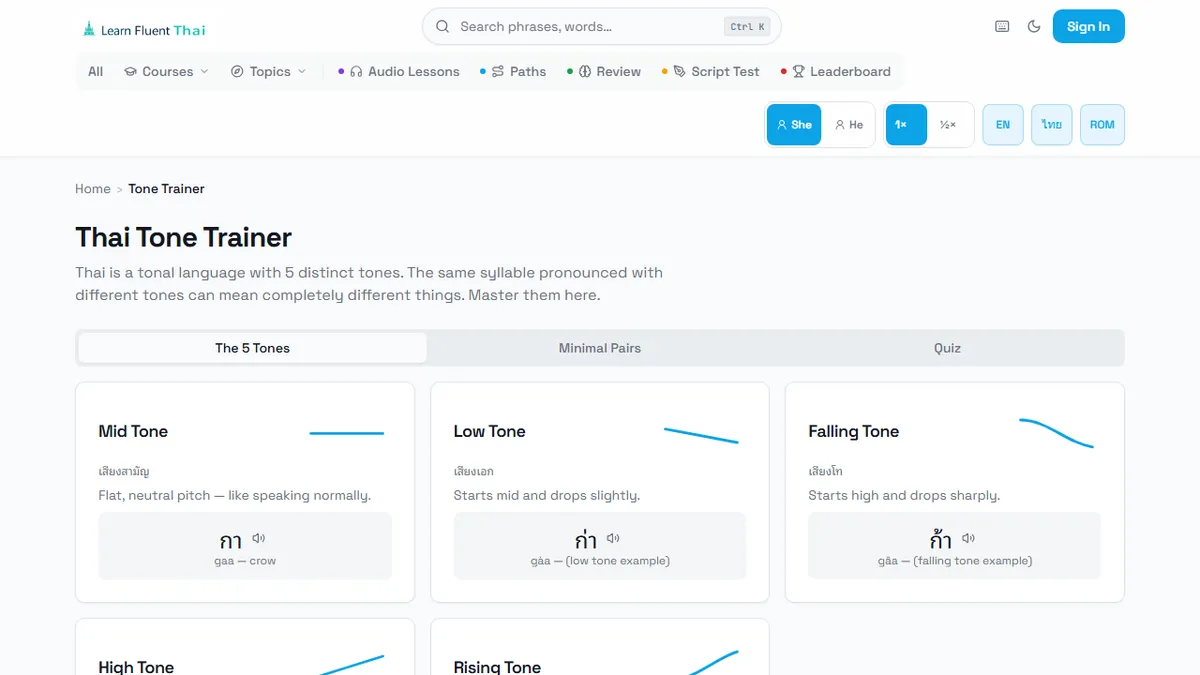
Thai has exactly five tones, each with a distinct pitch shape. Getting a clear acoustic model of each one before you try to produce them is essential.
The mid tone is delivered flat, at your natural speaking pitch. It does not rise, fall, or dip. Think of it as your vocal resting state.
The low tone starts below your natural pitch and stays there throughout the syllable, creating a subtle but distinct drop from your default register.
The falling tone is one of the most prominent: it begins high and sweeps decisively downward, like the intonation of a firm statement in English, but applied to a single syllable.
The high tone sits noticeably above your natural register and is held there, often with a slight upward push at the end in faster speech.
The rising tone does the opposite of falling: it begins low and curves upward, similar to the questioning lilt in English but again confined to a single syllable rather than a whole sentence.
Each tone occupies its own pitch territory, and that separation is what allows the Thai ear to distinguish them reliably, even in fast conversational speech.
How Tone Determines Meaning: Real Examples That Prove the Point
The classic teaching example is the syllable "mai", which, depending on tone, can mean new, burn, wood, not, or serve as a question particle. Change the pitch and you change the word entirely. This is not a quirk of one syllable; it applies across the vocabulary.
Similarly, "khao" can mean white, rice, news, or enter, each on a different tone. Native Thais process these distinctions automatically, the way English speakers distinguish "bare" from "bear" by context and spelling. The difference is that in Thai, context alone may not rescue a mistoned utterance, especially for beginners who do not yet have the surrounding vocabulary to signal intent.
The practical implication: sloppy tones do not merely make you sound foreign. They produce a different word. Ordering food, giving your address, or describing someone's age all involve syllables where a wrong tone creates confusion or unintended comedy. Getting the tones right from the start protects both comprehension and credibility.
Common Mistakes English Speakers Make With Thai Tones
English speakers approach Thai tones with a specific handicap: their native language uses pitch to signal emotion, question, and emphasis, not to distinguish vocabulary. This habit runs deep and produces several recurring errors.
The most common is flattening under stress. When beginners concentrate on forming words correctly, they unconsciously level out all pitch variation, producing everything in a monotone mid-register. The result is syllables that are technically pronounced but tonally incorrect across the board.
A related error is rising at the end of sentences. English interrogatives rise at the end, and Thai learners often import this habit, inadvertently toning the final syllable of every question as rising even when the word requires a different tone.
Learners also tend to exaggerate the falling tone while undershooting the high tone. The falling tone feels intuitive because it resembles English declarative intonation at a sentence level. The high tone, which requires pushing pitch into an uncomfortably elevated register, feels unnatural and gets produced at mid-tone volume instead.
Practical Drills: Training Your Ear Before Your Mouth
The sequence matters: hear before you speak. Before attempting to produce tones, spend time listening to minimal pairs (same syllable, different tones) until you can reliably identify which tone you are hearing without looking at notes. This trains the perceptual discrimination that has to precede accurate production.
Once you can hear the difference consistently, begin production drills using a single syllable. Pick one vowel ("aa" works well) and practise each of the five tones in order, checking your pitch against a reference audio. The aim is not perfection but conscious awareness of what each tone feels like in your vocal apparatus.
From there, practise short words in each tone category, then minimal pairs, then short phrases. The interactive tone practice tool provides structured audio reference and visual pitch charts to help you self-correct during practice sessions. Using visual feedback alongside audio accelerates the calibration process.
Using Visual Tone Charts and Audio Tools to Self-Correct
A tone chart maps each of the five tones onto a pitch grid, showing start point, trajectory, and end point as a simple curve or line. These charts are useful not because they replace audio, but because they give you a visual anchor when your ear is still calibrating.
When you practise a tone and it sounds wrong but you cannot identify why, looking at the chart while replaying the reference audio often clarifies whether your pitch started too high, dropped too soon, or failed to rise far enough. The combination of visual and auditory feedback works faster than audio alone.
Record yourself regularly. Listening back to your own production with a few seconds of distance is more revealing than trying to monitor yourself in real time. Compare your recording against a native speaker's reference, focusing on one tone at a time rather than assessing everything simultaneously.
How Long Until Tones Feel Natural? Honest Expectations
Six to eight weeks of daily deliberate practice is a reasonable timeline for tones to shift from effortful to semi-automatic. That does not mean perfect — it means you stop consciously calculating tone on every syllable and begin producing it alongside pronunciation without the mental overhead doubling.
Full automaticity, where tones are embedded in your motor memory and no longer require separate attention, typically takes four to six months of consistent speaking practice with feedback. The key variable is whether you practise producing tones in context (in real sentences and conversations) or only in isolation.
Tones practised only in drills often fail to transfer smoothly into speech. The goal is to move from isolation practice to phrase practice to conversational practice as quickly as the foundation allows. Tones that feel fragile in drills but usable in slow conversation are tones that are progressing correctly.
The Single Most Useful Insight for Beginners
Tone errors feel more catastrophic to learners than they are to patient Thais. Native speakers who interact regularly with foreigners develop the ability to infer meaning from context even when tones are imperfect. This does not mean tones do not matter (they do, significantly), but it means your early attempts will be understood more often than you fear. The embarrassment is smaller than the anticipation of it.
Commit to correct tones from the first lesson rather than treating them as something to fix later. Habits formed in the beginner stage are notoriously resistant to correction; the learner who half-tones their way through A1 vocabulary and then tries to retroactively fix everything at B1 faces a substantially harder task than the learner who built accuracy in from the start.