On this page
Mistake 1: Using the Same Greeting Regardless of Gender
The first lesson most Thai learners encounter covers sawasdee (the ubiquitous Thai greeting), and the first complication is usually glossed over: the word is almost always completed by a gender-appropriate politeness particle. Men add "khrap"; women add "kha". Without that particle, the greeting is technically incomplete and registers as either childlike or indifferent to Thais who hear it.
This is not a minor stylistic preference. Politeness particles in Thai carry significant social weight, and their absence is noticed. The greeting "sawasdee" delivered alone, without a terminal particle, is the linguistic equivalent of mumbling your way through an introduction. It is understood, but it communicates something unintentional about your attitude toward the interaction.
Fix it by deciding immediately which particle is yours and making it an absolute reflex. It should be the last sound of every greeting you produce, every time, without exception.
Mistake 2: Ignoring Politeness Particles (Khrap vs Kha)
This follows directly from Mistake 1 but extends further. Politeness particles in Thai are not limited to greetings: they punctuate affirmations, requests, answers, thanks, and farewells. Omitting them throughout a conversation creates a cumulative impression of bluntness that can be misread as rudeness, even when no rudeness is intended.
Male speakers use "khrap" (often reduced in speed to "kap" in casual speech). Female speakers use "kha" in rising tone for warm or questioning contexts and "kha" in low tone for declarative statements. The tonal distinction in the female particle is subtle but audible to native speakers and worth mastering.
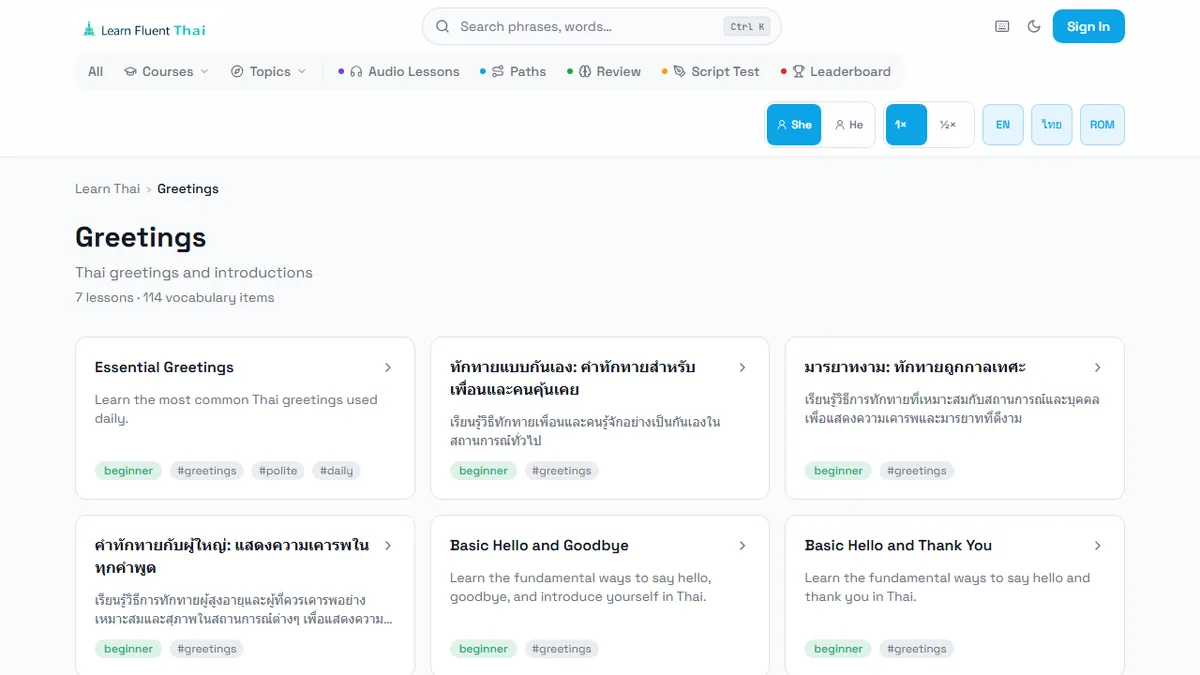
The Thai greetings lesson category covers the full range of greeting contexts alongside their appropriate politeness completions, which is a faster way to embed the habit than drilling particles in isolation.
Mistake 3: Saying Sawasdee Without the Wai — or Wai-ing Everyone
The wai is the Thai gesture of greeting: palms pressed together at chest or face height with a slight bow. Foreigners typically handle it in one of two ways: either they never use it at all, greeting verbally while standing straight, or they wai indiscriminately at everyone they encounter including service staff, children, and people significantly younger than themselves.
Both are errors, though the first is forgivable and the second is more awkward. The wai is a gesture calibrated to relative social status and context. Higher-status or older persons generally receive the wai first. Monks, teachers, and respected elders are wai-ed at forehead level. Peers are wai-ed at chest level. Service staff in a transactional context are typically not wai-ed by customers. Doing so creates a momentary social confusion that puts the other person in an uncomfortable position.
The practical starting point for foreigners: wai when it is offered to you, and reciprocate appropriately. Initiating the wai toward monks, teachers, and clearly older individuals is always correct. Defaulting to a slight nod when uncertain is safer than an unsolicited wai in the wrong social direction.
Mistake 4: Treating All Time-Based Greetings as Interchangeable
Thai has time-of-day greetings — morning, afternoon, evening variants — that are grammatically distinct from sawasdee. These are used in formal and semi-formal contexts, particularly in professional settings, schools, and official environments. They are not casual alternatives to sawasdee; they carry a register that signals formality.
Using a time-based greeting in a casual encounter can land as stiff or overly formal, while using the universally applicable sawasdee in a formal presentation or meeting can read as insufficiently prepared. Understanding the register distinction, and when each applies, is the difference between greetings that open doors and greetings that accidentally close them.
Mistake 5: Mispronouncing the Falling Tone on Sawasdee
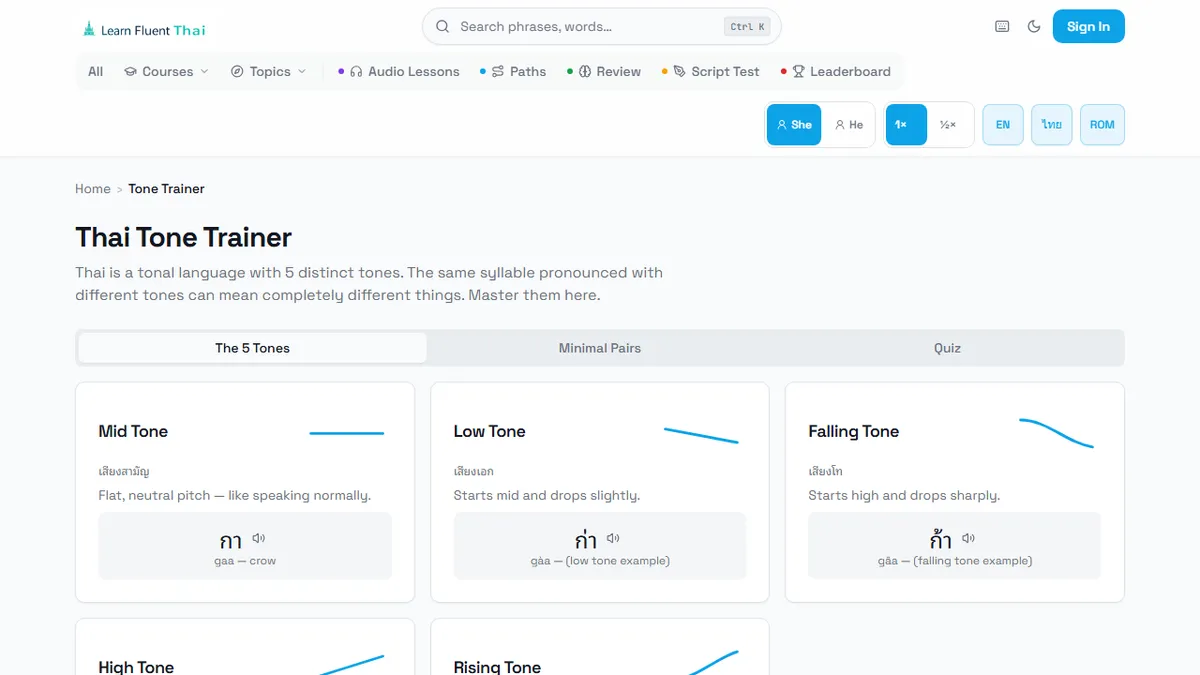
Sawasdee contains a falling tone on its final syllable, "dee": the pitch begins high and sweeps downward decisively. Beginners who have not yet internalised Thai tones almost universally pronounce this syllable as flat or slightly rising, following English prosodic habits where terminal syllables either level out or rise slightly.
The practical effect: a Westernised pronunciation of sawasdee does not produce a wrong word the way a mistoned single syllable would, because the full word provides enough context. But it does immediately mark the speaker as someone who has not engaged with Thai tones, which changes the subsequent conversation. Thais adjust their speech speed and vocabulary to suit the perceived level of the foreigner, sometimes helpfully, sometimes in ways that actually slow down learning.
Correct the falling tone on "dee" early. It is an easy win for authenticity and signals to your Thai interlocutor that you are worth engaging with in natural speech.
Mistake 6: Forgetting to Adjust Formality by Social Context
Thai operates across a broad spectrum of formality levels, and greetings index that spectrum immediately. The same verbal greeting delivered to a Buddhist monk, a colleague, a street food vendor, and a close friend should differ not just in the presence or absence of a wai but in vocabulary, particle use, and speed.
Highly formal greeting vocabulary, used inappropriately in a casual context, comes across as pompous. Casual greeting vocabulary in a formal context communicates disrespect. Beginners, having learned one register, apply it everywhere — usually the polite-but-not-formal middle register — which mostly works but misses opportunities to build genuine rapport and occasionally missteps in clearly formal settings.
Developing formality sensitivity comes from exposure: listening to how Thais greet different interlocutors in different contexts and noting the vocabulary and particle choices. Audio lessons categorised by context accelerate this exposure considerably compared to classroom study.
Mistake 7: Skipping Farewells Entirely
The farewell is the greeting's overlooked twin. Many beginners invest real effort in learning the opening greeting and then end encounters by simply walking away or saying "bye" in English. In Thai culture, where the quality of an interaction is assessed in part by how gracefully it concludes, an abrupt or absent farewell is noticed.
"Laa gon" is the standard farewell, completed with the appropriate politeness particle. There are also warm informal leave-takings that signal affection or anticipation of meeting again. Using any Thai farewell rather than a defaulted English one dramatically improves how the interaction registers.
Quick Reference: Greeting Phrases That Actually Impress Thais
Beyond the fundamentals, a handful of phrases signal genuine cultural engagement. Asking after someone's wellbeing using the idiomatic Thai equivalent, rather than the direct translation that beginners often reach for, lands very differently. Knowing the phrase for "see you again" versus "goodbye for now" shows awareness that the language distinguishes these situations.
Most Thais who encounter foreigners speaking Thai are genuinely delighted rather than critical. The bar for impressing someone with your Thai greetings is lower than beginners fear: get the particle right, use an appropriate wai when warranted, deploy the correct tone on sawasdee, and follow through with a farewell. That four-part checklist is achievable within a week and produces a measurably warmer reception in virtually every Thai encounter.