What the E33G Digital Nomad Visa Actually Grants You
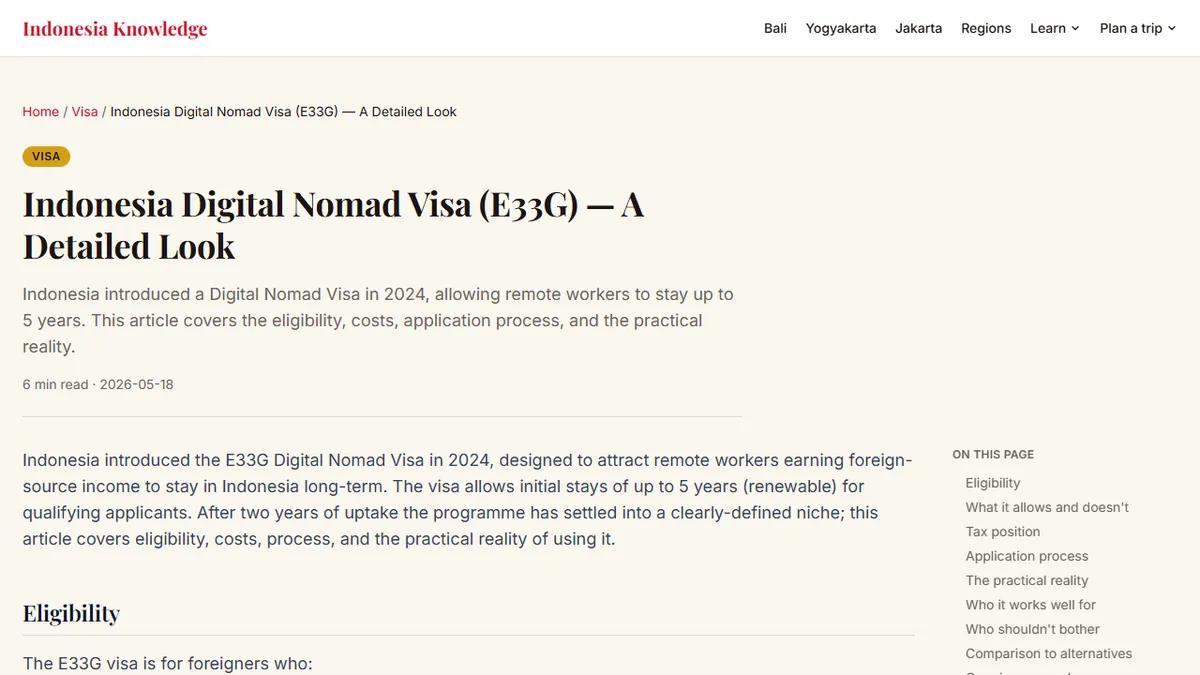
Indonesia's E33G visa, formally classified under the B211 social-cultural stay permit category with digital nomad subcategory, offers one of the more generous long-stay authorisations in Southeast Asia. The headline figure is a five-year stay entitlement, with annual extensions processed in-country. Holders are authorised to reside in Indonesia and conduct remote work for foreign employers or clients. That is the critical legal structure that distinguishes it from a tourist visa, which carries no such work authorisation even if nobody is actively checking what you do on your laptop.
What the E33G does not grant is Indonesian work authorisation. You cannot be employed by an Indonesian company on this visa, and you cannot invoice Indonesian clients without triggering domestic tax exposure. The visa is designed explicitly for those earning income from sources outside Indonesia, and this distinction shapes almost every practical aspect of life on it.
The full breakdown of the E33G eligibility criteria covers the formal requirements, but the day-to-day reality of how the visa functions in practice (from banking access to co-working registration) differs in several ways from the official language.
The Income Threshold: USD 60,000 — What Counts as Proof
The stated annual income requirement for the E33G is USD 60,000. This figure trips up a substantial proportion of applicants, not because they don't earn it, but because the proof requirements are more specific than a simple income declaration.
Acceptable evidence generally includes bank statements showing inflows consistent with the claimed income, employment contracts from foreign companies, or accountant-certified annual accounts for freelancers. The challenge for many remote workers is that income arrives through platforms like Stripe, PayPal, or Wise, which generate statements that Indonesian immigration officials are less familiar with than standard payslips. Some applicants supplement platform statements with client invoices, business registration documents, or declaration letters from their accountants.
The USD 60,000 threshold is not applied as a rolling average in all processing offices. Applications reviewed in different cities have received different interpretations, another reason why preparation and documentation depth matter more than simply assuming the threshold is met.
Tax Residency Risk: When Does Living in Bali Trigger Indonesian Tax?
This is where the E33G can create unexpected obligations for applicants who don't take advice beforehand. Indonesian tax law applies a 183-day rule: any individual who spends more than 183 days in Indonesia within a 12-month period becomes a tax resident, which triggers domestic tax obligations on worldwide income.
The practical implication is that an E33G holder who arrived in January and reaches 183 days by early July could, in theory, owe Indonesian tax on their full global income for that year, even if that income was earned from a foreign employer and paid into a foreign bank account. The current enforcement reality is that foreign digital nomads are rarely targeted by the Directorate General of Taxes, but the legal exposure is real and the regulatory environment has been tightening since 2023.
The safest approach for anyone planning to exceed six months is to obtain local tax advice before the clock reaches 183 days. Some nomads manage this by taking a brief trip out of the country before the threshold is crossed; others structure their Indonesia stays to fall below the trigger and maintain tax residency in their home country.
E33G vs Tourist VOA vs Second-Home Visa: A Decision Framework
The tourist Visa on Arrival (VOA) grants 30 days extendable to 60, with a possible second 30-day extension, a maximum of around 60 days per entry, though some visitors use visa-run strategies to reset the clock. This works for short stays but has no work authorisation attached and becomes logistically awkward for anyone planning more than two months.
The second-home visa targets a different demographic: wealthy individuals or retirees who can demonstrate either a significant bank balance (the threshold is substantial) or ownership of qualifying Indonesian property. It is a longer-stay instrument but without the income-source flexibility of the E33G.
The E33G sits between these two: accessible to working professionals with verifiable income, relatively clear in its requirements, and long enough to build a genuine Indonesia base. For most remote workers planning a stay of three months or longer, it is the appropriate route — but only after the tax implications have been considered.
Practical Application Steps and Which Agents to Avoid
The E33G application can be submitted at an Indonesian consulate abroad or, in some circumstances, converted from an existing tourist status in-country. The consulate route is generally more predictable. Required documents typically include the income proof described above, a valid passport with at least 18 months remaining, a health insurance certificate covering the full stay period, and a clean criminal record certificate.
The agent market around Indonesian visa processing is extensive and uneven. Many legitimate agents operate in Bali's Canggu and Seminyak areas and offer genuine value by navigating the paperwork and following up with immigration offices. The risk is that a proportion of agents advertise services for visa categories they have limited experience processing, or charge premiums for expedited timelines they cannot guarantee. Recommendations from other E33G holders (found in online communities and dedicated expat forums) are a more reliable screening mechanism than agent websites.
Life on the E33G: Banking, Co-Working and Health Insurance Realities
The practical day-to-day guide for digital nomads in Indonesia addresses these topics in full, but several friction points deserve specific mention.
Banking on an E33G is possible but not seamless. BCA, Indonesia's largest private bank, and BNI, the state bank, both accept E33G holders for account opening, but the process requires in-person branch visits, KITAS-equivalent documentation (the E33G functions similarly), and patience. Some nomads continue operating through foreign accounts for months before completing local banking. Wise and Revolut function in Indonesia for day-to-day spending but have transfer limits that matter for anyone paying villa rentals in rupiah.
Co-working infrastructure in Bali is genuinely good: Dojo in Canggu, Outpost in Ubud, and numerous smaller spaces across the island provide reliable fibre, meeting rooms, and the social structure that combats the isolation of solo remote work. Internet speeds in good co-working spaces typically benchmark above 100 Mbps, adequate for video calls and cloud-based work without limitation.
Health insurance is mandatory on the application and advisable to maintain throughout the stay. The international policy requirement is a genuine one: Indonesian public healthcare, while improving, is not calibrated to the expectations of most Western applicants, and private hospital bills without coverage can be substantial.