On this page
Why Your Bali Base Matters More Than Anywhere Else in Indonesia
Bali is small enough to look simple on a map but large enough that choosing the wrong base creates a constant logistical drag. Traffic between the major areas (particularly between the southern beach zones and Ubud) moves slowly, especially during high season. A couple staying in Kuta who spend their holiday wishing they were somewhere quieter, or a digital nomad who books a peaceful Ubud villa and discovers there's nowhere to co-work nearby, is making a problem that could have been avoided with twenty minutes of upfront research.
The island's character shifts dramatically between its zones. The southern tip, from Kuta north through Canggu, has a coastal energy built on surf, nightlife, and international food. The central highlands around Ubud operate at a slower register, shaped by temples, rice paddies, and wellness. The eastern coast around Sanur is where the sea calms down and families find their footing. Understanding these zones is the single most effective Bali planning step available.
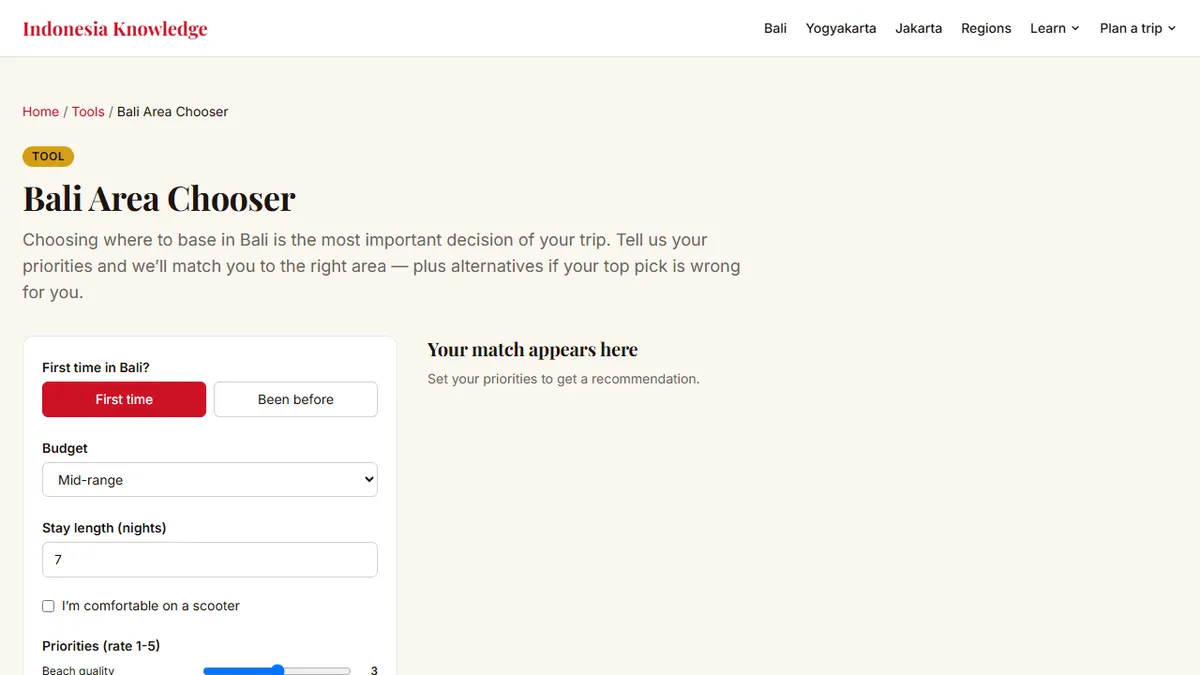
For those who want a data-driven approach, the interactive tool that scores Bali areas against your priorities matches each neighbourhood to your travel style across categories including surf, quiet, family suitability, and digital nomad infrastructure.
Canggu and Pererenan: The Digital Nomad and Surf-Bar Crowd
Canggu became Indonesia's remote-work capital over the decade following 2015, and its northern extension Pererenan has absorbed the overflow of people seeking a slightly calmer version of the same offer. The neighbourhood's draw is a dense ecosystem of co-working spaces, reliable fibre internet, specialty coffee shops, and surf breaks within walking distance. Batu Bolong beach has manageable swells for intermediate surfers; Echo Beach is larger and more powerful.
The cost here has risen sharply since the post-pandemic surge. A decent villa with a private pool in Canggu now benchmarks at prices comparable to parts of Lisbon or Lisbon, which surprises first-timers expecting budget Southeast Asia. The trade-off is excellent: strong infrastructure, an enormous social scene for solo travellers, and a concentration of good restaurants that punches well above the neighbourhood's modest size.
Seminyak and Petitenget: Upmarket Dining and Beach Clubs
Seminyak is what Kuta aspired to be before it got too crowded to pull it off. The streets are lined with high-end restaurants, boutique fashion shops, and some of Bali's best beach clubs. Potato Head Beach Club and Ku De Ta (now rebranded as COMO Beach Club) sit on Seminyak's beachfront and represent the polished end of the island's hospitality. The food scene spans every price point from good warungs to long-table tasting menus.
The beach here is sunset gold at the right hour, and the main Seminyak strip (Kayu Aya and Oberoi) concentrates dining, shopping, and nightlife within a walkable area. Accommodation ranges from mid-market hotels to spectacular private villas, and the relative order of the streets compared to Kuta is genuine. Petitenget, just north, is quieter still and where many long-term residents position themselves.
Ubud: Cultural Immersion, Rice Paddies and Wellness Retreats
Ubud is the counterpoint to everything south Bali represents. Where the coast is about hedonism and surf, Ubud is about Balinese Hindu culture, the mechanics of traditional craft, and a silence that the southern areas genuinely cannot offer. The town sits surrounded by rice terrace walks (the Campuhan Ridge Walk and the Tegalalang terraces are both within twenty minutes) and the density of temple activity here gives a sense of what Bali's religious life actually looks like beyond sarong-at-the-gate formality.
The wellness industry arrived here first and is still concentrated here most strongly. Yoga retreats, sound-healing sessions, raw-food cafes, and Ayurvedic massage options are all available in a ten-minute walk radius of the central market. The central market itself is worth a morning of unhurried browsing for textiles, woodwork, and silver.
The limitation: Ubud is inland and the nearest usable beach is an hour away. If swimming in the ocean is a daily priority, Ubud should be a mid-trip detour rather than a full-stay base.
Uluwatu and the Bukit Peninsula: Cliff Temples and Serious Surf
The Bukit Peninsula hangs off Bali's southern tip like a stone thumb, and its dramatic limestone cliffs create some of Asia's most technically demanding surf breaks. Uluwatu, Padang Padang, and Bingin are names in the international surf circuit, and the breaks here attract serious surfers who accept that the access points often involve stairs cut into cliffsides. Padang Padang's canyon entry, narrow, steep, and crowded during a good swell, is genuinely inconvenient for everyone except the people who have come specifically for it.
The Uluwatu Temple is one of Bali's six directional sea temples, perched on the cliff edge at sunset with views down to the breaking waves. The kecak fire dance performed here at dusk is a full performance, not a truncated tourist excerpt. Beyond surf and temples, the Bukit has developed a good clutch of surf lodges, cliff-top restaurants, and infinity-pool resorts. It suits couples who want dramatic scenery and experienced surfers who want the breaks.
Sanur and Nusa Dua: Families, Calm Seas and Resort Comfort
Sanur's beach faces east, which means morning light, gentle surf protected by an offshore reef, and calm water conditions that make it the most reliably swimmable beach zone in southern Bali. This configuration makes it the preferred family destination. The promenade running along the beach (flat, walkable, shaded in parts) is used by cyclists and walkers at all hours. The town itself is quieter than anywhere else in south Bali, and the accommodation market skews toward established resort hotels and long-stay apartments.
Nusa Dua, further south, is a purpose-built resort enclave with manicured grounds, five-star chains, and very little of Bali's organic character. The trade-off for this is impeccable service standards and an almost entirely controlled environment that suits families with young children and travellers who prioritise comfort over authenticity.
North and East Bali: The Quiet Alternative Most Visitors Overlook
Amed, on Bali's northeast coast, and the areas around Lovina in the north represent the island's quietest visitor zones. Amed has built a small diving and free-diving community around its calm bay, and the black-sand beaches here (though not dramatic) offer a genuine sense of escape from the south's density. The USAT Liberty wreck at nearby Tulamben is one of the most accessible shore-dive shipwrecks in Asia, reachable by walking in from the beach.
Lovina is known for its dawn dolphin-watching boat trips (modest in spectacle but popular) and the cooler highland interior between north and south Bali passes through the volcanic landscapes around Mount Batur, where a dawn hike delivers a different kind of Bali sunrise than Borobudur's famous viewpoints. Travellers who allocate a day or two to the north find a version of the island that operates at a different tempo to the south — less polished, more representative of what the island looked like before the international tourism wave fully arrived.