The Core Question: Are You Optimising for Lifestyle or Budget?
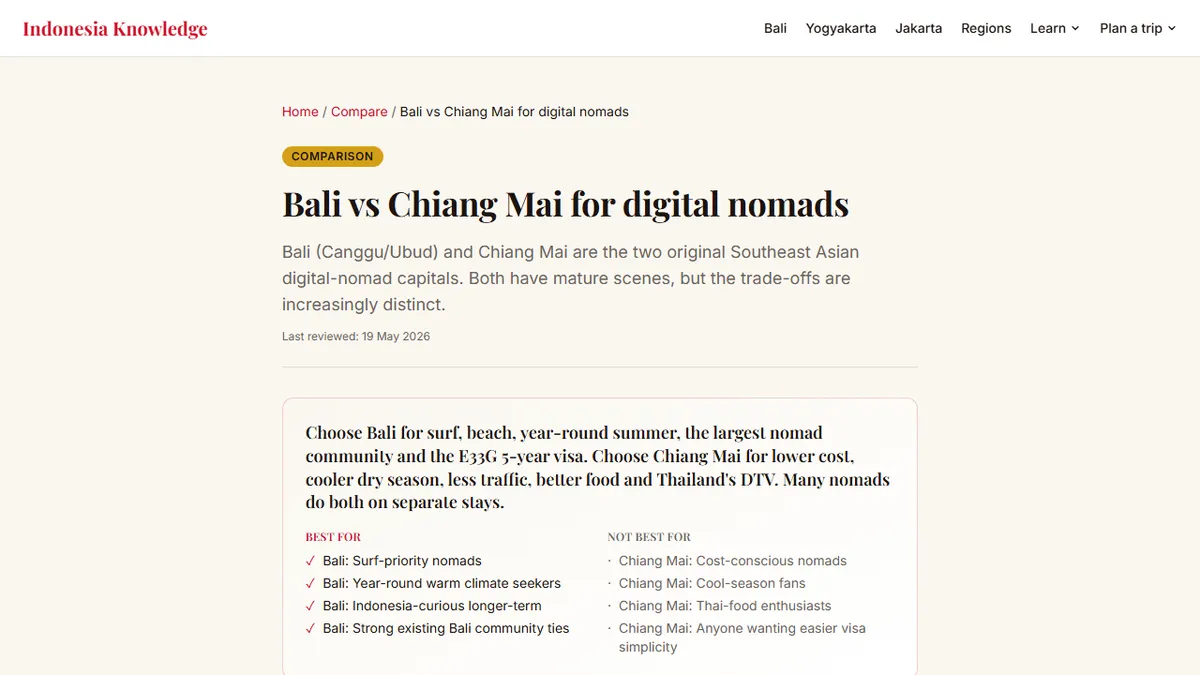
Before running any detailed comparison, it helps to identify what you're actually trying to maximise. Bali and Chiang Mai have both earned their places at the top of remote-work destination rankings, but they do so for different reasons and suit different working personalities.
Bali's appeal is largely experiential: ocean swims, surf sessions before the laptop opens, temple ceremonies on a Tuesday, and a social scene built around a large and self-renewing international community. The lifestyle feels exceptional even on a modest budget, if you define modest by Western European or North American standards. But by Southeast Asian standards, Bali's Canggu has become expensive. You are paying, in part, for the experience of the place itself.
Chiang Mai's appeal is quieter and more rational. The city is inland, surrounded by mountains, cooler for much of the year, and significantly cheaper across almost every spending category. The food culture is arguably the deepest in Southeast Asia outside Bangkok. The co-working infrastructure is mature. The nomad community is large and friendly, and the city functions exceptionally well as a place to get work done.
The side-by-side scoring of Bali and Chiang Mai across ten nomad criteria gives the detailed comparison across categories; what follows is the nuanced assessment behind those scores.
Cost Breakdown: Rent, Food, Co-Working, Transport (2025 Numbers)
In Canggu, a decent private villa (not a luxury villa, but a clean modern room with air conditioning, a pool, and reliable Wi-Fi) now rents at between USD 700 and USD 1,400 per month depending on proximity to the beach and the season. A studio apartment further from the action can come in lower, but the Canggu premium is real and has roughly doubled since 2019.
In Chiang Mai's Nimman area (the nomad neighbourhood equivalent), a furnished apartment of comparable quality runs USD 350 to USD 600 per month. A shared house option can halve that. The gap is substantial.
Food spending closes some of the gap. Bali's warung culture makes local eating very affordable, and a full meal at a good local restaurant costs under five dollars. Chiang Mai is similarly cheap for local eating, but the proportion of daily spending that goes toward food is lower in absolute terms. Co-working day rates are roughly comparable: between USD 8 and USD 15 for a full day at quality spaces in both cities. Monthly desk memberships at Chiang Mai co-working spaces average slightly lower than Bali equivalents.
Transport costs in Chiang Mai are lower, primarily because scooter rental is cheaper and the city's geography is more compact and less traffic-prone than Canggu's coastal strip.
Visa Routes: Indonesia E33G vs Thailand DTV Compared
This is where the two destinations diverge structurally. Thailand introduced the Destination Thailand Visa (DTV) in 2024, offering a 180-day stay per entry with multi-entry rights on a five-year validity, a generous instrument that requires proof of funds (THB 500,000, roughly USD 14,000) rather than the E33G's USD 60,000 annual income threshold.
The lower financial bar of the DTV makes it accessible to a broader range of remote workers, including those earlier in their freelance careers. Indonesia's E33G requires more documentation and a higher provable income but grants the clearer legal work authorisation framing. For anyone who wants formal recognition that their remote work is sanctioned, the E33G is the stronger document. For those who prioritise accessibility and flexibility, the DTV wins.
Both countries enforce their visa conditions inconsistently, and the majority of nomads at both destinations use tourist entries rather than specialist long-stay visas — but the specialist routes are valuable for those who want legal certainty and plan multi-year stays.
Internet Reliability and Co-Working Quality in Each City
Both cities have mature co-working ecosystems with fibre connectivity, meeting rooms, and community programming. Bali's Canggu-Seminyak corridor has a particularly high concentration of quality spaces: Dojo, Outpost (which also operates in Ubud), and Tropical Nomad are consistently rated for reliable connectivity and amenity quality.
Chiang Mai's leading spaces, including CAMP at Maya Mall, RISTR8TO (which doubles as one of the city's best coffee roasters), and larger dedicated spaces in the Nimman area, offer comparable internet quality and the advantage of extremely good air conditioning during the hot season.
Bali has one real internet vulnerability: power outages during heavy rain can affect villas and co-working spaces alike, and the island's electrical grid, while dramatically improved, still lags behind Chiang Mai's stability. Nomads working with hard video-call schedules occasionally find Chiang Mai's reliability marginally better.
Community and Networking: Which City Has the Bigger Scene
Canggu's nomad community is probably the more visible of the two: the beach club scene creates constant opportunities for social interaction, and the concentration of nomad-specific events, meetups, and co-working community programming is very high. The community skews younger and more lifestyle-oriented.
Chiang Mai's nomad scene is older on average and, some argue, more professionally diverse. The city has hosted long-term nomads since the early 2010s, which means a deeper layer of established businesses, experienced operators, and individuals with deep knowledge of the region. The social calendar is less event-saturated than Canggu but the connections made tend to be more substantive.
Neither city has a disadvantage for networking; the difference is in character. Canggu is easier to meet people immediately. Chiang Mai is better for building relationships slowly.
Climate, Air Quality and Wellness Considerations
Bali's climate is coastal tropical, with temperatures ranging between 24 and 32 degrees through the year. The wet season (November to March) brings daily afternoon rain but rarely all-day downpours; mornings are frequently clear. Humidity is constant but the ocean breeze mitigates it significantly in the coastal areas.
Chiang Mai has a marked seasonal variation. The cool season from November to February sees temperatures drop to comfortable mid-twenties during the day, occasionally cooler at night (by Southeast Asian standards, genuinely pleasant). The concern is the March-April burning season, when agricultural fires in northern Thailand and neighbouring Myanmar create particulate levels that reach hazardous on the AQI scale for weeks at a time. This is a genuine quality-of-life limitation that should feature heavily in any Chiang Mai evaluation for anyone with respiratory sensitivities.
Verdict by Nomad Profile
For solo younger nomads who prioritise social life and ocean access, Bali wins. For budget-conscious individuals or couples planning stays longer than six months, Chiang Mai's lower costs and excellent infrastructure are compelling. Families with school-age children find Chiang Mai's international school options, road safety, and cooler climate easier to manage than Bali's traffic. Long-stay nomads seeking the most legally sound remote-work visa should evaluate the E33G against the DTV based on their income level. Both cities reward the investment of a longer stay — the one to two month visit rarely captures what either place offers at its best.