Why Raja Ampat Tops Every Serious Diver's Bucket List
The superlatives attached to Raja Ampat are not marketing language — they reflect genuine scientific documentation. The Bird's Head Seascape, of which Raja Ampat forms the heart, contains more documented marine species per unit area than anywhere else on Earth. Scientists have identified coral species here that don't exist in comparable density anywhere else in the Indo-Pacific. A single dive can yield sightings that would take a week of diving at lesser sites: reef sharks, multiple manta ray passes, pygmy seahorses, walking sharks, wobbegongs, schools of barracuda.
This is not accidental. The convergence of oceanic currents through the narrow straits between Raja Ampat's islands creates an upwelling of nutrients that supports extraordinary biodiversity at every level of the food chain. The communities who live here have invested in conservation infrastructure (from patrol boats to dive guide licensing) that has kept the reef system in far better condition than most comparable sites globally.
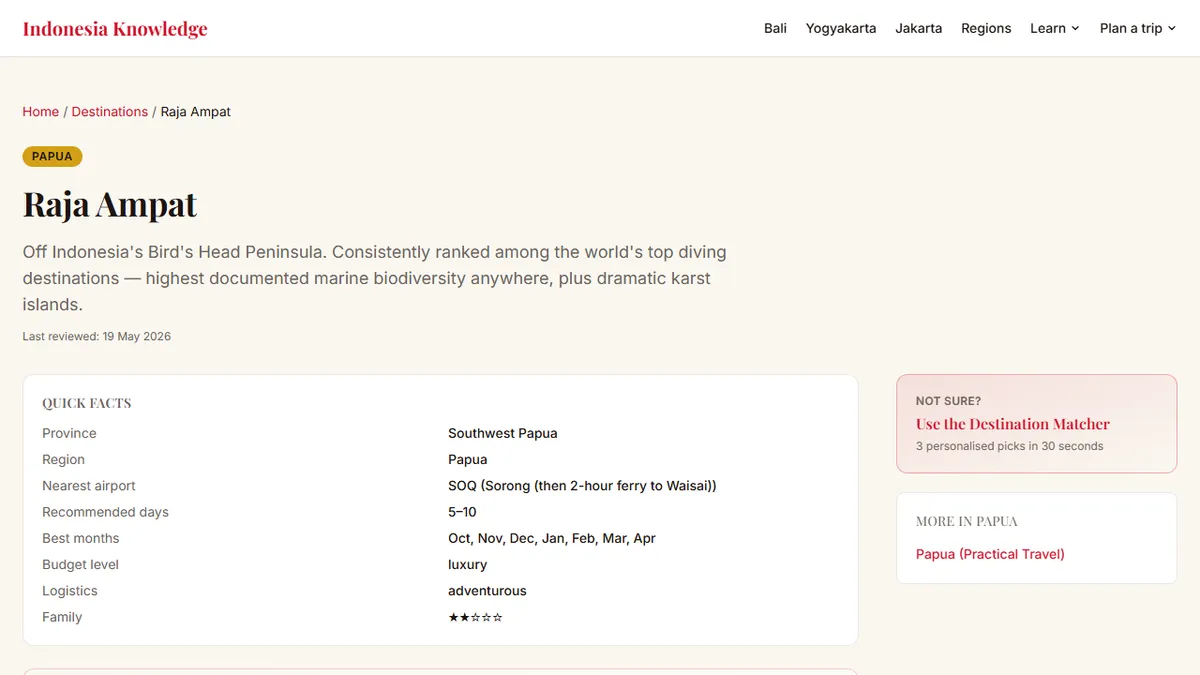
The quick-facts card for Raja Ampat including best months and transport difficulty gives the operational summary; what follows is the fuller picture of what you're getting into.
The Logistics Truth: Transit Time, Connections and Costs
Raja Ampat's remoteness is real and should be understood before booking. The gateway airport is Sorong (SOQ) in Southwest Papua. From Bali, the journey involves a domestic flight to Sorong (typically with a connection through Jakarta, Makassar, or Manado), adding up to between six and ten hours of flight time depending on the connection. From Singapore, London, or Sydney, add your international segment on top.
On arrival at Sorong, travellers transfer to the city's ferry terminal and board the 2-hour public ferry to Waisai, the capital of Raja Ampat regency on Waigeo Island. From Waisai, reaching the most frequently dived areas (the Dampier Strait, Wayag, or Misool in the south) requires additional boat transfers ranging from 30 minutes to four hours.
Total transit from Bali to a homestay in the Dampier Strait area: approximately 14 to 18 hours across two days. The return journey is the same. This is not a weekend trip and should not be planned as one.
Budget Reality: Why the 'Cheap Homestay' Is a False Economy Here
Budget options exist and are widely advertised. Basic homestays, family-run wooden structures on stilts over the water, start at around USD 50 to USD 80 per night including meals. This sounds reasonable until you account for the meals themselves: fish, rice, vegetables, served three times a day without variation for the duration of your stay. The experience can be authentic and memorable. It can also become monotonous quickly.
The more significant issue is dive infrastructure. Cheap homestays frequently have older, less well-maintained dive equipment, limited oxygen availability, and boat captains who may not have formal dive guide training. In one of the world's strongest-current dive environments, equipment quality and guide experience are not optional extras — they affect safety.
Mid-range operations that combine clean rooms with competent dive guides and regularly serviced equipment benchmark at USD 150 to USD 250 per night all-inclusive. For most first-timers, this tier is the better value proposition: the price difference over a seven-day trip is recoverable; a poor experience from substandard equipment is not.
Non-Divers in Raja Ampat: What You Can and Cannot Do
This question deserves honest treatment. Raja Ampat is promoted as a destination; for non-divers, it is a more limited one. The landscape, dramatic karst islands rising from flat seas and channels of intense blue water between forested hills, is genuinely spectacular and provides extraordinary photography regardless of whether you enter the water.
Snorkelling is strong in several areas, particularly in the shallower bays around Kri Island and Arborek. Sea turtles are frequently seen from the surface. The walking shark (epaulette shark) is visible in very shallow water without diving. Kayaking through mangrove channels and stand-up paddleboarding in calm bays are available at most homestays.
What is not available: nightlife, restaurants beyond your homestay, shopping, cultural attractions in any conventional sense, or the kind of varied land activities that make non-diving days fulfilling at most tourism destinations. A non-diver who goes to Raja Ampat primarily to keep a diver partner company will find the trip worth doing once but would likely prefer a destination where both parties have more to do.
Best Months, What the Rainy Season Means for Diving
Raja Ampat's diving calendar runs broadly opposite to Bali's. The best conditions occur between October and April, when seas in this part of Papua are calmer and visibility is highest. This inversely correlates with Bali's wet season, which means a diver planning a combined Bali-Raja Ampat trip has to accept one or the other in suboptimal conditions, or plan the trip around Raja Ampat's schedule.
The period from May to September sees rougher seas, lower visibility, and some homestays and resorts closing entirely. Diving is not impossible during these months, but the conditions are less predictable and the remote logistics become more difficult when weather creates ferry delays and boat cancellations.
Conservation Fee, Permit Rules and Responsible Tourism
The Raja Ampat Marine Conservation Fee is currently set at approximately USD 65 per visitor, paid on arrival at the designated collection points in Waisai or at certain homestay registration desks. The fee is legitimate, mandatory, and goes toward reef patrol, guide training, and community conservation programs. Attempts to avoid it, occasionally offered as a shortcut by informal agents, undermine the conservation programs that keep the marine environment in the condition that makes the destination worth visiting.
A separate entry permit is required for photographing certain sensitive areas and for some specific islands. Your dive operator or homestay should manage the permit paperwork; if they don't mention it, ask explicitly.
How to Structure a Seven-Day Trip from International Arrival
The seven-day Raja Ampat itinerary with logistics mapped out goes into full operational detail, but the broad framework is: arrive Sorong day one, stay overnight in Sorong, ferry to Waisai day two morning, reach your dive base by afternoon. Five full diving days, with one non-diving day recommended to allow your body to off-gas before the return flight. Depart Waisai the morning of day seven, return through Sorong, and reconnect with your international routing.
This structure allows four to five full days of two-dive days, which is meaningful without being exhausting. Extending to ten days allows a liveaboard component that accesses the more remote southern areas around Misool, a qualitatively different experience that experienced divers rate above the more accessible northern sites. Seven days is the effective minimum; anything shorter is logistically inefficient given the transit investment.