The Passion Trap
Most advice for new creators starts with a question: what do you care about? The logic seems sound. Pick a topic you love, and you will still be making videos in a year. The problem is that passion is a terrible predictor of sustainability. It tells you what to talk about, but not what the making will demand of you. A topic can be fascinating and still require a twelve-hour deep dive every week when you have four free hours. A topic can be meaningful and still demand a face on camera when the thought of being watched makes you freeze.
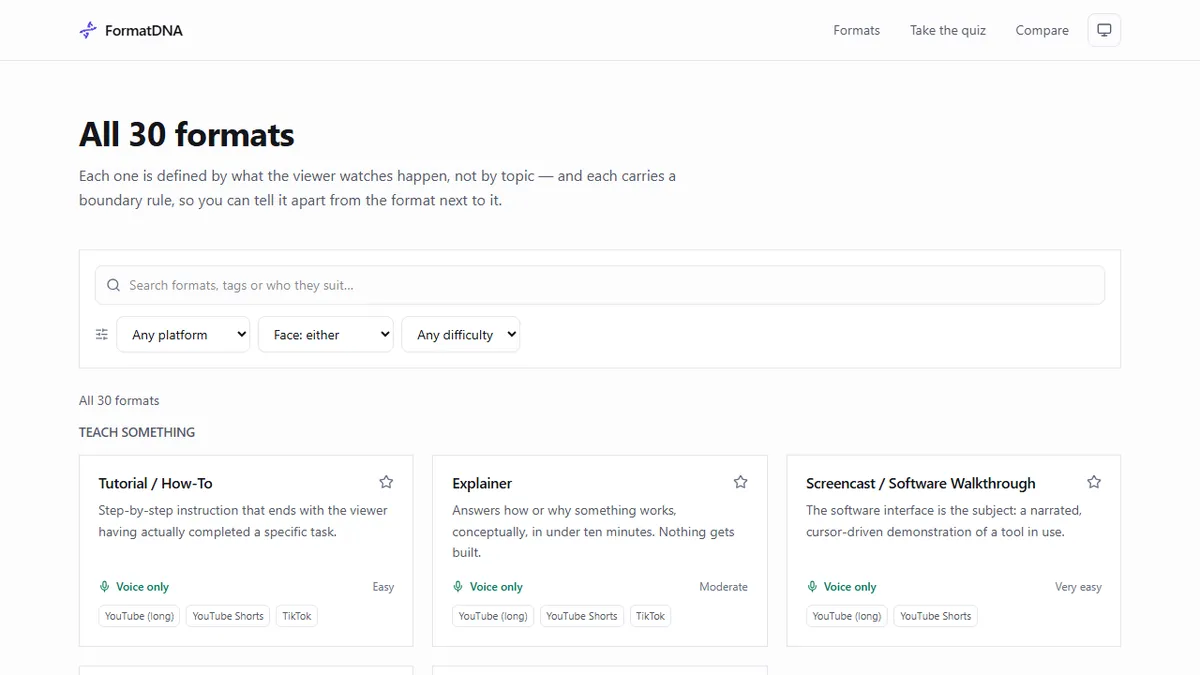
The format is the repeatable shape of the video. It determines whether you need a camera, a microphone, a budget, an editor, and a schedule. It determines whether you can make something in two hours or need twelve. The format, not the niche, is what you actually have to sustain. So the smart first move is to match your week, not your passion. The full catalogue of thirty formats can tell you what each one demands before you commit. Most people never look at it until they have already failed at the wrong one.
Step One: Count the Hours You Actually Have
The first number in any format description is the minimum sustainable hours per week. This is not the same as the time you wish you had. It is the time left after work, family, sleep, and the rest of your life. If that number is two, a vlog is a bad idea. A vlog asks for five minimum, and ten is the sweet spot. A deep dive asks for twelve minimum, and twenty-two is ideal. A screencast asks for two minimum and four ideal. These are not suggestions; they are the difference between a format that survives a bad week and one that collapses under it.
Sit down with a blank page and write your real weekly number. Not your best week, not your holiday week. Your average week. Then look at formats whose minimum hours sit below that number. If you work full time, the gap between your available hours and the format's minimum is the entire game. There are formats built for people working full time, and they are not the ones that require a studio and a crew. The question is not whether you love the format. The question is whether you can still produce it on a week when everything else goes wrong.
Step Two: Decide What You Will Show
The next variable is presence. Every format on the list says whether it needs none, voice, face, or faceLive. This is not about what you are comfortable with eventually. It is about what you can tolerate in week two, when the novelty has worn off and the recording feels like a chore.
If you do not want to show your face, there are formats that need no camera at all. A curated clip compilation asks for no presence. ASMR asks for none. A process video asks for none. A stock-footage voiceover asks for voice only, which means you can record narration in a closet and never appear. A screencast asks for voice only, and the software interface is the subject. These are not lesser formats. They are formats with a different constraint profile.
If you are willing to show your face, storytime needs only two hours minimum and a phone. A reaction needs two hours and a face. A vlog needs five hours and a face. The presence field is not a judgement on your attractiveness or charisma. It is a technical requirement. If you choose a face format when you are not ready to be seen, you will not fail because you are bad at the topic. You will fail because you cannot bring yourself to hit record. Choose the presence level you can sustain, not the one you aspire to.
Step Three: Be Honest About Your Budget
Budget is the second most ignored constraint. A tutorial can be made with a phone. A screencast can be made with a phone. A commentary video can be made with a phone. But an interview format lists under1000 as its minimum budget, and a longform podcast lists under1000 too. A build-maker project lists under1000. A performance lists under1000. That does not mean you cannot make something with less, but the format's own data says what it realistically expects.
The trap is buying equipment before you have proven the format. A microphone is useful. A camera is not what makes a tutorial work. The script, the pacing, and the clarity of instruction are what make it work. A phone can do all of those. If a format lists phoneOnly as its minimum, the barrier to entry is your willingness to speak clearly and edit simply, not your ability to spend.
Step Four: Check the Cadence You Can Keep
Formats also carry a cadence label: flexible, regular, or strict. This is the publishing rhythm the format rewards. A deep dive is flexible, which means you can release when the research is ready. A vlog is strict, which means the audience expects you to show up on a schedule because the content is your life. A commentary is strict. A vertical shorts serial is strict.
Cadence matters more than it seems. A strict format with a low minimum hour count can still break you if you are not a routine person. A storytime asks for only two hours minimum but regular cadence, which means you need a steady supply of bounded stories from your past. A deep dive asks for twelve hours minimum but flexible cadence, which means you can disappear for three weeks and come back with something substantial. Match the cadence to your temperament, not to what looks impressive.
Step Five: Run the Boundary Rule Test
Once you have a shortlist, the format definitions include boundary rules that separate similar formats. These rules are useful because they force you to be precise about what you are actually making. If the viewer finishes the video having done something, it is a tutorial. If they only understand something better, it is an explainer. If you defend a thesis over twenty minutes with sources, it is a deep dive. If you retell a chronology without arguing, it is a case file. If you write the take before recording, it is commentary. If you respond live with the source on screen, it is a reaction.
Run your idea through these boundaries. You might think you are making a vlog, but if the story is bounded and from the past, it is actually a storytime. You might think you are making a review, but if you are putting two products through the same protocol, it is a versus test. The boundary rule tells you which format's demands you are really signing up for. That matters because a storytime and a vlog have completely different presence and hour requirements, even though both feel personal.
Step Six: The 20-Minute Fit Test
Here is the practical part. Clear twenty minutes and do this on paper.
Write your real weekly hours. Write your presence comfort level: none, voice, face, or faceLive. Write your budget level: phoneOnly, under200, under1000, or over1000. Then open the format list and write down every format whose minimum hours are below yours, whose presence you can tolerate, and whose budget you can meet. You will likely have five or six candidates. Narrow to three by checking cadence and saturation. If a format is saturated five out of five, that does not mean avoid it. It means you need a sharper angle or a more specific audience. If a format is saturated two out of five, you have more room.
Then pick one. Not the one that feels most exciting. The one that you could still make on a bad week. Commit to it for four weeks. At the end of four weeks, evaluate the actual experience: did you dread recording? Did you skip editing? Did the hours balloon? If yes, the format is wrong for you, and that is useful. If no, you have found your fit.
What Fit Looks Like at Week Six
By week six, a format that fits your week does not feel like a constant motivational crisis. It feels like a routine. You know what you are making, you know how long it takes, and you know the ceiling on your effort. The videos may not be great yet, but the process is stable. That stability allows improvement. The creators who last are not the ones with the most passion. They are the ones whose format does not ask for more than their week can give.