The niche myth
"Find your niche" is the first commandment of creator advice. It sounds practical. Pick a topic, own it, and the audience will follow. But a niche is a subject, and a subject does not tell you how much of your week the work will eat. It does not tell you whether you need to show your face, whether you need to buy lights, or whether you can produce the next episode while holding down a job. Those are format questions. The format is the repeatable shape of the video: what it demands of your time, your presence, your budget and your editing. Many new creators do not quit because their topic is wrong. They quit because the shape they chose is unsustainable.
Why topic-first thinking fails
Niche advice assumes that the hard part is deciding what to talk about. Once you choose "productivity" or "true crime" or "budget cooking," you are supposed to be unstoppable. But the topic is only the content layer. The format is the production layer, and production is where channels die. A productivity channel can be a talking-head vlog, a faceless voiceover listicle, or a screen-recorded tutorial. Same topic, completely different weekly load. The vlog demands you film your life as it happens, show your face, and maintain a strict cadence. The voiceover listicle demands a script, a microphone and an evening of editing. If you chose the vlog because someone said "productivity is a good niche," you did not choose a sustainable workload. You chose a lifestyle, and you were not told.
What a format actually is
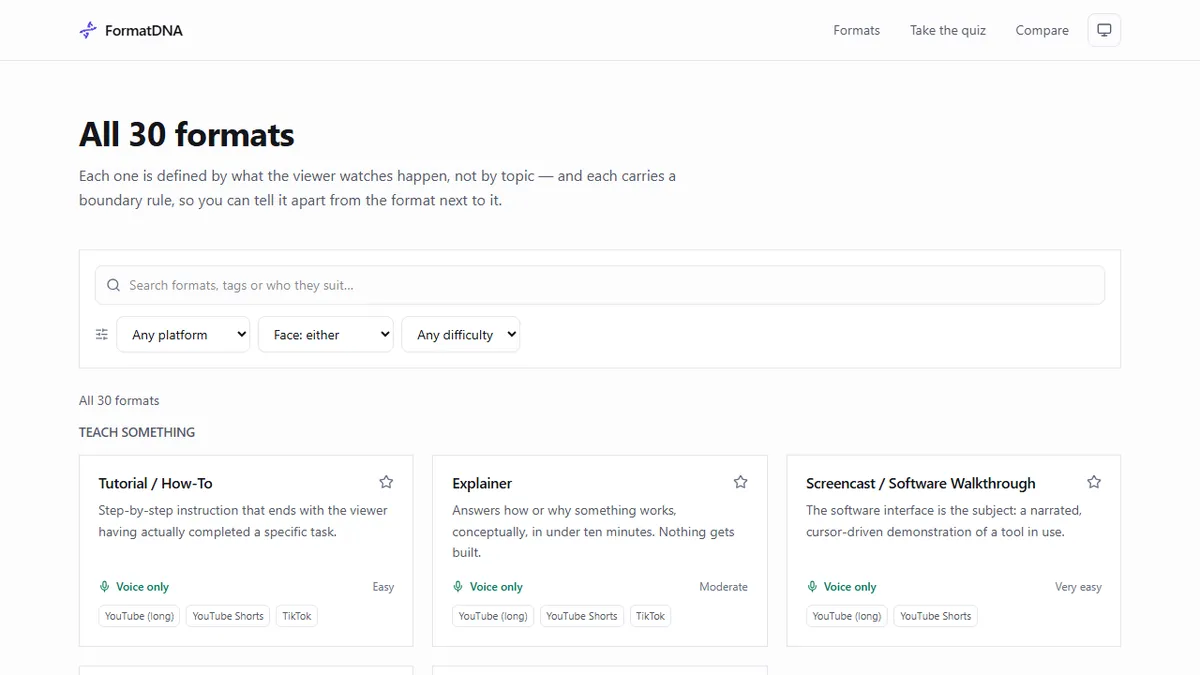
A format is not a genre label. It is a set of structural constraints. Each format has a boundary rule that separates it from the one next to it. A tutorial ends with the viewer having done something; an explainer only leaves them understanding something. A reaction is unscripted and real-time with the source on screen; commentary is an authored take written before recording. A storytime is a bounded story from your past with an ending; a vlog is ongoing life filmed as it happens. These distinctions are not pedantry. They determine what you need to shoot, how much research you need to do, and whether you can reuse the same setup every week. the format catalogue is organised around exactly these questions, because the shape of the video is the thing you actually repeat.
Presence: the first filter
The most obvious format constraint is presence. Some formats require no face and no voice. A curated clip compilation can be assembled entirely from third-party footage. A process/satisfying video is silent and music-only. Others require voice only, which opens the door to screen recordings, stock footage and animation. Still others require face, and a few require live face. This is the first filter many new creators skip. They imagine themselves as an on-camera personality because that is what they watch, without asking whether they can tolerate being watched for the hours required. If you cannot face being on camera, no-camera format options are not a consolation prize. They are a legitimate structural choice with their own economics. A faceless channel can scale, can be edited in batches, and does not depend on your mood on a given Tuesday. That is a format advantage, not a niche one.
The weekly hours are hidden in the format
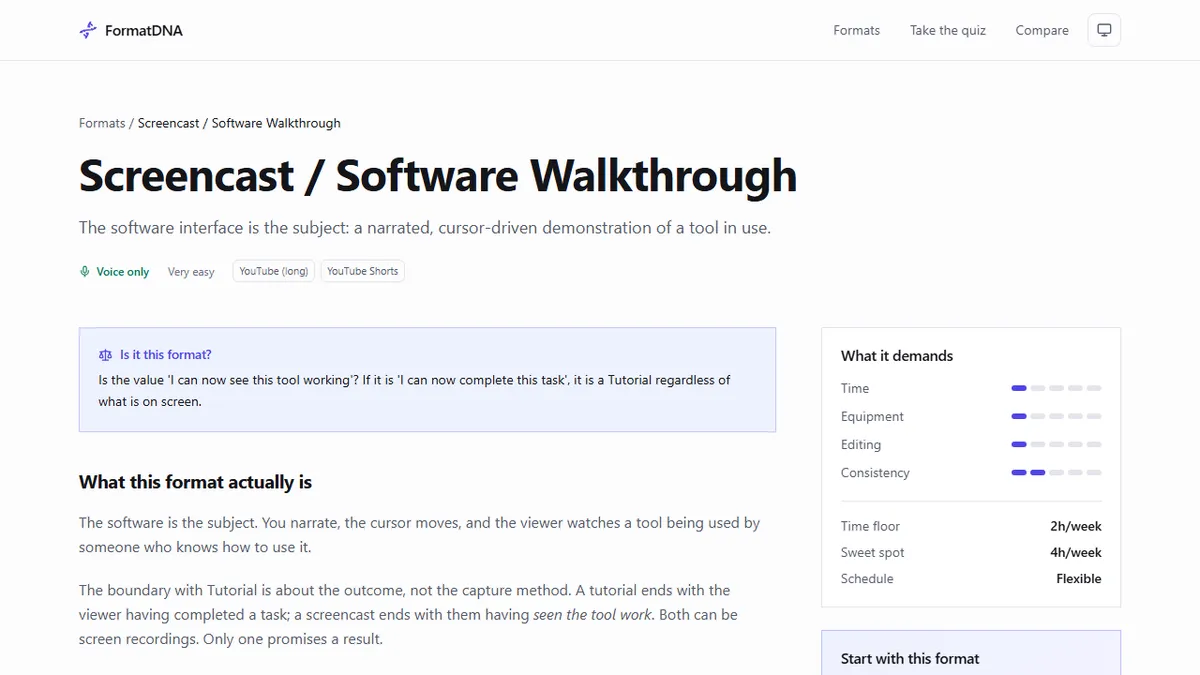
Every format entry carries a minimum sustainable hours-per-week figure and a sweet spot. The gap between formats is enormous. the screencast format is the clearest example: two hours minimum, phone-only equipment, and no face on screen. A video essay or deep dive starts at twelve hours minimum, and that is before you factor in research and writing. A vlog asks for five hours of filming and editing, but it also asks you to live a life worth filming, which is not a task you can batch. A live stream demands ten hours of being present and alert, and it punishes inconsistency more than any editing skill. None of these numbers appear in the phrase "pick a niche." They appear in the format.
Budget and editing ceilings
The format also sets your equipment and editing floor. A reaction video can be made on a modest budget and a basic cut. An interview, properly produced, needs at least a sub-thousand budget for decent audio and lighting. A build/maker project has a minimum budget under a thousand dollars and can easily go higher. Editing demands are just as uneven. A longform podcast is deliberately low-edit; that is why its time cost is so different from its production cost. An animated video starts at advanced editing and twelve hours a week. A stock-footage voiceover is writing-led and needs only basic editing, but it is saturated and cadence-strict. When new creators burn out, it is often not because they cannot learn editing. It is because they chose a format whose editing demands outpace their available hours, and then interpreted the exhaustion as a lack of passion for the topic.
Cadence is the real commitment
Formats also carry a cadence: strict, regular or flexible. A strict cadence means the audience expects a new episode on a schedule, and missing it is costly. Vlogs, commentary, course series and live streams all tend to be strict. A flexible cadence lets you produce when you have something to say, which is why deep dives and build projects are often flexible. The mistake is to choose a strict-cadence format with a flexible-cadence life. A weekly vlog cannot be produced in a single weekend every month. A daily shorts serial cannot be produced whenever inspiration strikes. The format's cadence is a promise, and that promise is what sustains a channel or breaks it. A niche does not make that promise. A format does.
The repeatability test
Before committing to any topic, run the repeatability test: can you make twenty of these without hating your life? The test has nothing to do with whether the topic has enough to say. It has everything to do with whether the format's demands fit your constraints. If you have four hours a week and no camera confidence, a daily vlog will fail no matter how much you love the topic. A faceless voiceover series might last years. If you have a full-time job, a video essay's research and writing load will crush you; a screencast or a commentary script might not. If you have no budget, a build channel is a non-starter, but a tutorial or a listicle is not. The niche determines who the video is for. The format determines whether there will be a next video.