On this page
The question “should I show my face?” sounds like an identity question. It is actually a logistics question. Whether you can sustain a channel depends less on how you look and more on what a format demands of your week. FormatDNA defines four presence levels: none, voice, face, and live face. Each one changes the formats available to you, the editing you will need to learn, and the relationship you build with an audience. Most new creators pick a presence level by instinct (usually “I don’t want to be on camera” or “I’ll do everything”) and then wonder why they burn out. The better order is to look at the format first and let it tell you what presence level is actually sustainable.
The Four Levels Are Not a Ladder
The four presence levels are none, voice, face, and live face. They are not ranked by quality or ambition. A faceless compilation can reach millions; a live stream can be unwatchable. The levels are better understood as four different contracts with your audience. None means no voice and no face, and the content has to carry everything. Voice means you are heard but not seen, which lets you use narration over b-roll, screen recordings, or stock footage. Face means you appear in the video, and the audience can recognise you. Live face means you appear in real time, with no edit to save you.
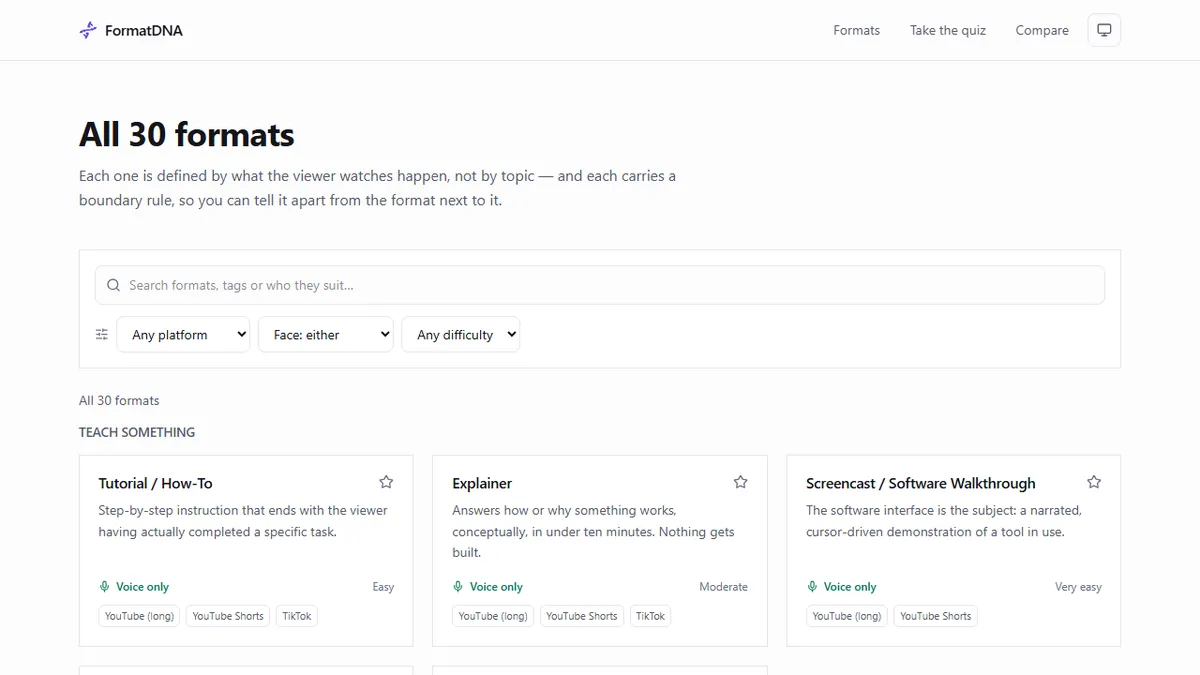
The mapping in the format library is useful because it prevents you from choosing a format that quietly requires a presence level you are not willing to maintain. Reaction formats require a face. Commentary formats require a voice. Process videos require neither. The format is the first decision; the face is a consequence of it.
What “No Face” Actually Demands
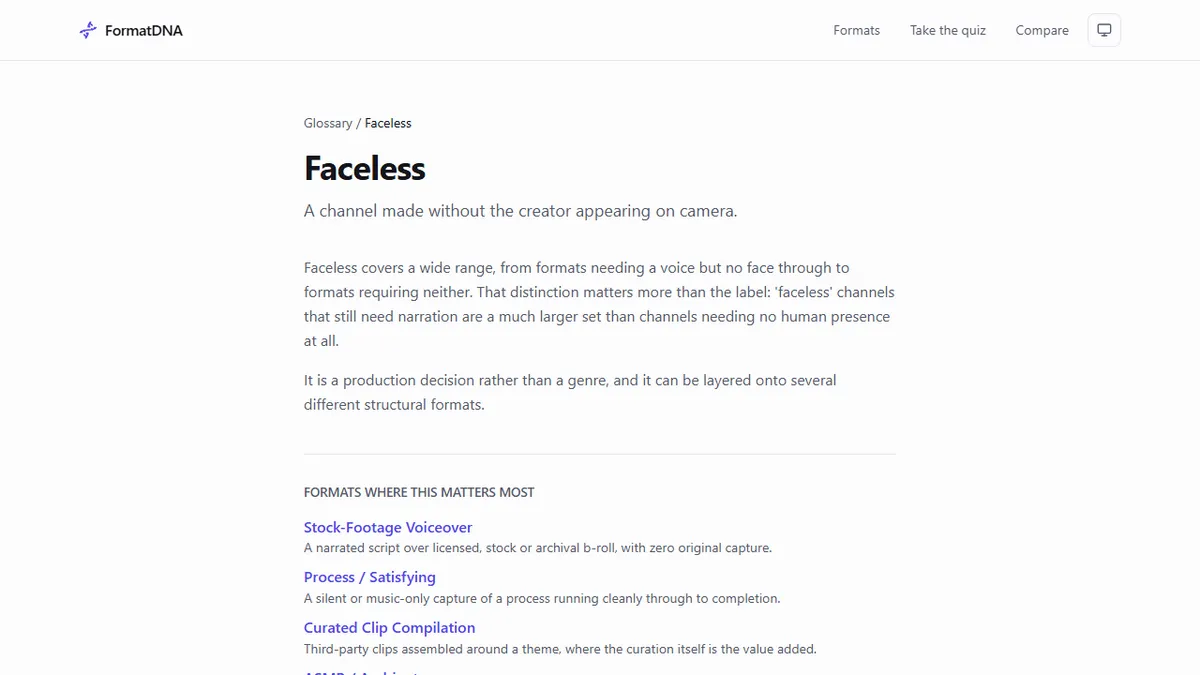
The none level is often chosen by people who want privacy. It is a legitimate choice, but it is not the easy choice. Formats at this level include curated clip compilations, ASMR, process and satisfying videos, and vertical shorts serials. They require no camera confidence, but they still require taste, editing skill, and in some cases careful rights management. A compilation of third-party clips is not the same as a listicle where every beat is originally scripted. The curation is the value, and the curation is hard to sustain.
Use the term faceless precisely: it includes voice formats too. The distinction between none and voice matters because voice gives you a tool that none does: narration. If you are choosing a no-face path purely for privacy, voice formats are usually more sustainable than silent ones because you can explain, argue, and structure the video around a script. If you are choosing none because you do not even want to record your voice, then you are limited to visual formats and your editing skill becomes your main bottleneck.
Voice Is the Middle Ground Most Creators Miss
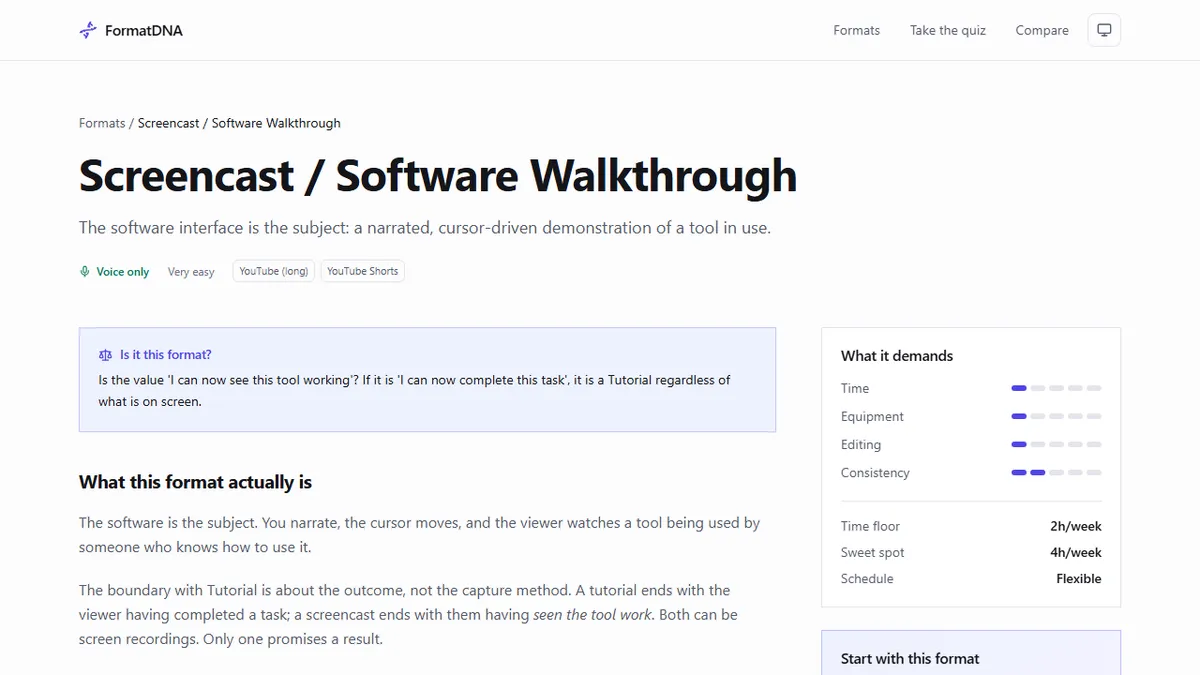
Voice is the most underrated presence level. It gives you the intimacy of narration without the exposure of a face. Tutorials, explainers, screencasts, commentary, deep dives, case files, listicles, reviews, build videos, and stock-footage voiceovers all sit here. That is the largest cluster of formats in the catalogue, and it includes some of the lowest-barrier options.
Voice does not mean you can ignore editing. A narrated video with no face needs something on screen, and that something is usually b-roll, screen capture, or stock footage. If you are making a screencast, the software interface is the subject and the editing is minimal. If you are making a commentary video, you need to write a take, record it, and cut it against footage. The writing becomes the job. People who are not writers often find voice formats harder than they expected, not because of the microphone but because of the script.
The privacy trade-off is partial. A voice can be recognised, especially by people who already know you. But it does not follow you into a grocery store the way a face does. For most prospective creators who are on the fence, voice is the level to test first.
Face Buys Connection and Costs Anonymity
Face formats include reaction, vlog, storytime, interview, haul, challenge, street experiment, sketch, and performance. They all ask for the same thing: you are willing to be seen. The benefits are real. Viewers form a stronger sense of who you are, and formats like vlogs and storytimes depend on that. A storytime told by a voice is just a story; a storytime told by a face is a person telling you something that happened to them.
But face changes the editing math. A vlog is filmed as life actually happens, which means you have to carry a camera or phone into your real day. A reaction video needs less editing but still needs you to perform in real time. A sketch requires writing, acting, and a willingness to look foolish. Face does not automatically mean high production value — phone-only is enough for many formats — but it does mean you cannot hide. The audience will notice when you are tired, uncomfortable, or faking enthusiasm.
There is also a durability problem. Face formats build a parasocial bond, and that bond is hard to sustain if you decide later that you want your privacy back. It is easier to move from voice to face than from face to voice without losing an audience.
Live Face Is a Scheduling Commitment, Not an Editing One
Live face is the most demanding level in time and the least demanding in editing. Livestreams, longform podcasts, and live Q&A sessions all have near-zero editing. That sounds like a relief until you read the hours. A live stream needs a minimum of ten hours a week and an ideal of twenty. A longform podcast needs six minimum and twelve ideal. A live Q&A is lighter at two minimum and five ideal, but it still requires you to be present, alert, and responsive while the camera is rolling.
Live face is a shortcut for people who hate editing, but only if they also have large blocks of time and high energy; hating editing alone is not enough. The audience is part of the content. If chat is not shaping what happens next, you are not really live-streaming; you are recording a video with extra steps. That is a specific skill, and it is a different kind of exhaustion.
The Decision, Reduced to Three Questions
You do not need a personality test to choose a presence level. You need three honest answers.
First, how much privacy do you require? If the answer is “complete”, then none or voice are your only levels. If the answer is “I can handle being recognised by strangers”, then face is available. If the answer is “I am comfortable being watched in real time”, then live face is available. There is no judgement in any of these, but there is a hard constraint.
Second, how many hours do you actually have? Face and live face are not inherently better, but some of them demand a lot. A live stream at ten minimum hours per week will eat a full-time job. A commentary video at four minimum hours per week can fit into evenings. If time is your scarcest resource, look for a no-camera route that fits your constraints rather than forcing a face format that needs you to be available all week.
Third, how much editing can you tolerate? If you hate editing, face formats with basic editing like reaction, storytime, and live Q&A are options. If you love editing, voice formats like deep dives and animations reward you. If you want minimal editing and no face, your options are narrower — process videos, vertical shorts serials, and curated compilations — and they require consistency more than craft.
A Note on Changing Levels Later
Presence levels are not permanent. You can start with voice and reveal your face later. You can start with face and move to voice, though you should expect the audience to feel the difference. You can even start with none and add narration once you are comfortable with your voice. The mistake is not choosing the “wrong” level. The mistake is choosing a format that requires a level you are not actually willing to maintain, and then blaming yourself when you quit. The format is the map. The presence level is the terrain. Pick the terrain you can walk.