What 'The Clinch' Actually Means in Muay Thai
Watch a Muay Thai fight for the first time and the clinch will probably confuse you. Two fighters grab each other, press close, land some knees that you can barely see, and then either separate or get pulled apart by the referee. It looks like a rest phase, like two boxers holding on to run out the clock.
It is not. The clinch, or plam, is a distinct offensive and defensive range that has its own positions, its own scoring criteria, and its own technical demands that take years to develop. A fighter who looks passive from the outside might be actively controlling their opponent's posture, angling for a dominant position, and setting up knees to the body that will systematically drain energy reserves across five rounds. The appearance of inactivity is deceptive.
The Main Positions: Standard, Side, and Body Lock
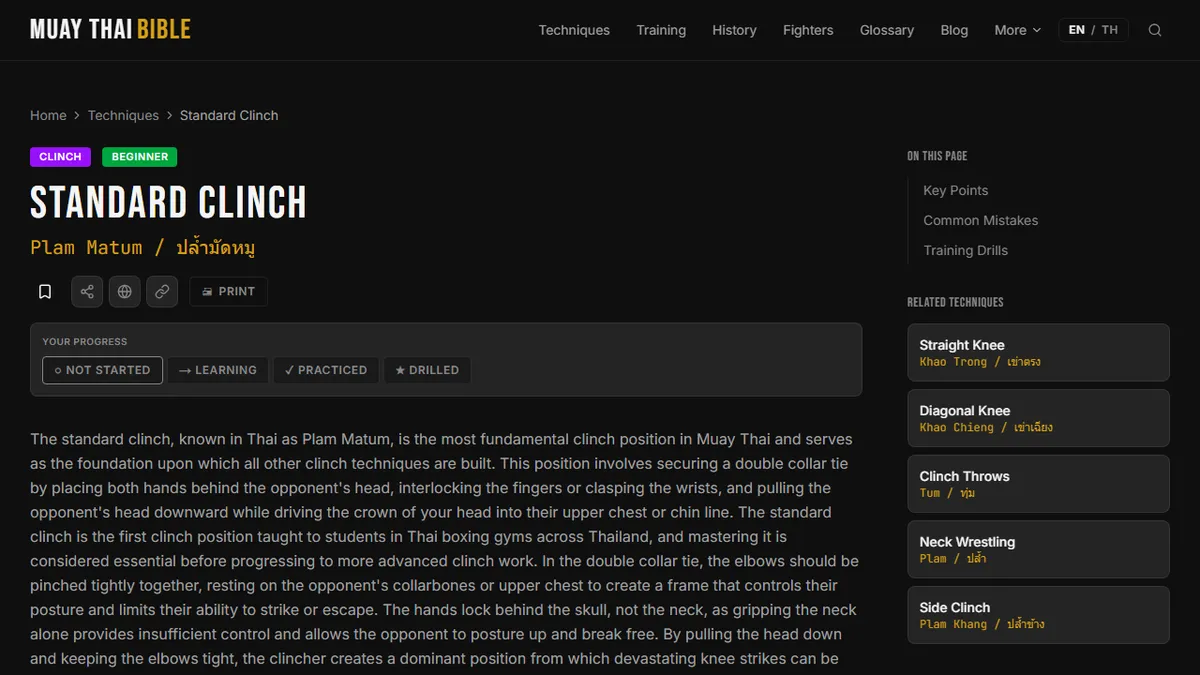
The three primary clinch positions in Muay Thai each create different offensive and defensive options. The standard or double-collar tie has both hands behind the opponent's neck, pulling the head downward and forward while generating knee strikes to the midsection and thighs. Understanding the standard clinch entry and neck-wrestling mechanics is the foundation from which every more advanced position develops.
The side clinch is achieved when one fighter has secured a position to the lateral side of the opponent (one arm around the neck, the other controlling the near arm). From here, knee strikes land to the thigh or ribs on the open side, and throws and sweeps become available. The fighter who achieves the side clinch typically has a significant positional advantage.
The body lock involves wrapping both arms around the opponent's torso, usually from behind. It is a dominant position for delivering knees and initiating throws, but it also exposes the controlling fighter to elbows if the lock is not tight. Position transitions between these three states happen in seconds, and the outcome of a five-round fight can hinge on which fighter controls those transitions more consistently.
How Knees, Sweeps, and Throws Score Points
Within the clinch, knees to the body and legs score points but rarely end fights outright unless they accumulate. A fighter who lands twenty effective knees to the ribs across five rounds has degraded their opponent's breathing capacity, their core stability, and their willingness to engage. Judges watching at Thai stadiums recognise and reward this kind of systematic work.
Sweeps and throws carry more immediate scoring weight. When one fighter successfully breaks the other's balance (launching them off their feet or toppling them to the canvas), judges award that exchange clearly to the throwing fighter. A clean sweep is visually unambiguous and signals physical dominance in a way that lands on both the judge's scorecard and the audience's instincts. Fighters who are repeatedly thrown lose the crowd, and in Thai scoring, losing the crowd matters.
Neck Wrestling: The Hidden Chess Match
The invisible contest inside every clinch is the battle for head position. Each fighter is trying to bring the opponent's head lower than their own, creating a mechanical disadvantage that limits the opponent's knee strikes and makes sweeps easier to execute. When the head is pulled downward, posture breaks, base weakens, and balance becomes precarious.
This neck wrestling is exhausting. It engages the traps, the forearms, the lower back, and the hip flexors simultaneously. A fighter with superior neck strength and technique can dictate the entire character of a fight even if their other weapons are roughly matched. Trainers at serious Muay Thai camps dedicate specific sessions to neck bridging, pulling resistance, and clinch drilling, not because it is exciting training, but because it is decisive in competition.
Why Referees Sometimes Break It and Sometimes Don't
The inconsistency in clinch breaks drives new viewers mad. Two fighters hold for five seconds and the referee breaks them. Thirty seconds later, two different fighters hold for ten seconds and the referee watches. What determines when the break happens?
The answer involves several factors that experienced referees read in real time. Active work (knees landing, attempted sweeps, visible effort to achieve position) gives the referee a reason to let the clinch continue. Stalling (where both fighters are locked without either working) invites the break. Additionally, referees respond to crowd noise; if the audience is engaged by what is happening in the clinch, the referee tends to allow it. Stadium referees also have discretion to reward a fighter who has just achieved a dominant position by letting them use it briefly before separating.
How to Start Learning Clinch Work as a Beginner
Beginners in most gyms outside Thailand do not see clinch work until several months into their training, and in some gyms they never see dedicated clinch instruction at all. This is a significant gap, because clinch exposure late in training means the student has developed movement habits optimised for a range that excludes a large portion of the scoring system.
If your gym does not offer dedicated clinch drilling, ask for it. Even thirty minutes per week of controlled neck-wrestling drills with a partner will accelerate your understanding of the clinch faster than any amount of watching fights. The fundamentals (learning to feel when a position is dominant versus disadvantaged, understanding how the head drives the body, developing resistance against being swept) require physical repetition, not just observation.