What Actually Happens Inside the Shin Bone When You Kick
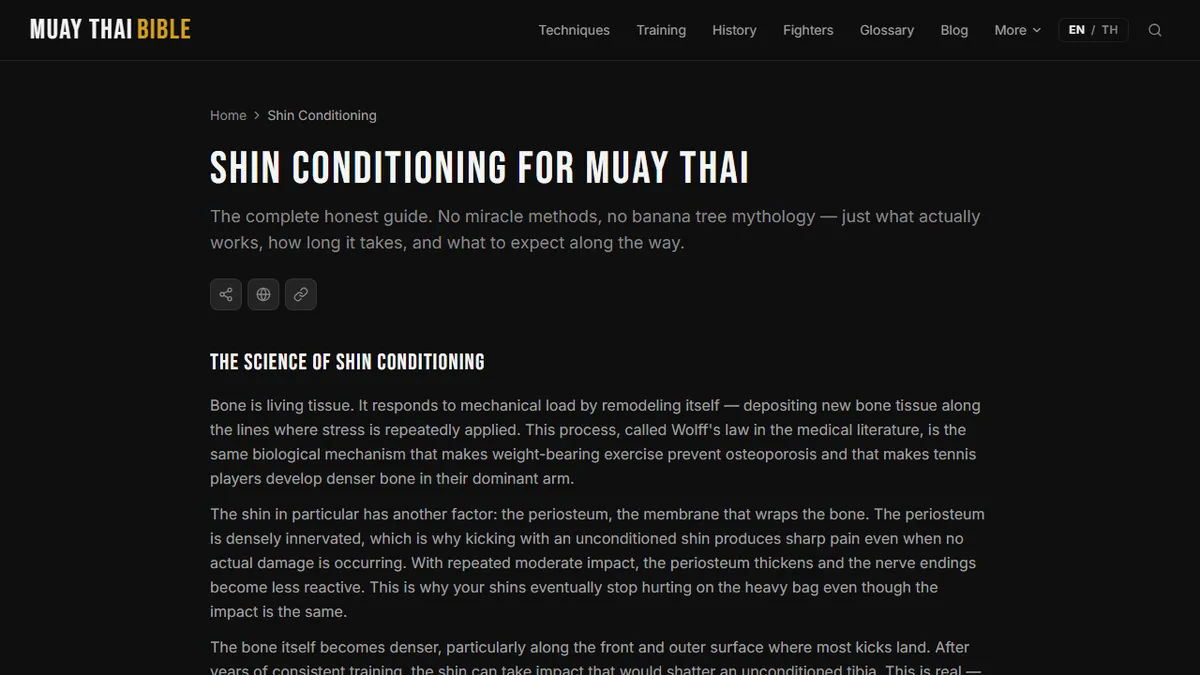
The mechanics of shin conditioning are not mysterious once you understand the underlying biology. When you kick a hard surface, you create microfractures in the periosteum (the dense fibrous tissue surrounding the tibia). Your body responds to these micro-injuries by depositing new bone material along the damage lines, gradually increasing the density and strength of the bone over repeated cycles of stress and recovery.
This process is called Wolff's Law in action: bone remodels itself in response to the forces placed upon it. The same mechanism explains why weight-bearing exercise improves bone density and why astronauts lose bone mass in zero gravity. For Muay Thai practitioners, it means that every session of controlled impact is an investment in future resilience, but only if the stimulus is appropriate and the recovery is adequate.
The critical word is controlled. Too much stress before the bone has had time to repair creates cumulative damage rather than adaptation. This is the mechanism behind stress fractures, and it is exactly what practitioners who follow the most aggressive conditioning advice tend to produce in themselves.
The Realistic Timeline: Months 1-3, 3-6, and 6-12
Months one through three are the most uncomfortable phase. The shins have not yet begun meaningful adaptation, and every bag session will produce bruising, tenderness, and what feels like a bone ache that persists for days. Many beginners during this period are convinced they are injured. Most are not. They are simply adapting. The appropriate training volume during this phase is moderate bag work at no more than seventy percent effort, supplemented by light shadow work and pad drills that do not require heavy shin impact.
Months three through six mark the transition. The surface bruising becomes less severe. Recovery between sessions shortens noticeably. Fighters who have been training consistently during this period begin to land harder kicks without the same immediate soreness, and blocking low kicks feels less alarming. The shin is beginning to function as a weapon rather than a liability.
Months six through twelve represent consolidation. By this stage, practitioners who have trained consistently and recovered appropriately will have shins that can absorb and deliver significant impact without the acute sensitivity of the early months. The adaptation continues past twelve months, but the most dramatic shift (from painful to functional) usually occurs within that first year. Following evidence-based shin conditioning protocols for Muay Thai through each of these phases keeps the process on track and reduces injury risk.
Safe Conditioning Methods vs the Ones That Cause Fractures
Heavy bag work is the gold standard. A quality bag gives appropriate resistance without the unpredictable hardness of a human shin or a steel bar. Controlled pad sessions with a knowledgeable trainer allow the impact to increase gradually as the shin develops. These two methods, done consistently over months, produce the adaptation that experienced practitioners describe.
The methods that cause fractures are the ones that apply sudden or excessive force to bone that has not yet adapted. Striking hard objects — wooden posts, bamboo, concrete blocks — before the periosteal adaptation is established does not accelerate conditioning. It produces compressive injuries that require complete rest, which undoes any adaptation already made and sets the practitioner back further than if they had never done it.
Rolling a glass bottle or rolling pin along the shin is a traditional conditioning supplemental tool, not a primary method. It addresses surface tissue sensitivity rather than bone density, and while it is not harmful in moderation, it will not produce bone adaptation on its own.
5 Shin Conditioning Myths Debunked
The first myth is that hitting trees or wooden posts is how Thai fighters condition their shins. A small number do, but these are experienced fighters whose bones have already undergone years of adaptation. The foundation was built on bags and pads. The tree comes later, if at all.
The second myth is that pain equals progress. Soreness after training is normal; sharp localised pain that persists at rest is a potential stress injury. These are not the same signal.
Third: that numbing the skin with Tiger Balm or liniment accelerates conditioning. These topical treatments address surface soreness and circulation but have no effect on bone density.
Fourth: that six weeks of hard training is enough. It is enough to begin the process, not to complete it. Most practitioners who claim their shins are "conditioned" after six weeks have adapted to the sensation of impact without the underlying bone density that makes that adaptation meaningful under fight conditions.
Fifth: that only the shin needs conditioning. The ankle, the lower calf musculature, and the proprioceptive systems around the ankle all participate in delivering and absorbing a kick. A shin conditioning programme that ignores ankle mobility and lower leg strength training is working on one component of a multi-part system.
How to Monitor Your Shins and Spot Early Stress Injury Signs
Stress injuries announce themselves before they become fractures, but only if you know what to listen for. Persistent pain at a specific point on the tibia — not along the whole shin, but at one location — that worsens during activity and continues at rest is the primary warning sign. Pressing on that spot with a finger will usually produce disproportionate tenderness.
Training through this signal is the mistake that converts a stress reaction into a stress fracture. The appropriate response is a week of rest from impact work, followed by a gradual return if the localised pain has resolved. If it has not resolved, a medical assessment is warranted.
The Role of Nutrition and Sleep in Bone Adaptation
Bone density adaptation requires calcium, vitamin D, and adequate protein, none of which are exotic or expensive. A practitioner eating a varied diet with regular dairy or fortified alternatives is likely meeting their calcium requirements. Vitamin D deficiency, however, is common in people who train indoors and live at northern latitudes, and it directly impairs bone mineralisation. If you train primarily indoors during winter months, supplementation is worth considering after blood testing.
Sleep is when bone repair happens. Growth hormone — the primary driver of bone remodelling — is released predominantly during deep sleep. A practitioner consistently getting five hours of sleep and training twice a day is undermining every hour of bag work they complete. Six to eight hours of quality sleep per night is not optional for anyone expecting a conditioning response from their training.