The 10-Point Must System vs Thai Criteria: Core Differences
If you have watched Western boxing, you already carry a mental model for judging fights. Every round has a winner who gets ten points. The loser gets nine. More punches landed, more aggression, better defence. These all factor in, but fundamentally you are looking for the busier, cleaner fighter to win more rounds.
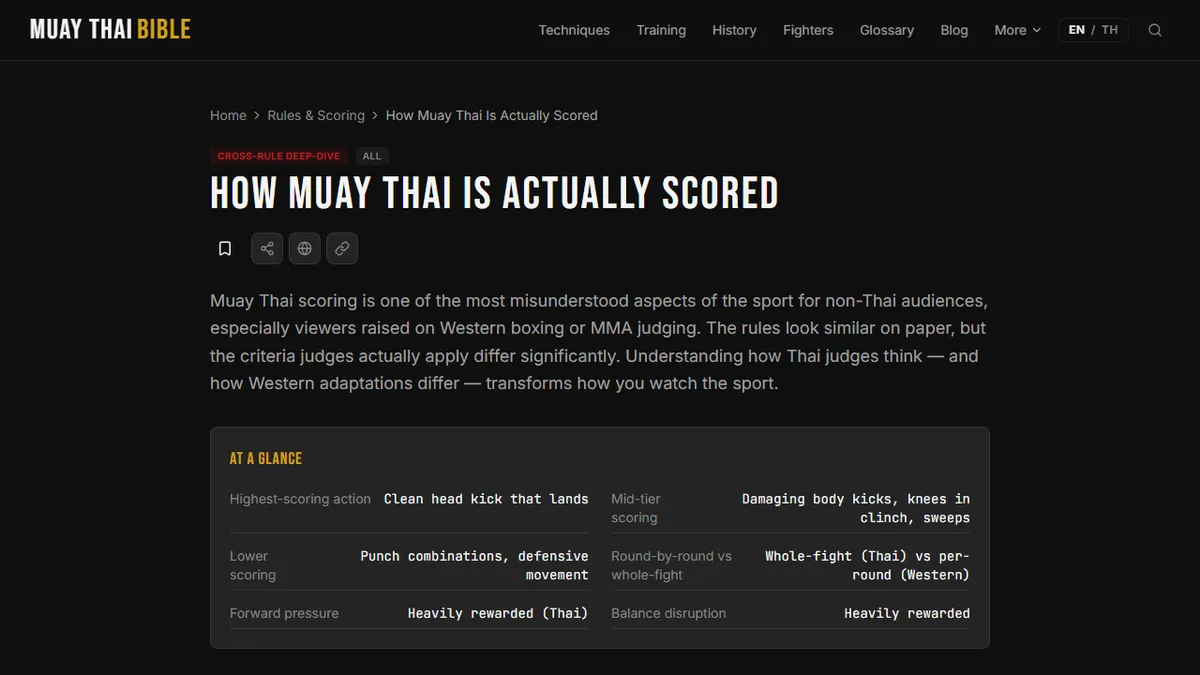
Thai scoring works from a different set of starting assumptions. The criteria emphasise weapon effectiveness over volume. A fighter who lands three precise, damaging strikes to an opponent who threw twenty mediocre ones can win that exchange in the judge's estimation. Quantity of strikes is not a scoring category. Quality (meaning clean connection, hard surface landing on a vulnerable target with observable effect) is.
The official Muay Thai scoring criteria and round weighting exist in codified form, but understanding how they are applied at stadium level requires context that the rulebook alone does not fully convey.
What 'Effective Weapon' Actually Means to a Thai Judge
The term that appears in Thai scoring discussions most frequently is "effective weapon use", and it has a specific meaning that goes beyond simply landing strikes. A kick that connects but does not move the opponent, does not produce a visible reaction, and does not create any strategic advantage is weighted less heavily than a strike that stuns, destabilises, or visibly damages.
Judges look for the aftermath of a strike as much as the strike itself. Did the opponent's posture break? Did they take a backward step? Did their guard drop in reaction? These responses indicate that the weapon worked. A jab that snaps the head back counts. A jab thrown to the air or smothered against a shoulder does not, regardless of whether it technically connected.
This means a fighter who throws a compact, powerful roundhouse to the ribs and watches their opponent's arm drop in pain is scoring more effectively than a fighter racking up fifty lead-hand jabs over three minutes. The punch volume looks impressive on camera; the body kick looks devastating to a judge sitting ringside.
How Rounds 3 and 4 Are Weighted More Heavily
This surprises nearly every new viewer: rounds three and four carry more scoring weight in traditional Thai judgment than rounds one, two, or five.
The logic is embedded in the betting culture that has historically surrounded stadium Muay Thai. Rounds one and two are considered scouting rounds: fighters are establishing range, reading tendencies, and presenting false information. A fighter who wins the first two rounds aggressively may be manufacturing a betting line while holding their actual game plan in reserve. Knowledgeable observers know this, and judges do too.
Rounds three and four are where fighters perform their actual strategies with full commitment. A fighter who dominates these rounds is demonstrating true superiority. Round five, conversely, is sometimes discounted if the fight's outcome appears settled. A dominant fighter who coasts to a decision in the final round is not necessarily penalised, because they have already made their argument in rounds three and four.
Knockdowns, Sweeps, and the Bonus Points Most Fans Miss
A knockdown in Muay Thai scoring is significant but not automatically decisive in the way it is in boxing. A clean knockdown scores heavily for the round, but the affected fighter can recover the round through subsequent dominant performance, especially in rounds three and four.
Sweeps in the clinch are where many casual observers lose track of scoring. When a fighter throws their opponent to the canvas with a technically clean sweep or trip, judges award that exchange clearly to the sweeping fighter. This is distinct from a boxer clinching for survival. The clinch in Muay Thai is an active scoring environment, and falls from it are points lost.
Elbows that open cuts generate immediate scoring attention. A cut is visible evidence of effective weapon use, and even a small one that bleeds steadily sends a signal to judges that the elbow was real and landed well. Fighters who chase cuts strategically are doing so with scoring implications fully in mind.
Reading a Stadium Crowd as an Unofficial Scorecard
Experienced fight-watchers use crowd noise as a real-time scoring tool. Thai stadium crowds, particularly at venues like Lumpinee or Rajadamnern, are composed largely of gamblers and serious enthusiasts who understand the sport at a detailed level. When the crowd surges in reaction to a technique, that technique almost certainly registered on the judges' scorecards as well.
Conversely, when a fighter lands a flurry of strikes to minimal crowd reaction, it usually means the strikes lacked genuine impact: the crowd has seen enough Muay Thai to distinguish between busy-looking and actually damaging. Following the crowd's energy through a fight is an imperfect but surprisingly reliable proxy for how rounds are being scored.
Practical Tips for Watching Your First Muay Thai Fight
Come prepared to ignore punch totals. Instead, track which fighter's strikes produce visible reactions. Note who controls the clinch and who gets swept. Observe whether fighters are working to the body with any real consistency. Body work that generates defensive reactions is being noted by judges even if it does not produce dramatic moments.
Watch rounds three and four with particular attention, knowing judges are doing the same. And pay attention to the betting section of the stadium if you are attending in person. The way odds shift mid-fight reflects the collective expertise of people who have watched thousands of bouts and have financial skin in the game. Their consensus judgment is often ahead of the casual viewer's by an entire round.