From Individual Asset to Whole Narrative: Why Themes Matter
Most crypto research focuses on individual assets: Bitcoin's price, Ethereum's transaction volume, a particular token's recent announcement. That granularity has its place, but it misses something important about how capital actually moves through crypto markets.
Institutions and sophisticated allocators rarely pick assets in isolation. They rotate by theme: identifying a narrative with structural tailwinds and then distributing exposure across the strongest assets within it. When the DeFi narrative catches momentum, capital flows into Aave, Uniswap, Curve, and a dozen smaller protocols simultaneously. When AI crypto captures attention, multiple tokens move in rough synchrony regardless of their individual fundamentals.
This means that tracking narratives is often more predictive than tracking individual assets. An asset can have a rising mood score while its parent narrative remains cold, in which case the individual signal may be fragile. But when the narrative is also heating up, the individual asset has structural support: attention, capital, and commentary are all pointing in the same direction.
Narrative heat scores make this rotation visible and measurable, reducing what would otherwise be an intuitive observation into a trackable, comparable number.
The Heat Score Formula: Social Volume x Asset Count x Sentiment
A narrative heat score aggregates social activity not for a single token but across all assets that the monitoring system classifies as belonging to that theme. The calculation blends three elements that together capture whether a narrative is genuinely active or merely recognised.
Social volume within the narrative is the first input: the total mention count across all classified assets, measured against a rolling baseline. A narrative whose constituent assets are collectively generating more social attention than they typically do is showing early heat, even if no individual asset has yet spiked dramatically.
Asset count enters as a weighting factor reflecting breadth. A narrative where twelve of its fifteen constituent assets are receiving elevated attention is more robustly hot than one where a single standout token is pulling the entire score upward. Breadth of engagement across the theme is a more durable signal than concentration in one name.
The third input is narrative-level sentiment: the aggregate emotional tone across all posts that reference assets within the theme. Positive breadth and positive sentiment together indicate that the community is not only paying more attention but doing so in an optimistic register, which is the condition most associated with capital inflow.
Momentum vs Acceleration: Two Signals in One Dashboard
Narrative dashboards typically display two related but distinct signals: heat and momentum. Understanding the difference prevents misinterpretation.
Heat is a current-state reading. It tells you how hot the narrative is right now relative to its own history and relative to other narratives tracked on the same scale. A heat score of 77 says: this narrative is among the more active on the board at this moment.
Momentum is a directional signal (essentially the first derivative of heat). It tells you whether the current heat score is rising, stable, or declining. A narrative at heat 77 with strong momentum is still accelerating. A narrative at heat 77 with weak momentum has plateaued. The same headline number carries very different implications depending on whether it is a peak or a continuing climb.
The most actionable combination is a narrative that ranks high on heat while also showing strong positive momentum — meaning both the current level and the direction are favourable. A narrative with high heat but declining momentum is one to watch carefully for rotation out. A narrative with moderate heat but sharply accelerating momentum is often the more interesting discovery.
A Walk Through the Narrative Rankings Right Now
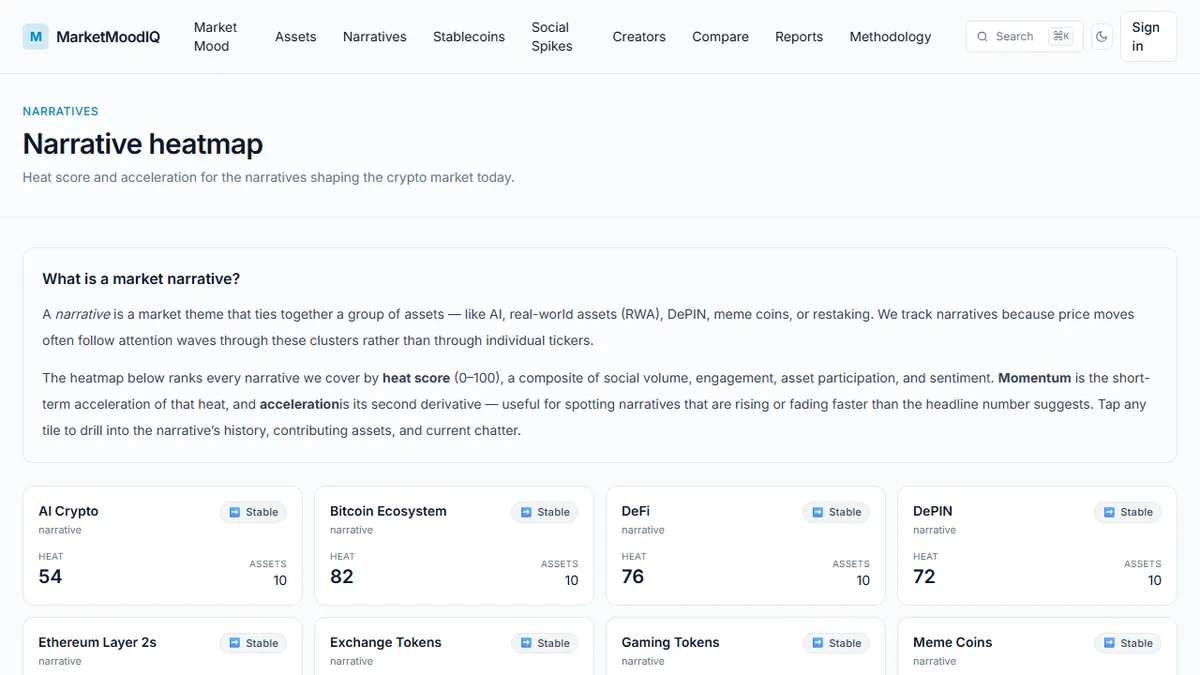
Looking at the current narrative heat table provides an instructive illustration of how the scores spread in practice. At the top of the board, the Bitcoin Ecosystem and Solana Ecosystem narratives both sit at heat 83, while DeFi reads at 77 and Prediction Markets at 80. These scores reflect narratives with broad asset coverage, elevated social attention across multiple assets simultaneously, and broadly constructive community sentiment.
In the middle band, DePIN and Real World Assets register at 74 each, with Exchange Tokens at the same level. These are active but not red-hot narratives (themes that have attracted sustained interest without yet triggering the kind of euphoric surge that characterises the top of a narrative cycle).
At the cooler end, Ethereum Layer 2s and Gaming Tokens both sit at 35, while Privacy Coins register 44. These readings indicate that community attention has migrated elsewhere, that the assets within these narratives are generating less social activity than their own recent baselines would suggest as normal, and that sentiment where it exists is less strongly positive.
The live narrative heat rankings across all tracked themes give you this table in real time, updated throughout the trading day, so you can identify which themes are warming, cooling, or holding steady at any given moment.
Rotating Capital: How Institutional Traders Follow Narrative Heat
Sophisticated market participants have long used thematic rotation as a strategy. The logic is straightforward: a narrative building heat is one attracting new entrants, capital, and attention simultaneously. Entering before that convergence peaks is more efficient than entering after it is widely recognised.
The challenge has historically been identifying narrative heat early enough to act, before it shows up in price. Social data helps because community engagement tends to precede price movement — particularly in crypto, where retail-driven narratives amplify quickly once they gain initial traction.
Institutional traders look at narrative heat to calibrate broad exposure decisions rather than specific entry points. If the DeFi narrative is clearly hotter than the gaming narrative by twenty or more heat-score points, a portfolio with material gaming token exposure might redirect new capital toward DeFi until the heat differential narrows or reverses.
Pitfalls: When High Heat Is a Sign of a Narrative Topping Out
High heat is not uniformly a buy signal. Just as an individual asset's mood score can peak at the moment when the last optimistic buyers are entering, a narrative's heat score can register its maximum precisely when the distribution of early holders into late-arriving capital is most active.
Several patterns warn of a narrative that is overheated rather than sustainably hot. One is a very large single-asset concentration: if 70 percent of a narrative's heat score is being generated by one token while the rest of the theme is quiet, the breadth condition that makes high heat durable is absent.
Another warning sign is a divergence between heat and price performance. If a narrative's heat score is at a multi-month high while the constituent assets have already rallied 80 to 120 percent, the momentum may be decelerating in price terms even as social attention peaks, a classic late-cycle pattern.
Finally, narrative heat that arrives alongside high creator concentration (where a small number of influential accounts are generating a disproportionate share of the conversation) is more susceptible to sudden fade if those creators move their attention elsewhere.