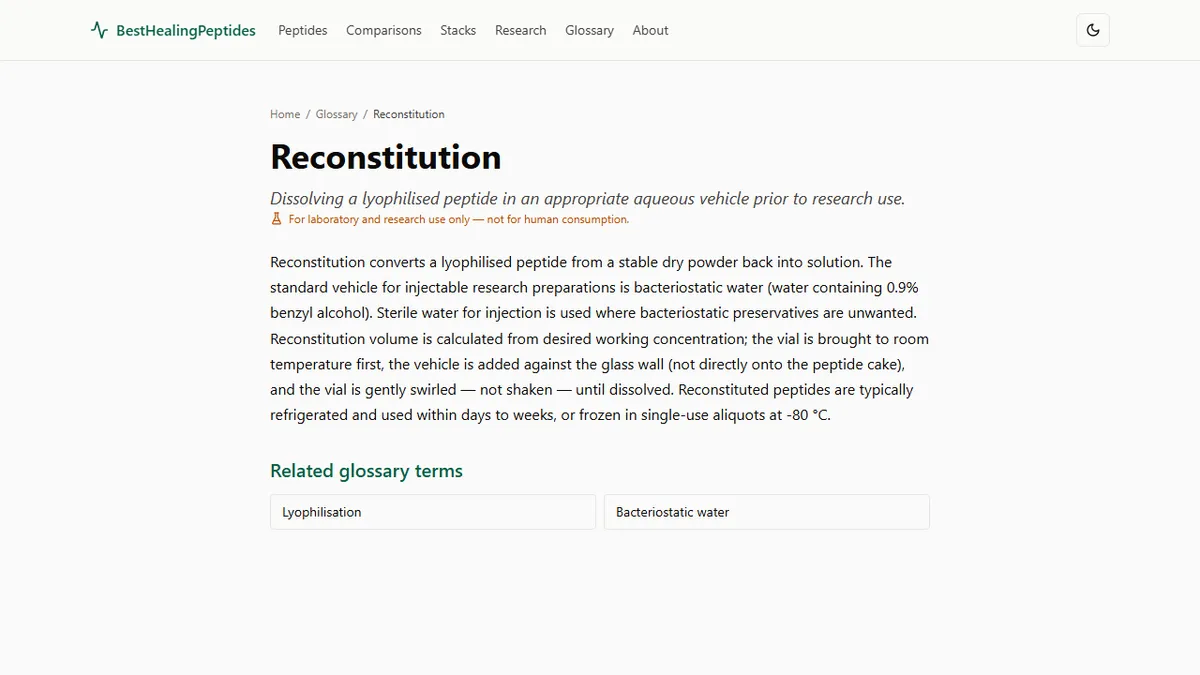
Mistake 1: Using Sterile Water When Bacteriostatic Water Is Required for Multi-Use Vials
Sterile water and bacteriostatic water are not interchangeable, and confusing the two has consequences that compound with every subsequent use of the vial. Sterile water is free of microorganisms at the point of filling, but it contains no preservative. Once the septum is pierced for the first time, sterile water provides no ongoing protection against bacterial contamination from the syringe, the needle, or ambient air. A vial used multiple times with sterile water as the reconstitution vehicle is a bacterial culture medium by the third or fourth entry.
Bacteriostatic water contains 0.9% benzyl alcohol, a preservative that inhibits microbial growth and maintains the sterility of the reconstituted solution across multiple uses over a period of weeks under refrigeration. The why bacteriostatic water is preferred over sterile water for multi-use peptide vials explains the preservative mechanism and its practical limits. For single-use aliquots drawn once and immediately administered to an animal, sterile saline is acceptable and avoids benzyl alcohol exposure. For any vial that will be re-entered multiple times, bacteriostatic water is the standard choice.
The mistake is not restricted to beginners. It appears repeatedly when researchers switch suppliers and receive a different product specification sheet, or when purchasing agents substitute sterile water when bacteriostatic water is temporarily out of stock. The consequences (contaminated solutions that generate inflammatory responses in animal subjects or confound cell-culture cytokine data) are rarely obvious without microbiological testing.
Mistake 2: Reconstituting at Room Temperature Instead of 2–8 °C
Lyophilised peptides are stable at freezer temperatures because the absence of water suppresses enzymatic degradation and oxidative reactions. The moment water is introduced, degradation pathways become thermodynamically accessible. Temperature during reconstitution matters because a warmer solvent accelerates the initial dissolution-phase chemistry, including hydrolysis of peptide bonds, oxidation of susceptible amino acid residues (methionine, cysteine, tryptophan), and racemisation at sensitive positions.
For most peptides, the practical recommendation is to refrigerate both the solvent and the vial before reconstitution, add the solvent cold, and allow dissolution to proceed in the refrigerator rather than on the bench. The reconstituted solution should then be moved directly to its storage temperature (typically 2 to 8 degrees Celsius for short-term use) rather than left at room temperature while labelling, calculating doses, or handling other equipment. The cumulative time a reconstituted peptide spends at room temperature across multiple handling sessions can meaningfully shorten its functional half-life.
Mistake 3: Excessive Agitation — Vortexing Peptides That Should Only Be Swirled
Many researchers reflexively reach for the vortex mixer when trying to dissolve a peptide quickly. For small organic molecules this is often harmless. For peptides, particularly those with amphipathic sequences that expose hydrophobic regions at air-water interfaces, vortexing promotes aggregation. Vigorous agitation creates foam, and each bubble is an air-water interface where peptide chains denature, partially unfold, and associate in biologically inactive aggregates.
The correct technique for peptide reconstitution is gentle swirling or rolling of the vial between the palms. If the peptide does not dissolve readily with gentle movement, allow additional time at refrigerator temperature; do not escalate to mechanical agitation. Some peptides require addition of a small amount of dilute acetic acid or DMSO as a co-solvent before aqueous dilution. Check the specific guidance for each compound. The standard peptide reconstitution protocol for laboratory use covers solubility characteristics and co-solvent options for the most commonly used research peptides.
Mistake 4: Repeated Freeze-Thaw Cycling of Reconstituted Stock Solutions
Once a peptide is reconstituted, the molecular dynamic changes fundamentally. Water is present, enzymatic and chemical degradation pathways are available, and the compound is in a less stable state than its lyophilised form. Freezing and thawing a reconstituted solution does not restore it to the stability of its original lyophilised state; it introduces additional physical stress (ice crystal formation, concentration spikes at the freezing front, pH shifts as buffers freeze differentially) that can cause peptide aggregation, oxidation, and loss of potency with each cycle.
The standard protocol is to prepare single-use aliquots immediately after reconstitution, freeze these at minus 80 degrees Celsius, and thaw each aliquot only once before use. For routine work where aliquots will be used within one to two weeks, refrigeration at 2 to 8 degrees Celsius is acceptable if the vial is sealed and the number of re-entries is minimised. The critical discipline is accepting that a frozen reconstituted stock that has been thawed three or four times is no longer a reliable experimental reagent, regardless of how it appears visually.
Mistake 5: Mixing GHK-Cu With Ascorbic Acid or Sulfite-Containing Vehicles
GHK-Cu is a copper chelate, and copper chemistry is sensitive to reducing agents. Ascorbic acid (vitamin C) reduces Cu(II) to Cu(I), destabilising the coordinate complex and generating a form of copper that is more reactive and potentially cytotoxic at the concentrations used in research. Sulfite-containing preservatives in some injectable formulation vehicles present the same risk.
This mistake is particularly likely when researchers prepare combination formulations (topical vehicles or gel matrices that incorporate multiple bioactive compounds) without checking the redox compatibility of each ingredient. The problem may not be immediately visible as precipitation or colour change; the complex can be disrupted at the ionic level without obvious physical signs, and the first indication may be that the GHK-Cu-treated group in a cell experiment shows unexpected cytotoxicity at doses that should be sub-toxic.
Practical resolution: verify the absence of reducing agents in any vehicle or co-solvent before combining with GHK-Cu. Prepare vehicle blanks and test for cupric ion release using a simple spectrophotometric copper assay if there is any doubt about vehicle compatibility.
Mistake 6: Skipping the 0.22 µm Syringe Filter Step for Injectables
Injectable research peptide preparations must be sterile. For animal injection studies, a lyophilised peptide reconstituted with bacteriostatic water is not automatically sterile. The solvent adds a baseline of microbial protection, but it does not guarantee sterility of the dissolved solution, particularly if the dissolution step is performed in a non-sterile environment or with incompletely validated aseptic technique.
The 0.22 micrometer syringe filter removes bacteria, fungi, and most particulates. Passing the reconstituted solution through the filter immediately before drawing the dose for injection is standard practice for any preparation intended for intraperitoneal, subcutaneous, or intravenous administration in research animals. Filters must be size-appropriate and compatible with the solvent being used; polyethersulfone filters are widely used because they have low protein-binding characteristics and are compatible with aqueous and mildly organic solutions.
Some researchers omit the filter step on the grounds that bacteriostatic water provides adequate protection, or because it adds a step that causes peptide loss through adsorption to the membrane. These are real concerns but not adequate reasons to skip filtering. Peptide loss to the filter surface is generally less than 10% for most compounds at typical research concentrations and is preferable to the alternative of an injection-site reaction or systemic inflammatory response confounding the experiment.
Mistake 7: Ignoring Adsorption — LL-37 and Polypropylene Labware
LL-37 is a cationic, amphipathic peptide. It carries a strong net positive charge and has both hydrophilic and hydrophobic surface regions. These properties, which are central to its mechanism of antimicrobial action (membrane insertion and disruption), also make it prone to non-specific adsorption to laboratory surfaces. Standard polypropylene microcentrifuge tubes and pipette tips adsorb LL-37 from solution, reducing the effective concentration of the preparation below the intended dose.
The same problem, to varying degrees, affects several other research peptides with cationic or amphipathic character. Researchers who observe unexpectedly attenuated effects from known active peptides, or who cannot reproduce published EC50 values in their own hands, should consider adsorption as a possible explanation before attributing the discrepancy to peptide quality or experimental error.
Mitigation strategies include siliconising labware, using protein lo-bind polypropylene tubes designed to minimise non-specific protein and peptide adsorption, preparing stock solutions at higher-than-required concentrations to allow for adsorption losses, and verifying working concentrations by UV absorbance or amino acid analysis immediately before use. These are not exotic precautions; they are standard practice in antimicrobial peptide research and should be adopted whenever working with strongly cationic peptides.