How Evidence Grades Work in Sleep Research
Not all sleep advice is created equal, and understanding why matters before you buy a supplement or rearrange your bedroom. Researchers who study sleep interventions typically rank evidence by how it was generated: randomised controlled trials at the top, observational associations further down, expert consensus and mechanistic plausibility at the bottom.
A Grade A intervention has been tested in multiple well-designed trials, the results replicate, and the effect size is clinically meaningful. Grade B means the evidence is decent but thinner, perhaps a single well-run trial, or consistent results from smaller studies. Grade C is where most wellness content lives: plausible, possibly real, but not yet demonstrated convincingly in humans at the doses and formats being sold.
This hierarchy matters because sleep optimisation marketing rarely distinguishes between them. A supplement with a promising mechanism in rat studies gets presented alongside an intervention with fifty human trials behind it, as if the evidence were equivalent. It is not.
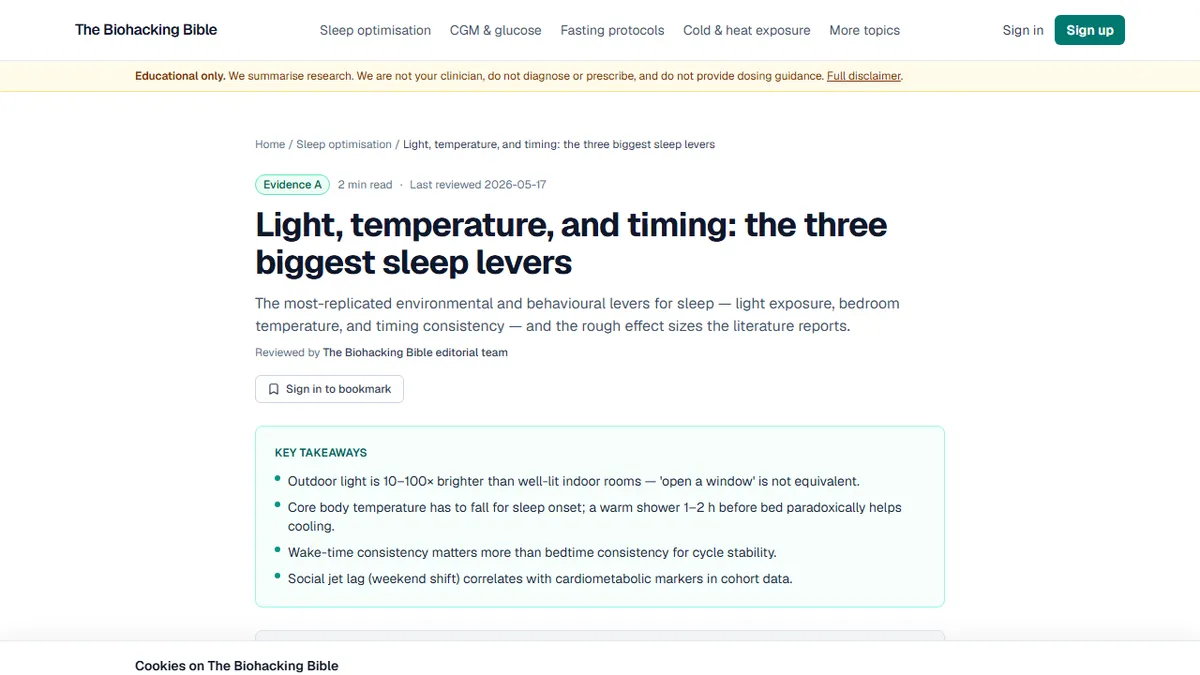
The Three Highest-Impact Interventions: Light, Temperature, and Timing
These are Grade A. They are free, they have decades of replicated research behind them, and they are the foundations on which every other sleep intervention sits. The three biggest environmental levers for better sleep are light management, bedroom temperature, and sleep timing consistency. The evidence for each is robust enough to act on immediately.
Morning and evening light shapes the circadian system more powerfully than almost any other external cue. Bright light in the morning anchors your rhythm earlier; blue-spectrum light in the evening delays it. The precise size of the evening screen effect has been debated, but the morning light effect is among the most replicated findings in chronobiology.
Core body temperature needs to fall by roughly one degree Celsius for sleep onset and maintenance to proceed efficiently. A cooler bedroom (generally 16–19 degrees Celsius for most adults) facilitates this drop. Research using precisely temperature-controlled bedrooms shows measurable improvements in sleep architecture at lower ambient temperatures compared with warmer conditions.
Timing consistency is perhaps the most underrated lever. Going to bed and waking at the same time seven days a week (including weekends) reduces what sleep researchers call social jetlag, a form of circadian misalignment that accumulates across weekdays and is only partially corrected by weekend lie-ins.
Why Sleep Hygiene Rules Vary Wildly in Quality
Sleep hygiene as a category lumps together interventions of very different evidential weights. Stimulus control (reserving the bedroom for sleep and intimacy, and getting up if you cannot sleep after twenty minutes) has solid trial evidence, particularly in the cognitive-behavioural therapy for insomnia literature. Caffeine cutoffs have pharmacological support (the half-life of caffeine is five to seven hours in most adults). Consistent wake time is Grade A.
Other common hygiene rules are harder to evaluate. Avoiding screens before bed conflates the blue-light effect (real but modest in most studies) with the arousal effect of engaging content (real and probably larger). Banning phones from the bedroom addresses both simultaneously but for different mechanistic reasons.
Which sleep hygiene rules hold up in the literature depends on which specific rule you are asking about. The category as a whole is Grade B, which means it is worth doing, but not every rule within it carries equal weight.
The Nightcap Myth: What Alcohol Actually Does to Sleep Architecture
This is perhaps the most consequential popular misconception about sleep. Alcohol does reliably reduce sleep latency: you fall asleep faster after drinking. But the second half of the night tells a different story.
As alcohol is metabolised, it disrupts the normal architecture of sleep stages. REM sleep, which is concentrated in the second half of the night and is important for memory consolidation and emotional processing, is suppressed. Sleep fragmentation increases. The net result is that total sleep time may be similar, but the composition shifts in a direction that most sleep researchers regard as meaningfully worse.
This effect is dose-dependent and measurable even with moderate drinking. Wearable devices with HRV monitoring make it increasingly visible to individuals; many users report noticeably lower recovery scores on nights when they consumed alcohol, even when they felt as though they slept normally.
Supplements with Weak Evidence Despite Heavy Promotion
Magnesium glycinate is one of the most frequently recommended sleep supplements online, and it is worth examining critically. Magnesium does play a role in neurological relaxation pathways, and deficiency is associated with sleep disturbance. The human evidence base for magnesium supplementation improving sleep in people who are not deficient, however, is thin. The trials that exist tend to be small, and the effect sizes are modest.
Melatonin is better studied but often misapplied. It is effective for circadian phase shifting (helping with jet lag or shift work), but the evidence for improving sleep quality in people with normal circadian rhythms is much weaker than supplement marketing implies. In the UK, melatonin is a prescription medicine, which means the unregulated products sold in health shops occupy a regulatory grey zone.
A Practical Hierarchy for Building Your Sleep Protocol
Start with the Grade A interventions before spending money on anything else. Get consistent morning light exposure. Make your bedroom cool and dark. Pick a wake time and hold it, including weekends. Eliminate alcohol within three hours of sleep, or eliminate it altogether if your wearable data shows consistent disruption.
Add evidence-supported hygiene practices next: consistent caffeine cutoffs in the early afternoon, stimulus control if you struggle with lying awake. These cost nothing and have reproducible effects.
Supplements occupy a lower tier. If you are going to try magnesium, correct any underlying deficiency first and measure the effect. Treat everything else in this category as exploratory (potentially helpful, not yet proven) and do not let supplement-buying substitute for fixing the fundamentals.
This article is for educational purposes only and does not constitute medical advice.
HRV and Sleep: A Note on Self-Tracking
Consumer wearables have made sleep data newly visible to ordinary people, and this has genuine value. Seeing the correlation between a late caffeine drink and your sleep efficiency the following morning, or between alcohol and HRV, accelerates the kind of personal experimentation that health research calls N-of-1 trials.
The limitation is that device-level sleep staging (distinguishing REM from deep from light sleep) is substantially less accurate than laboratory polysomnography. Total sleep time and sleep efficiency are more reliable consumer metrics than stage breakdowns. Use your device to identify directional patterns, not to draw precise conclusions about specific sleep stage percentages.
Not medical advice. Consult a qualified clinician before making changes to your health regimen.