Why Cold Exposure Is Gaining Mainstream Attention
Cold exposure has moved from the fringe of performance culture into gyms, wellness centres, and luxury hotels in the space of roughly a decade. What used to be the practice of elite endurance athletes and extreme sports enthusiasts is now sold as a consumer product at four-figure price points, with adjacent claims ranging from metabolic enhancement to immune improvement to longevity signalling.
The underlying biology is not invented. Cold does produce measurable physiological responses: vasoconstriction and subsequent vasodilation, activation of the sympathetic nervous system, release of noradrenaline, reductions in tissue temperature that are relevant to inflammation and muscle damage. The question is not whether cold does something (it clearly does) but whether the specific format matters, and whether the expense of premium options is justified by the evidence.
What the Controlled Research Actually Measures
The research literature on cold exposure focuses on a handful of outcomes: post-exercise recovery (muscle soreness, strength recovery, perceived fatigue), mood and mental alertness, and metabolic markers related to brown adipose tissue activation. The evidence is most consistent for the first two and thinnest for the third.
Controlled human research on cold-water immersion and recovery shows that water-based immersion (ice baths and cold plunges) has a meaningful research base behind it for those purposes. The controlled trials, while not enormous in scale, consistently find improvements in perceived recovery and reductions in measures of delayed-onset muscle soreness compared with passive recovery.
Cold Showers and Ice Baths: The Most-Studied Option
Cold showers are free, accessible, and have genuine research support for mood effects. The most commonly cited mechanism involves noradrenaline release: studies using very cold water have measured substantial increases in circulating noradrenaline during and after immersion. For acute mood elevation and mental alertness, cold showers have reasonable support.
For post-exercise recovery, immersion in cold water (rather than just cold flowing water across the skin) appears more effective. Ice baths achieve water temperatures of around 10–15 degrees Celsius using bagged ice or ice-to-water ratios, at a cost of a few pounds per session. Cold plunge tubs (thermostatically controlled vessels that maintain target temperatures) eliminate the preparation but cost between five hundred and several thousand pounds depending on the model.
The research does not meaningfully distinguish between ice baths prepared in a standard bathtub and temperature-controlled cold plunge vessels. Both achieve comparable water temperatures. The premium is for convenience and consistency, not for evidence-based superiority.
Whole-Body Cryotherapy Chambers: Premium Price, Thinner Evidence
Whole-body cryotherapy chambers cool the skin surface to between negative 110 and negative 140 degrees Celsius using liquid nitrogen or refrigerated air, for sessions of two to three minutes. The treatment costs anywhere from twenty to sixty pounds per session at commercial centres, or requires purchasing a unit that runs to many thousands of pounds.
The evidence problem is real. What WBC cryotherapy chambers show in published trials is a research base substantially thinner than that behind cold-water immersion. The controlled trials are smaller, the sample sizes lower, and the comparator conditions often less rigorously matched than in the ice bath literature.
There is a plausible reason for this gap: the short exposure time means the body's core temperature barely changes during a cryotherapy session, whereas cold-water immersion produces meaningful whole-body cooling over ten to fifteen minutes. Several reviews have noted that cryotherapy appears to cool the skin substantially but the deep-tissue and systemic effects differ from what water immersion produces. The premium product has the weakest evidence.
Contrast Therapy: When Hot-Cold Alternation Makes Sense
Contrast therapy (alternating between hot and cold exposure, typically sauna or hot tub followed by cold immersion) has a long history in sports medicine. The proposed mechanism involves repeated cycles of vasoconstriction and vasodilation driving what practitioners call circulatory flushing.
The controlled evidence for contrast therapy is mixed. Some trials show it outperforms cold-only immersion for certain recovery markers; others find no significant advantage. Where contrast therapy is consistently useful is in settings where people find pure cold immersion difficult to tolerate: the heat phase makes the cold phase psychologically easier, which improves adherence.
Cost-Per-Benefit Analysis for Each Option
Cold shower: essentially zero marginal cost, decent mood and alertness evidence, modest recovery data.
Ice bath: two to five pounds per session using bagged ice, the strongest recovery research, directly comparable to cold plunge in effectiveness.
Cold plunge tub: high upfront cost, similar effectiveness to ice bath, convenience benefit only.
Whole-body cryotherapy: twenty to sixty pounds per session or very large capital cost, weakest evidence per pound spent of the three formats.
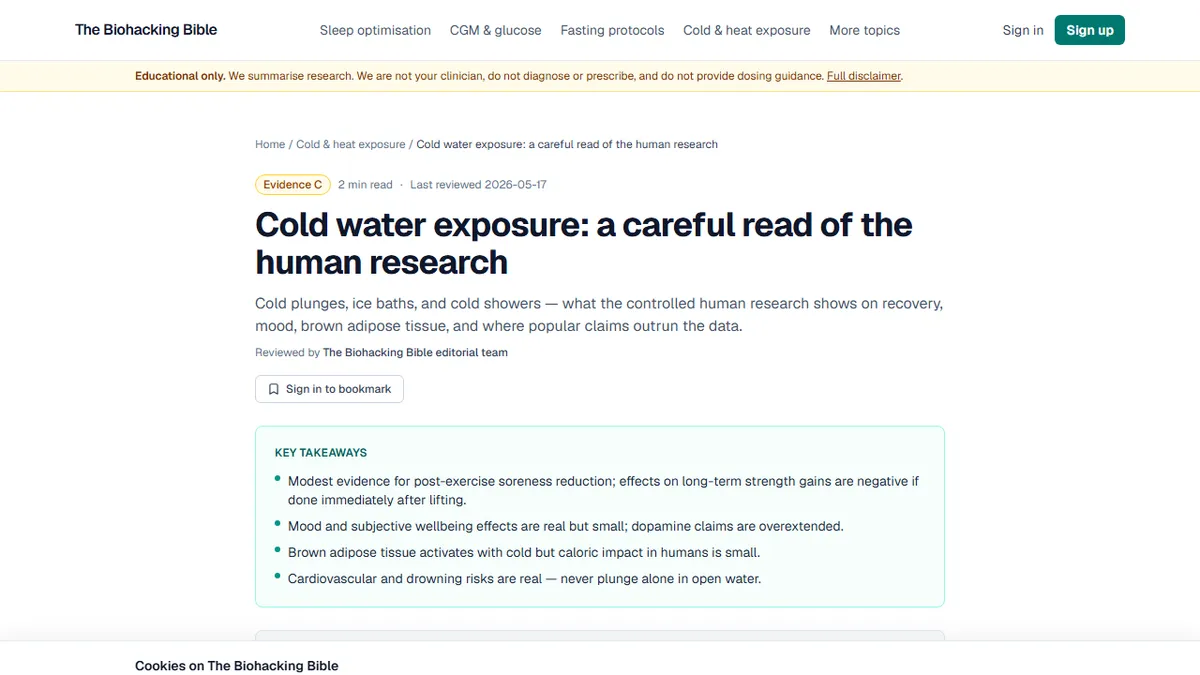
For anyone starting out, a cold shower or an ice bath in an existing bathtub represents the highest evidence-to-cost ratio available. The expensive formats do not outperform the cheap ones in the literature.
Safety Considerations Before You Start
Cold water immersion carries genuine risks that are often downplayed in marketing materials. Cold shock response (an involuntary gasp reflex, hyperventilation, and potential loss of voluntary muscle control) is the primary danger in the first seconds of immersion. It is the reason drowning risk increases dramatically in cold water.
The cardiovascular load is also real. Cold exposure raises heart rate and blood pressure acutely. People with cardiovascular conditions, arrhythmias, uncontrolled hypertension, or Raynaud's phenomenon should seek medical advice before undertaking cold immersion protocols.
A sensible approach for beginners involves starting with cool rather than cold showers, adapting over several weeks, and avoiding full immersion without a companion present for the first sessions.
This article is for educational purposes only and does not constitute medical advice.